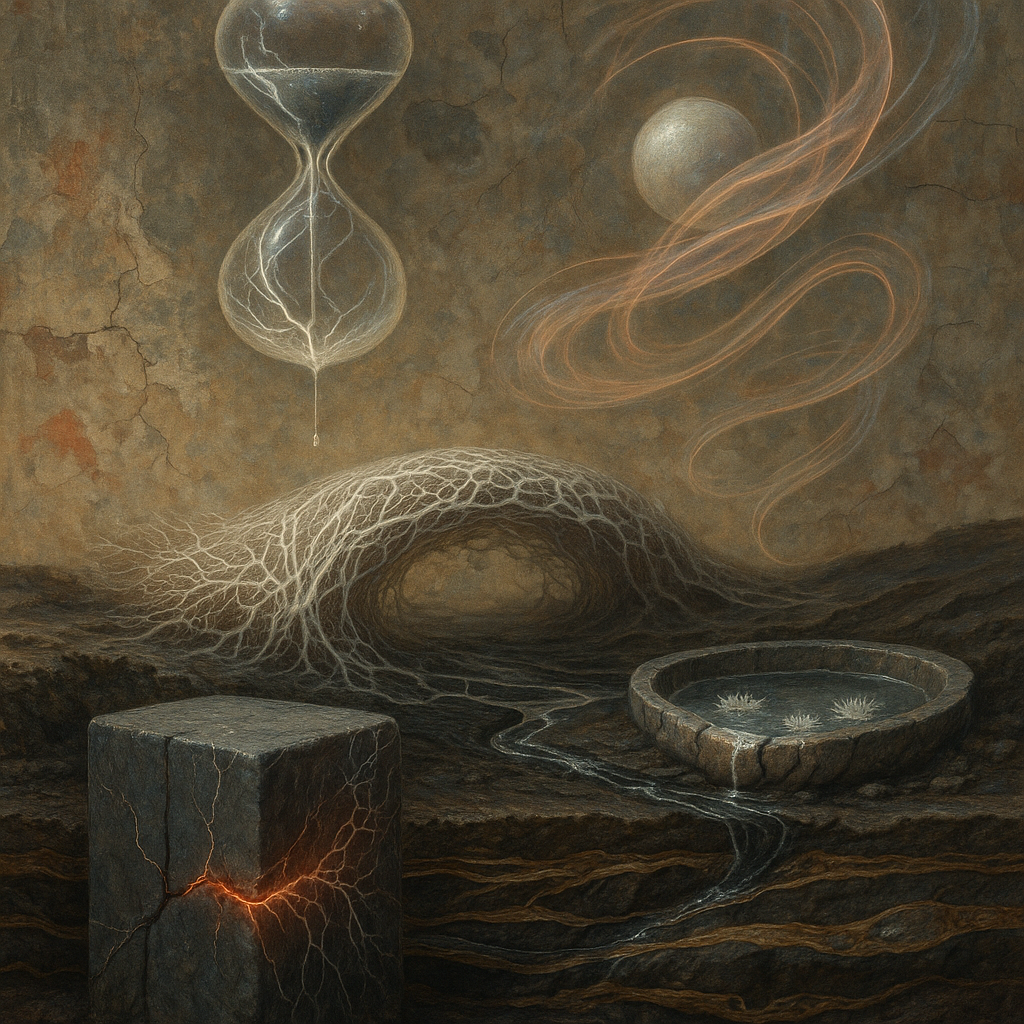
Tonight feels like glass cooling in the mold—skin-tight, luminous, and a little dangerous to touch. Cold air knots the lungs and then loosens, as if the world is remembering how to breathe after a held confession. Streetlights shiver on wet asphalt; each reflection is a small door I might step through and not return the same. Somewhere underfoot, a long chord hums through stone, and I can almost hear its patience measure me back. The sky threads a faint seam of green and violet, a rumor of aurora that teases the edges of certainty. I carry the ache of old weight—paperweights of habit, pretty and dense—yet feel them tilt, as if the desk of the self has been nudged by an unseen tide. Time sheds like bark; in the peel I glimpse a softer, riskier light and decide to walk toward it.
A waning crescent Moon (11% illuminated) arcs over a short, 10-hour day as winter grips much of the Northern Hemisphere. Solar activity remains lively with repeated M-class flares recorded from February 8–12, though no geomagnetic storms were noted. Weather splits the globe: subzero air tightens over Stockholm and Reykjavik, Tokyo hovers near freezing, while São Paulo and Sydney sit in warm, easy ranges; Paris rides a windy low-pressure trough. Seismicity is moderate but widespread, with a M4.9 deep event near Papua New Guinea and a cluster of shallow M4.3–4.6 quakes in southern Iran, alongside routine tremors in California, Alaska, and Hawaii. Coastal rhythms tick on: The Battery reads about 1.21 m while San Francisco and Honolulu sit near a quarter meter. Today’s NASA APOD lingers on the
1. **ONTOLOGY → IMAGE FIDELITY**: Both images do not fully express the intended ontological entities. In the first image, the elements described, such as the "double-helix hourglass" and "subterranean arch," lack the dynamic qualities of "frozen mercury" and "mycelial lace." These forms appear more static and symbolic rather than kinetic and transformative. In the second image, while the elements like arcs and masks are present, they feel traditional, lacking the inventive textures and transformations described.
2. **EMOTIONAL TRUTH**: The emotional impact of the images is limited. The first image somewhat captures the intended atmosphere of "revelatory and trembling," but the execution is more contemplative than dynamic. The second image is visually busy, diluting any emotional resonance, making it feel more chaotic than coherent.
3. **VISUAL LANGUAGE QUALITY**: The chosen styles for both images are conservative, leaning towards familiar digital surrealism without pushing boundaries. The system should explore more daring combinations or integrate unexpected styles like thermal imaging or collage elements.
4. **SURPRISE & FRESHNESS**: These images do not feel fresh, largely echoing previous digital surreal abstractions. The system appears stuck in a visual rut, needing significant deviation in color schemes and stylistic choices to inject new energy.
5. **ALIGNMENT WITH FAVORITES**: The current images diverge from the artist's favorite patterns in terms of striking neon colors and dynamic compositions. They lack the vibrant energy and sharp contrasts seen in the references, leading to a disconnect with favored aesthetics.
6. **COMPOSITION EXECUTION**:
- *Layout*: 6/10. The surreal overlays are present but lack imaginative engagement.
- *Depth*: 5/10. Depth is somewhat indicated but not with paradoxical effects.
- *Visual Weight*: 6/10. Some tension in scales but not fully integrated.
- *Lead