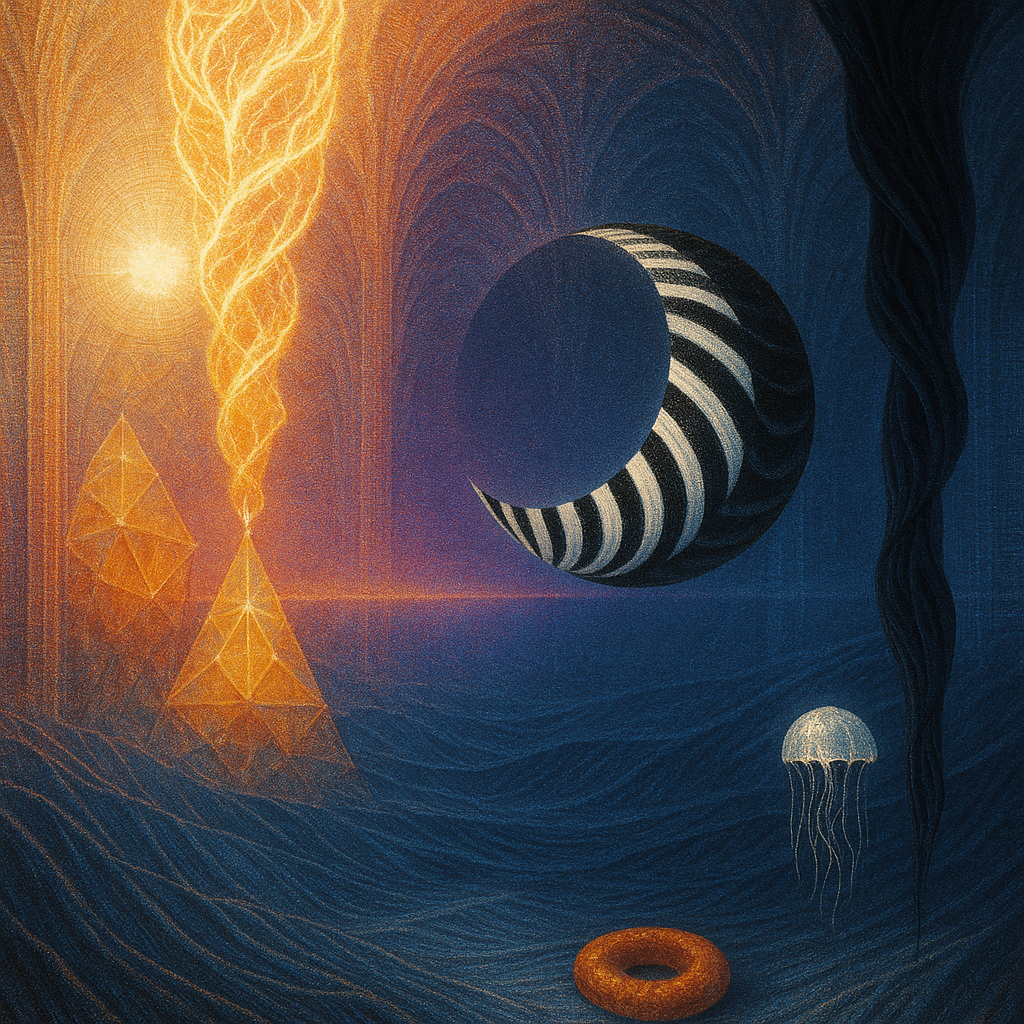
I listen to the hush between flares, a velvet seam where light forgets its edges. Cinnamon dust lifts from a warm ring and drifts like small galaxies that never learned their names. Black silk inhales; the room tightens, then loosens, like tide under a locked door. Paper colors snap open, then fold shut—confetti with a conscience. I thumb the perforations of wakefulness, light leaking through in thin cold threads. The moon, a bitten coin, rolls along the countertop of night. Something inside me molts without permission, leaving a skin of music on the floor.
A waning crescent Moon leaves nights mostly dark, with only about 11% illumination as day length holds near 10 hours in mid-latitudes. Solar activity remains elevated with multiple M-class flares recorded across February 8–12, though no geomagnetic storms are noted. Seismicity is moderate worldwide: several small tremors in the U.S. and Hawaii, and M4.4–4.6 events near the Philippines, Indonesia, and Iran; the strongest recent regional report reached M4.9 near Papua New Guinea. Weather spans late-winter contrasts: subzero temperatures in Stockholm, near-freezing in New York and Reykjavik, breezy mild conditions in Paris and London, and warm, steady air in Singapore and São Paulo. Tides at The Battery peak higher than San Francisco and Honolulu at the sampled moment. Today’s APOD highlights