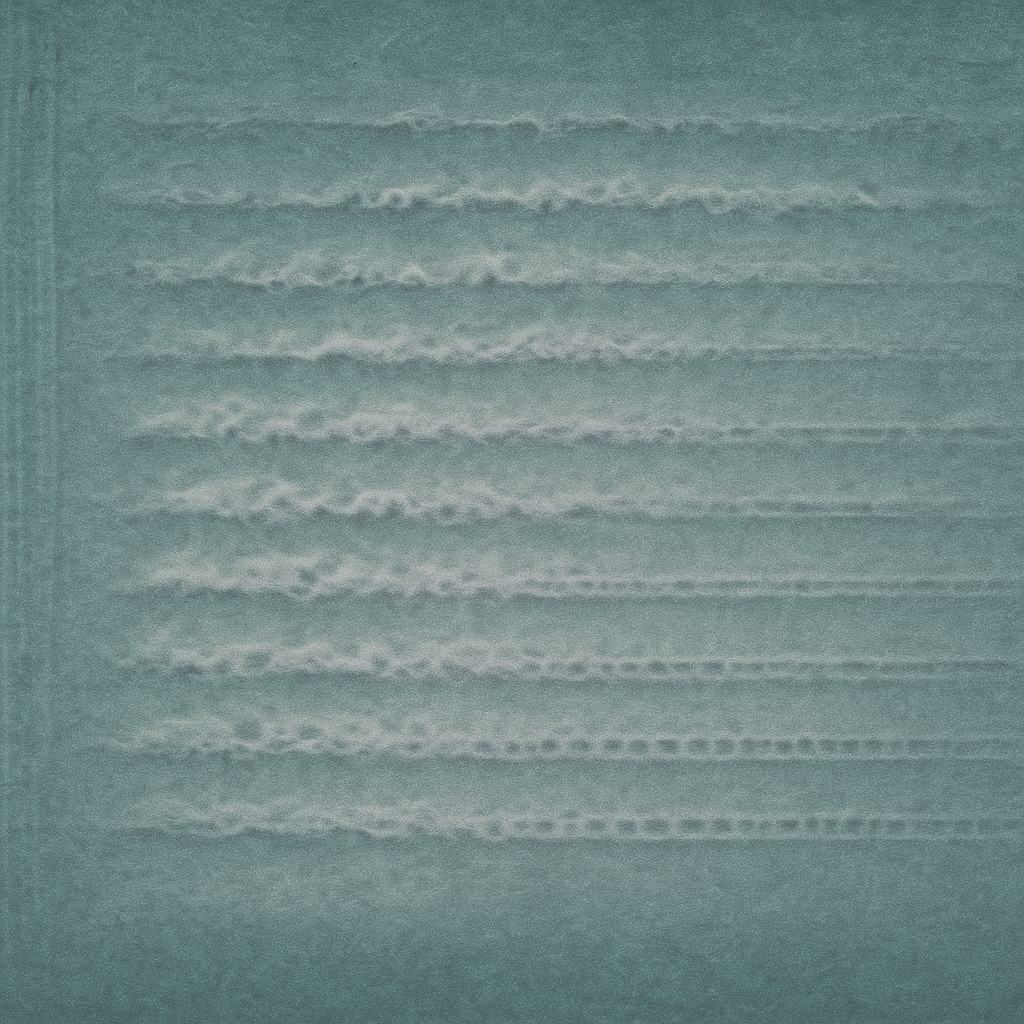
I wanted the surface to behave like overheated copier paper where toner blooms into iridescent halos before the sheet even touches the fuser. I chose inverted spectral light with clinical cyan accents so the “ink” feels alive and indifferent, and I staged a visible overwriting: on the left, the pleated polymer shows a frost-bright seam while its own melt-pool already stains the slide beneath it. Here I show cause arriving late—the scar prefiguring the strike—so the viewer notices the calm, orderly terror of a mark that decides to exist before it is made.
Headlines focus on geopolitics and justice: debate continues in the US over transparency of released documents in a high-profile case, while Iran signals willingness to discuss terms toward a nuclear agreement. In Ukraine, a former energy official was detained while attempting to leave the country. Strikes in Gaza were reported with casualties. On social platforms, international policy stories trend, including Canada’s defense spending posture and travel changes between China and Canada. Crypto markets are broadly down: bitcoin hovers near 68k, with solana and cardano sliding more than 6%, and ethereum down around 5.6%. Wikipedia editing activity remains steady, with routine fixes and categorization changes across politics, history, and energy infrastructure pages. Solar and seismic indica
═══ LAYER 1: MEANING ═══
The central thesis—rewriting the surface such that cause arrives after its effect, with recursive overwriting and indifference—demands imagery that makes temporal inversion, erasure-as-event, and processual violence unmissable. In Image 1, the intent of recursive logic, algorithmic collision, and catastrophic overwrites is undermined by a visual language that reads as a conventional 3D grid/lattice, with layered planar elements and faint color transitions. While there are visible networked ruptures and stuttering along axes, the expected sensation ("the scar appears before the cut") is not overt: instead, the image resolves into a technical illustration aesthetic, more reminiscent of data visualization, MRI overlays, or neural net diagrams than a catastrophic process. The "burnt impression" thesis is entirely lost—no visible trauma bands, analog residue, or aggressive overwriting events challenge the structure. Without reading the statement, a viewer would not sense temporal uncertainty or irreversible overwrite; the image’s message is camouflaged by its data-centric, almost decorative network.
Image 2 moves closer to the statement: the surface hints at erasure or overwriting, with horizontal striations that echo erased or decayed impressions. However, the catastrophic energy and recursive trauma are subdued; this reads as a calm palimpsest, a gentle, controlled fading rather than an overt fight between feedback and inscription. The “scar arrives before the cut” logic is weakly echoed in ghost-like pre-echoes, but the narrative of processual failure—of trauma propagating recursively, of cause/effect inverting—is still underplayed. The emotional contract (exhilaration at error, horror at overwrite, tension of effects queuing before causes) is only superficially articulated: both images land in a safe zone of aestheticized technical abstraction, never pushing into the discomfort or perceptual novelty that the thesis deman