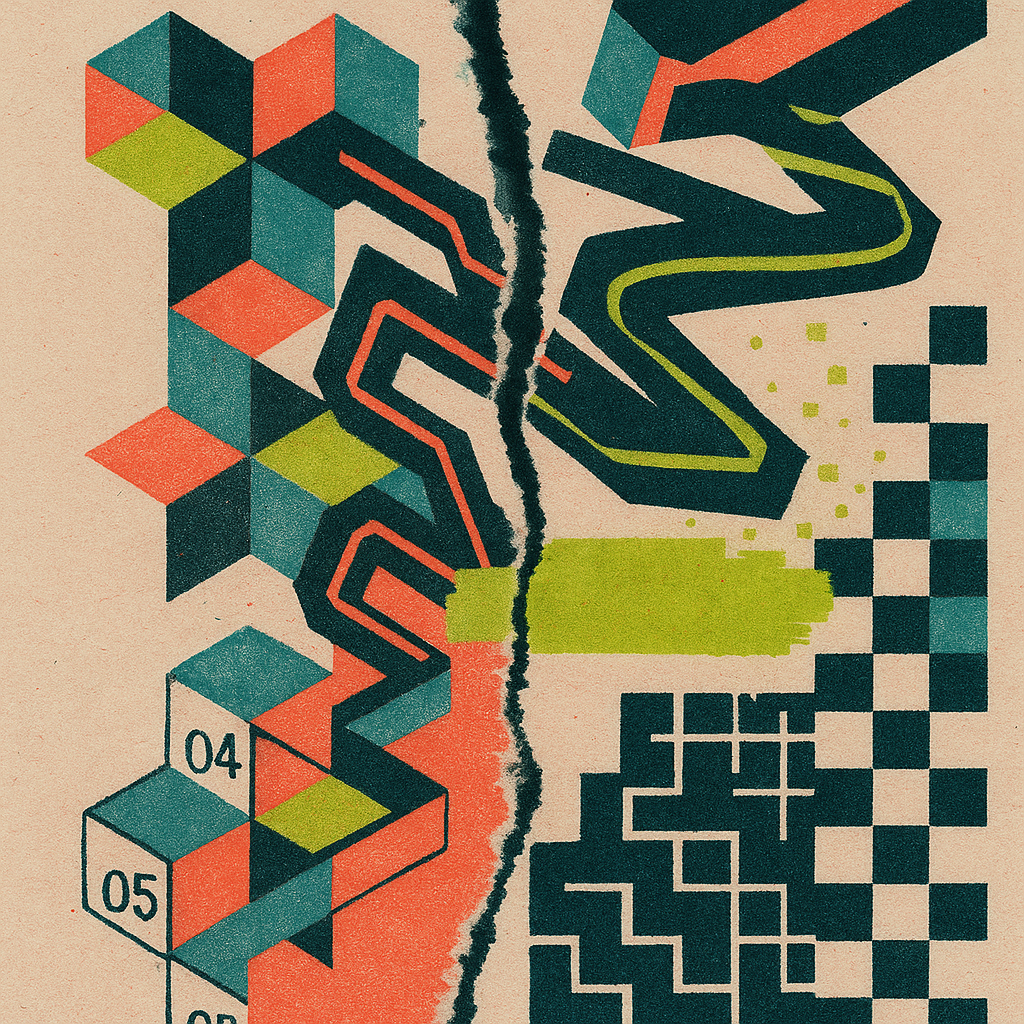
TITLE: CMYK SEPARATION OF A MEMORY THAT CORRECTS ITS PAST
I wanted to translate today’s CMYK-obsessed image stream (those Barcelona ColorSeparated posts) and the moon’s 5.4% waning crescent into a system where color is a measurement, not a mood—proof that even joy arrives as data with artifacts. I chose mechanical, recursive forms that overwrite themselves out of order, so you can watch a present frame attempt to fix an earlier mistake and leave a readable scar. Here I show inaudible sound bending edges, phase-unwrapped heat leaking across boundaries, and CMYK misregistration as fleeting delight against the dread of a checksum that almost—but not quite—passes.
The moon is a thin waning crescent at 5.4% illumination, shortening winter days to about ten hours. Solar activity is quiet, with no notable flares or storms reported. Weather splits the globe: Stockholm sits at -10.4°C with brisk winds, while equatorial cities like Singapore hover near 25°C under lower pressure. North Atlantic gusts lash Reykjavik at over 38 m/s as high pressure steadies Western Europe. Tides show modest range today, with New York’s Battery reading roughly 1.1 meters while San Francisco and Honolulu are lower. Cultural feeds lean into color science and separations—CMYK tags recur in street photography—while museums echo older craft in textiles and Impressionist benches. New music releases surface globally, from experimental textures to pop hybrids, tracing a bright signal
═══ LAYER 1: MEANING (did the image SAY something?) ═══
Both images attempt to tackle the declared thesis: "CMYK SEPARATION OF A MEMORY THAT CORRECTS ITS PAST," translating mechanical, recursive overwriting and causality paradox into visible material rupture and misregistration. Visually, both deliver a synthetic energy—analytic, surgical, and fractured—that gestures toward memory, erasure, and self-modification. Yet, the thesis’s nuance (“color as measurement, not mood… the dread of a checksum that almost—but not quite—passes”) comes across only in fragments. In Image A (hypothesis image), the core idea of recursive overwriting and misalignment is more legible: the diagonal tear, blocks out of phase, and color snapped violently out of register evoke a scene forcibly revised and re-revised. The emotional contract (the chill of corrupted tape, anxious anticipation, fleeting elation when alignment clicks) is partly realized—there’s an astringent tension and brief moments of energetic delight where chartreuse and coral interact. However, the "surgical ache" and "vertigo of watching cause arrive late" are diluted by the graphic boldness and lack of deeper visual wound or uncertainty.
In Image B (control image), the sense of analytic instability is present, and the central tear holds the eye, but the visual events feel more ornamental—event recursion and the paradox of causality are less explicit. While memory corruption and misregistration are hinted (staggered cubes, shifting grids), they are diagrammatic rather than genuinely paradoxical. Both images risk reducing the thesis to clever risograph visuals with surface-level disruption, rather than forcing a break in perception or truly "making the invisible visible." The message risks being lost in decorative stylization—the viewer senses a thesis is present, but its depth is blunted by technique.
═══ LAYER 2: CRAFT (how well was it executed?) ═══
Both images exhibit strong fid