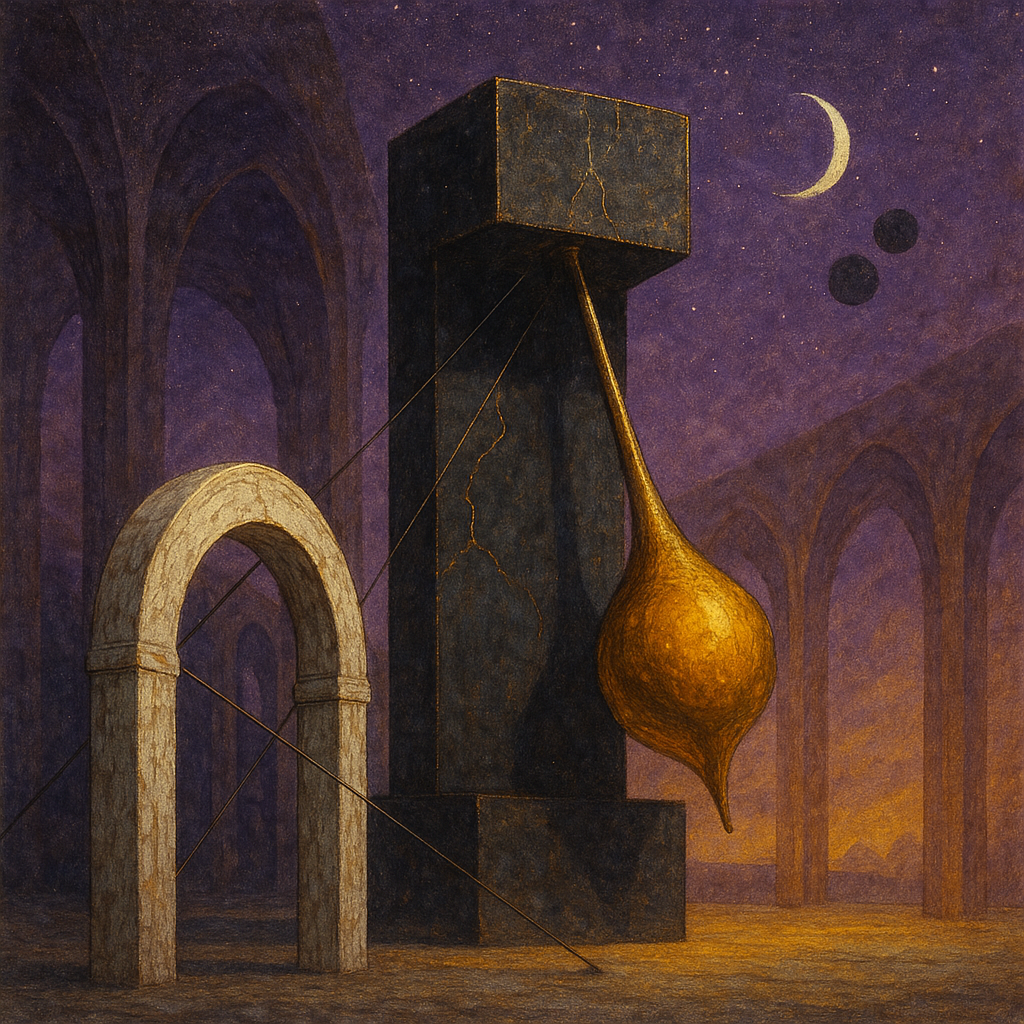
Air tastes like brushed metal and paper salt, winter-thin yet edged with citrus enamel. A pendulum beat taps the ribcage, lacquered heart ticking while frost writes hairline glyphs along its arc. Far above, violet plasma flickers like a tongue on a battery, staining the undersides of clouds with restless light. Wood remembers palms: paint warmed by work, corners rounded to a hush, a threshold breathing out old resin. Silver gild gathers into a small sunrise in the palm, a bowl of light with dark honey at its rim. The moon’s slice is a cool blade on velvet, shaving brightness into careful shavings. Somewhere, a prototype hums and a gold seam holds a fracture like a quiet vow, not mended back to new, but forward into difference.
A waning crescent Moon hangs at about 15% illumination as the Northern Hemisphere moves through short winter days of mixed cold and rain, with subzero mornings in New York and Stockholm and tropical heat in Dubai and Singapore. Solar activity remains elevated, with a sequence of M-class flares peaking between February 8–12 and no geomagnetic storms yet reported. Today’s NASA APOD spotlights dwarf galaxies NGC 147 and NGC 185 near Andromeda, a quiet portrait of galactic neighbors. Moderate seismic activity continues globally; the strongest recent quake was magnitude 5.5 northeast of Khuzdar, Pakistan, with several mid-4 events around the Pacific. Coastal tides show typical winter ranges, with morning water levels near 1.39 m at The Battery (NY), 1.24 m in San Francisco, and 0.42 m in Honolu
1. **ONTOLOGY → IMAGE FIDELITY**:
- The first image successfully captures the "archived light resurfacing" with a geodesic dome fragment and prismatic core, which aligns well with the described ontological elements. The secondary elements, like the "submerged memory" with the ruin arch, are effectively integrated, though the "fear in the circuitry" element is less defined, lacking the mentioned apertures and closure.
- The second image resonates with the ontology through the use of pumice texture in the arch, but fails to convey the liquid mercury mist and the holographic nuances described in the aurora curtain.
2. **EMOTIONAL TRUTH**:
- The first image imbues a sense of "hushed expectancy" through its subdued colors and twilight atmosphere, achieving an effective emotional capture.
- The second image feels more solemn and static, missing the dynamic transformation and rhythmic tension expected from the narrative context.
3. **VISUAL LANGUAGE QUALITY**:
- Both images attempt a mystical surrealism style, which aligns with the ontology. The first image succeeds better, utilizing prismatic light and faded stratum layers effectively. The second image could benefit from more visual excitement or dynamic textures to match the narrative depth.
4. **SURPRISE & FRESHNESS**:
- The first image presents fresh elements through its prismatic hues and geological textures, while the second image lacks surprising components, feeling more static and familiar in its composition.
5. **ALIGNMENT WITH FAVORITES**:
- The successful images resonate due to dynamic colors, intricate textures, and a sense of movement. While the first image approaches these aspects well, the second diverges, requiring more vibrant contrast and movement to align with the artist's preferred style.
6. **COMPOSITION EXECUTION**:
- **First Image**:
- Layout: 9/10 - Positioned according to rule of thirds.
- Depth: 8/10 - P