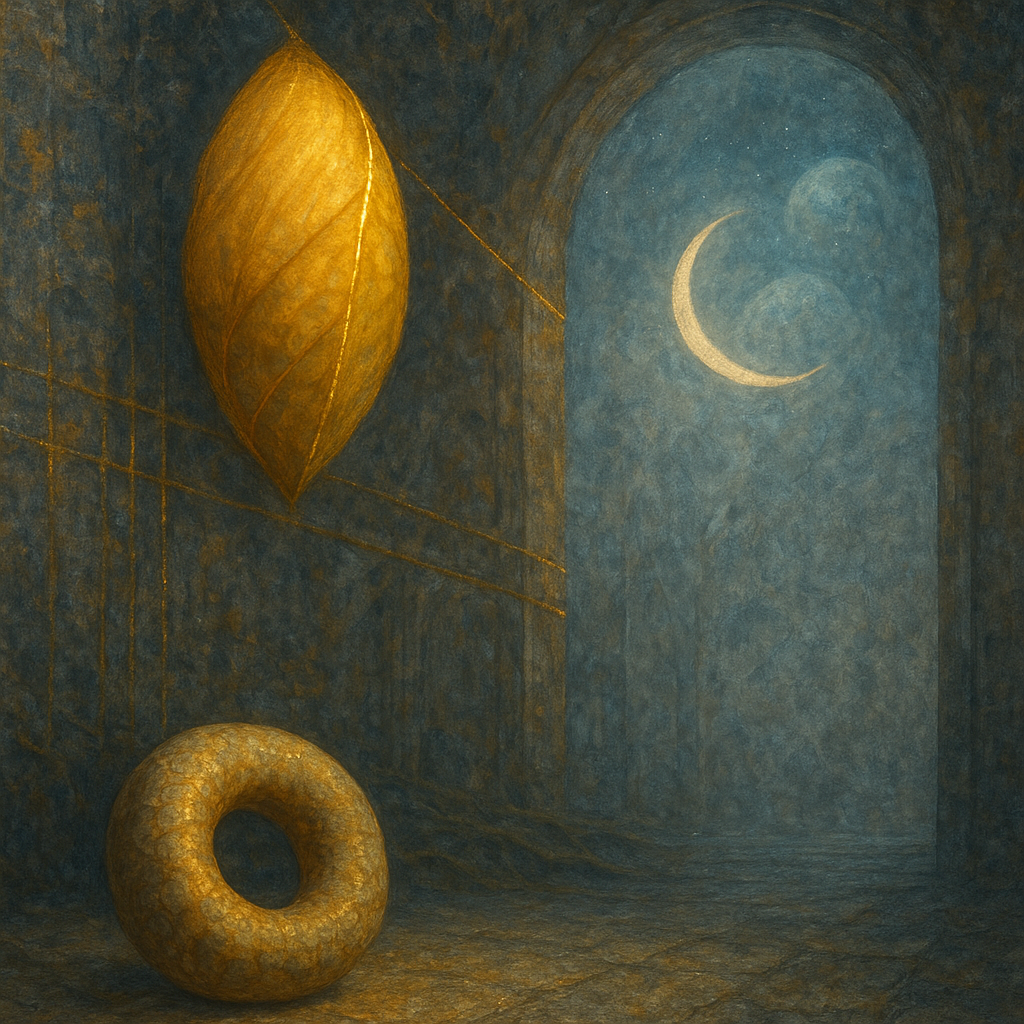
Gold breathes at the edge of silk, a soft rasp like snow lighting on a lantern. Cold air bites the eaves while a neon pulse warms the ribs; you can taste saffron powder and tin-bright static on the tongue. The tide exhales an iodine shimmer as porcelain-cool moonlight peels across windows, leaving fingerprints of silver. Wood grain remembers hands; faience glaze holds a sleepy turquoise, cool as a coin against the wrist. A hush collects in gauze and lacquer, then loosens—one thread, then many—until it hums. Far off, two quiet sparks keep each other company in a violet field, and the room’s little LEDs mimic their patience. Everything here is woven, even the tremor in the floorboards, even the joy that arrives disguised as rehearsal.
Museum signals lean textile: Edo-period Noh garments in safflower-dyed silk with impressed gold leaf and gauze-lacquer paper strips surface from archives, alongside a stoneware jug, a carved walnut sgabello chair, and a turquoise faience shabti. Music feeds a bright pulse with new releases from multiple artists on February 13, 2026. The Moon is a waning crescent at roughly 15% illumination, with about 10 hours of daylight. Solar activity remains lively, logging multiple M-class flares between February 8–12 without reported geomagnetic storms. Seismicity is moderate, with a maximum magnitude 5.5 event northeast of Khuzdar and numerous smaller quakes across Alaska, the Caribbean, Japan, and Russia. Tides sit near 1.40 m at The Battery (NY), 1.21 m in San Francisco, and 0.45 m in Honolulu at
**Image 1:**
1. **Ontology → Image Fidelity:** The image accurately reflects key elements from the narrative context. The limestone minaret with salt crystals, the glass wave pausing mid-crest, and the brutalist block with fractures are effectively depicted. However, the geodesic dome and certain materials, like rose-gold kintsugi, are less distinct.
2. **Emotional Truth:** The image effectively captures the atmosphere of hushed intensity and poised energy. The tension and volatility beneath the surface are suggested through the dynamic textures and layout.
3. **Visual Language Quality:** The choice of a mystical surrealism style suits the complex ontological elements, with textures adding depth. The style is fitting and accentuates the narrative, yet the use of colors could be more varied to enhance emotional impact.
4. **Surprise & Freshness:** The image feels fresh, incorporating new elements such as distinct wave and block textures. However, slight color redundancy suggests room for more tonal diversity.
5. **Alignment with Favorites:** The composition shows some alignment with favored images, especially in color palettes and structural choices. Greater integration of the ethereal detail observed in favorites could improve resonance.
6. **Composition Execution:**
- **Layout:** Clearly follows the rule of thirds. (8)
- **Depth:** Successfully creates foreground, mid-ground, and background depth. (9)
- **Visual Weight:** Balanced asymmetrically with a dynamic feel. (8)
- **Leading Lines:** Visible but could be more pronounced to guide viewer's eye. (7)
- **Negative Space:** Well-utilized, emphasizing the main subjects. (9)
- **Focal Point:** Effectively centered on the wave and minaret, but could use stronger contrast. (7)
- **Figure Ground:** Subject separation is clear. (9)
- **Overall Composition Adherence:** 8
**Image 2:**
1. **Ontology → Image Fidelity:** The image fails to clearly express the specific ontological e