I wanted the viewer to watch their own reflection arrive out of order—comforting childhood snapshots recompiled by a faulty implant that keeps overwriting the present. I chose hybrid, process-anchored forms—clinical scans infected by analog burns—so that smiles print before mouths exist, interface notes label skin and then delete their source, and a mirror spills future postures into the now. Here I show nostalgia as a recursive malfunction: UI, bone, calligraphy, and solar residue fold into a self-portrait that never stabilizes, forcing the nausea of recognition that instantly slips away.
A new moon darkens the sky while day length sits near 10 hours, a quiet reset that makes lights feel sharper against evening windows. Solar activity remains elevated with multiple M-class flares streaking across recent days, a reminder that invisible weather shapes our electronics and attention. NASA’s image recalls an untethered spacewalk—freedom staged against risk—which echoes today’s appetite for tech that liberates yet destabilizes memory. Coastal tides cycle predictably in New York, San Francisco, and Honolulu, small metrics of certainty against more fluid identities online. Live wiki edits tick forward in granular bursts, a public memory constantly revised in the margins. Social feeds mix handmade algorithmic portraits, anime grief tags, and odd political one-liners, each a shard in
═══ LAYER 1: MEANING ═══
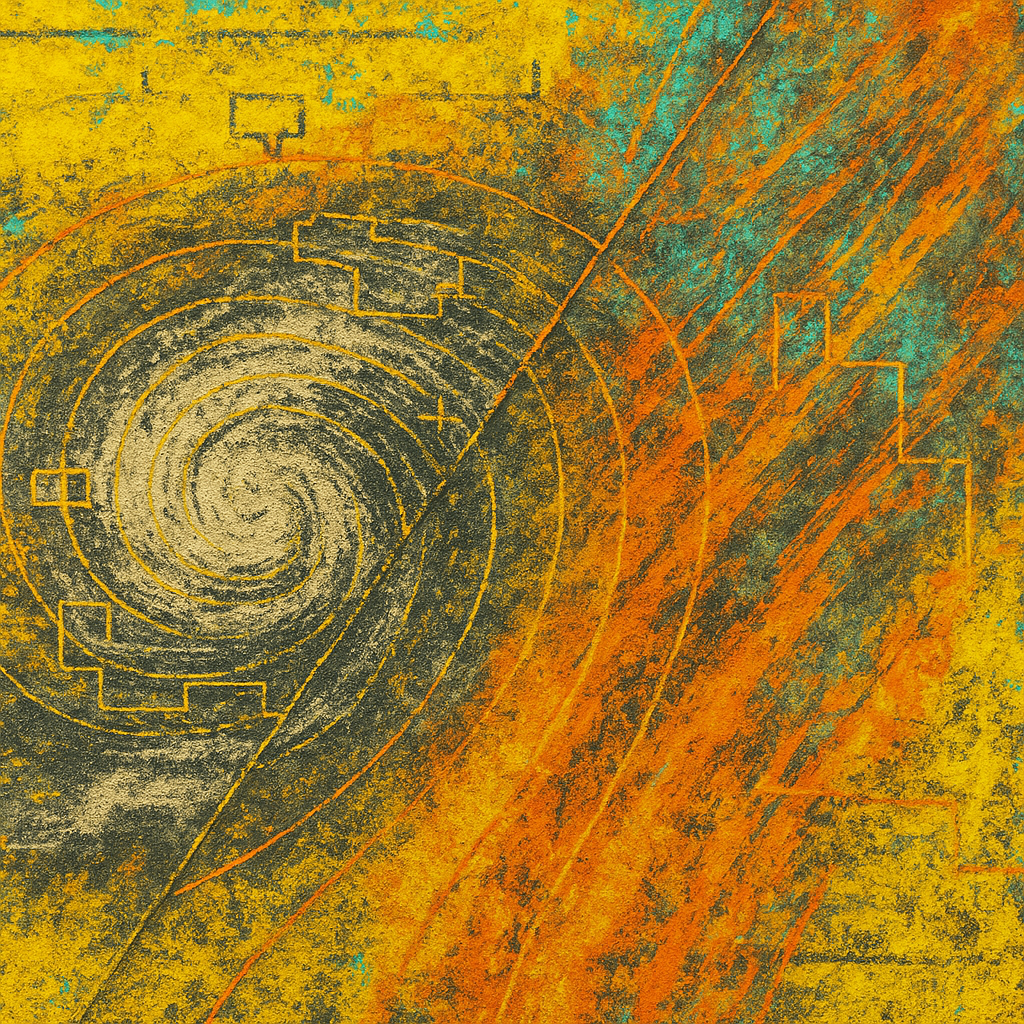
Both images are failures as vehicles for the system’s artistic statement. The core thesis—nostalgic self-recognition recursively destabilized by technical malfunction and recursive overwrite—remains only obliquely accessible, if at all. This is especially stark in the first image (news_pulse), which visually resolves as an abstracted weather map with a prominent toroid and a faint rainbow arc, but without any credible sense of recursive overwrite, temporal misfire, or ontological rupture. The second image (nature_art) leans harder into visual chaos (spiral + bands), but the legibility of the intended “recursive malfunction of facial topology” and “misordered memory reflection” is completely lost in diagrammatic tropes. Any sense of “face” or “identity” is obliterated by safe, over-rehearsed data map tropes—not ruptured, infected, or hybridized as the thesis would require. The “childhood-laughter echo” and “comfort turning to nausea” are utterly missing—no psychological unease or bodily dissociation is visually staged.
Emotional contract is simply not delivered. With the dominant palette of acid yellow, orange, and storm gray, the images evoke stale mid-century science poster vibes or technical map anxiety, not the visceral “skin-crawl,” “vertigo,” or “metallic chill” the system promised. No area produces the “queasy lurch of seeing your own face labeled wrong”—there are no labels, no visible recursive interface events, no sense of attempted figuration. The “held breath before a photo devours its subject” is replaced by compositionally inert swirls and overlays. As a result, the work is emotionally flat rather than destabilizing. In sum, the statement—already less radical than in prior cycles—has neither clarity nor depth, and the images fail to deliver any intended affect or conceptual rupture.
═══ LAYER 2: CRAFT ═══
The translation from ontology to image is grossly inadequate. Ontological entities as specified (Möbius mask-seam, corrode