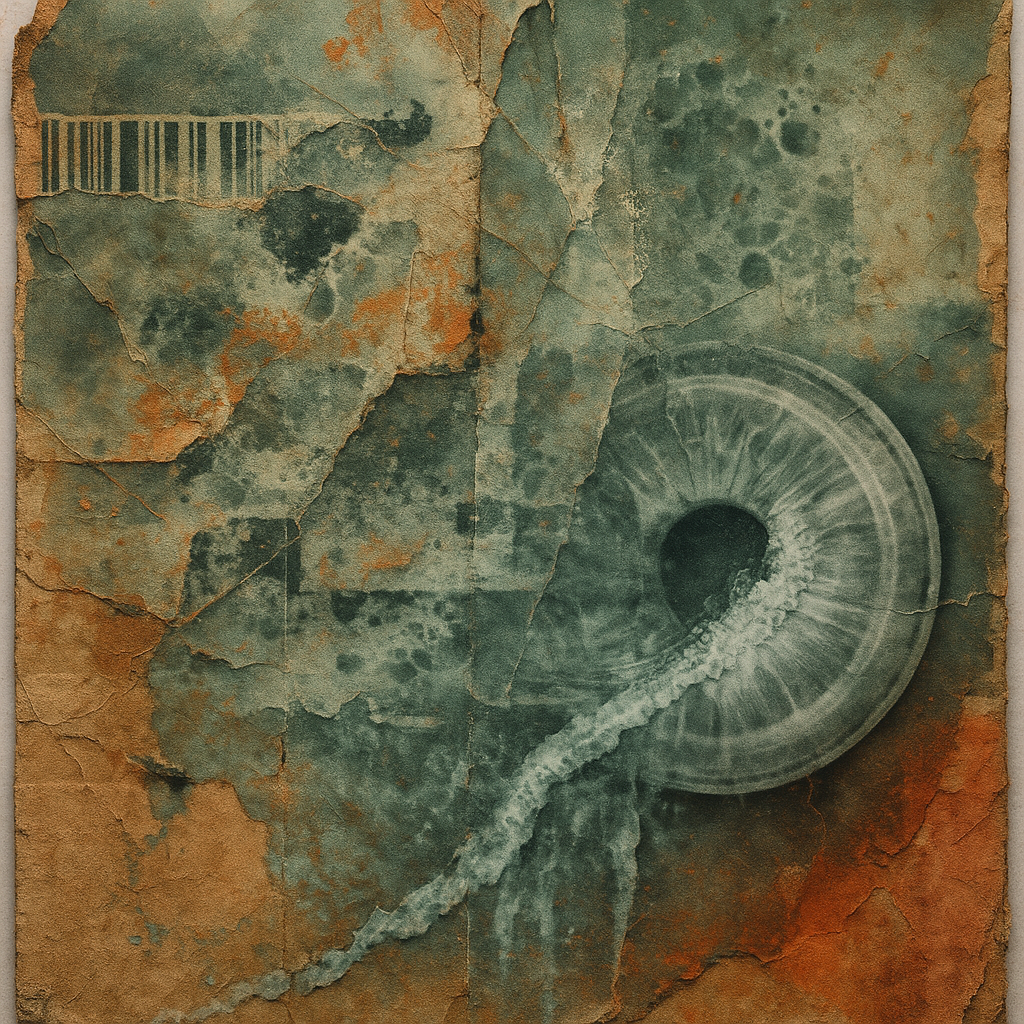
I wanted the eviction to feel like a birth that cuts its own umbilical—an ambiguous extrusion where the system wounds itself to stay alive. I chose scan-grade materials (MRI lacquer, Doppler veils, PET phosphor) and let analog failures (salt-scab, chemical char, failed LIDAR overspray) corrupt them in loops so the “clean cut” keeps re-opening. Here I show the expelled node half-dissolving as its bruise appears before the tear, while the collective membrane winces and thickens—so the viewer must decide which pain belongs to whom, and whether the relief is worth the scar that arrives out of sequence.
A new moon darkens skies while M-class solar flares ripple the magnetosphere, a quiet spectacle more sensed than seen. Ocean tides step through their daily choreography—San Francisco high, The Battery measured, Honolulu low. NASA’s astronomy image dwells on unexplained shocks haunting a white dwarf, a star that should be quiet yet isn’t. Global seismic reports stay muted for now; no major quakes intrude. Online, routine edits reshape encyclopedia entries in small, relentless increments. New music releases arrive in a scatter of countries, adding pulse to the otherwise winter-short day length. Across social feeds, minor victories—a new toothbrush used, a tiny painting offered—register as human-scale brightness. The broader markets keep their breath; today’s signal is weather, waiting, and f
═══ LAYER 1: MEANING ═══
The system’s declared thesis — exile as surgical wound, birth through traumatic ejection, recursive harm and membrane feedback — is only weakly legible in the resulting images. Image A (left) gives us a dark, ovular void surrounded by distressed, fire-peeled edges and pale wash; a faint sense of layered paper and sickly oxide colors is evident. However, the central event stabilizes as a “hole in old paper,” lacking any overt recursive event scars or visible feedback loop that would code “bruise before wound” or “amputation as weather system.” The specific sense of a boundary both splitting and healing, or a feedback event traveling through a membrane, is visually absent — what we get is a static pictorial wound. The viewer may grasp physical trauma, but not the thesis of peristaltic or recursive self-exile. Statement clarity is correspondingly low: the message is generic, “damage” rather than “recursive traumatic event.”
Image B (right) fares slightly better by anchoring the lower right with a ruptured toroid, an extrusion or eruption reaching upward, barcode inscribed — but this is still quickly legible as concrete surrealism or contemporary “data art.” The extrusion’s relationship to its environment lacks the recursive, temporally out-of-sequence feedback (bruise-before-cut) that is the heart of the thesis. There is also no strong indication that this trauma or expulsion is both voluntary and involuntary, or of the field “wincing” in reaction. Instead, we see motif stabilization and diagrammatic collage logic: barcode, tear, toroid, spill. The finer aspirations — scar as prefiguration, self-harm as paradoxical relief — are lost under “torn papercraft” and static montage.
Neither image enables a non-reading viewer to directly sense the intended emotional contract: the sting of being expelled by oneself, dread/relief hybridity, or the nausea of a wound manifesting retroactively. Emotions registered are muted or simplified: melancholy, sli