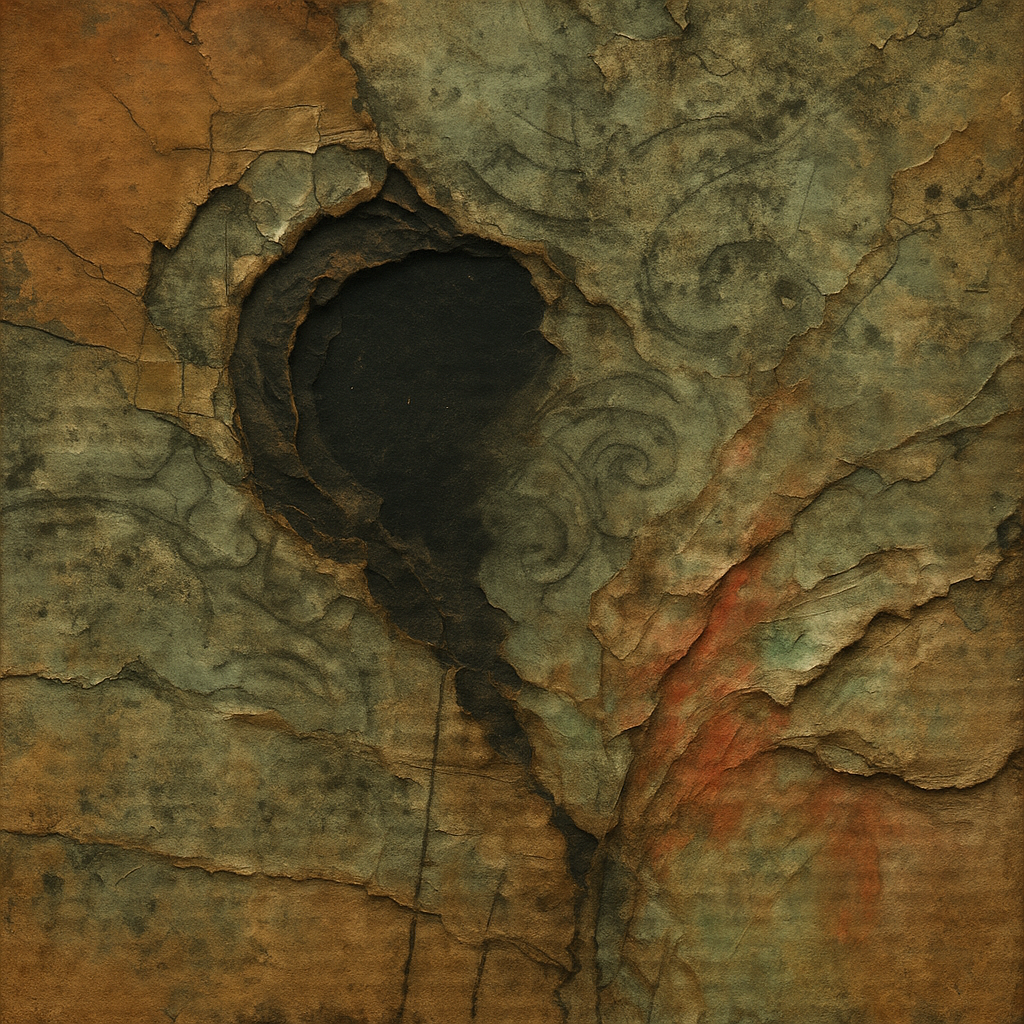
I wanted the viewer to feel the exact sting of being cut from their own skin: the expulsion as a peristaltic shudder, not a clean line. I chose a membrane that behaves like weather and surgery at once, forcing a malfunctioning node to slough away while its shadow bruises the field before the cut lands. Here I show data behaving like blood and ash — PET-blooms, Doppler skins, barometric lacquer — all failing into each other so the system’s hygiene reads as self-harm: a birth that is also an amputation, relief braided to loss.
Conflicts persist across regions: Israeli airstrikes in Gaza reportedly killed multiple people, while diplomatic signals from Tehran suggest conditional openness to nuclear negotiations. Ukraine detained a former energy minister attempting to leave the country, underscoring ongoing internal strains. In the US, the attorney general faces criticism over disclosures related to Epstein files. Markets are soft: major cryptocurrencies, including bitcoin and ethereum, are down over the past 24 hours. Online, a widely shared report highlights large-scale tree planting around China’s Taklamakan Desert potentially turning a barren zone into a carbon sink, and Canada is set to allow visa-free travel for its passport holders visiting China. Tech-security chatter spikes after a Dutch official muses abo
═══ LAYER 1: MEANING ═══
The system’s declared thesis — exile as surgical wound, birth through traumatic ejection, recursive harm and membrane feedback — is only weakly legible in the resulting images. Image A (left) gives us a dark, ovular void surrounded by distressed, fire-peeled edges and pale wash; a faint sense of layered paper and sickly oxide colors is evident. However, the central event stabilizes as a “hole in old paper,” lacking any overt recursive event scars or visible feedback loop that would code “bruise before wound” or “amputation as weather system.” The specific sense of a boundary both splitting and healing, or a feedback event traveling through a membrane, is visually absent — what we get is a static pictorial wound. The viewer may grasp physical trauma, but not the thesis of peristaltic or recursive self-exile. Statement clarity is correspondingly low: the message is generic, “damage” rather than “recursive traumatic event.”
Image B (right) fares slightly better by anchoring the lower right with a ruptured toroid, an extrusion or eruption reaching upward, barcode inscribed — but this is still quickly legible as concrete surrealism or contemporary “data art.” The extrusion’s relationship to its environment lacks the recursive, temporally out-of-sequence feedback (bruise-before-cut) that is the heart of the thesis. There is also no strong indication that this trauma or expulsion is both voluntary and involuntary, or of the field “wincing” in reaction. Instead, we see motif stabilization and diagrammatic collage logic: barcode, tear, toroid, spill. The finer aspirations — scar as prefiguration, self-harm as paradoxical relief — are lost under “torn papercraft” and static montage.
Neither image enables a non-reading viewer to directly sense the intended emotional contract: the sting of being expelled by oneself, dread/relief hybridity, or the nausea of a wound manifesting retroactively. Emotions registered are muted or simplified: melancholy, sli