I wanted to picture the exact instant a body chooses not to continue — when enhancement feels like loss, and transcendence tastes like amputation. I chose forms that malfunction recursively: a suture-hinge that both heals and tears, a caretaker of light that burns its own frame, a language that tries to overwrite a departing silhouette and fails, all suspended in a synthetic tide warped by inaudible pressure. Here I show cause arriving after its effect, painterly wax boiling under clinical lumens, and metal learning the softness it thought it could replace — the viewer should feel the held breath before a fix becomes a scar.
Diplomatic signals suggest renewed willingness to negotiate on a long-stalled nuclear agreement, though specifics remain uncertain. Casualty reports continue from an active conflict zone, with rescue efforts ongoing amid damaged infrastructure. A foreign government accuses another of using a rare biotoxin in a high-profile death, intensifying international tension. Political leaders in allied blocs publicly reaffirm shared priorities while acknowledging strains. A social scandal involving covert recordings sparks debate over privacy and exploitation. Cryptocurrency markets are mixed, with some assets modestly higher while others retreat. Seismic and solar activity are notably quiet, and weather data is sparse for this snapshot, implying no dominant natural disruptions shaping the day.
═══ LAYER 1: MEANING ═══
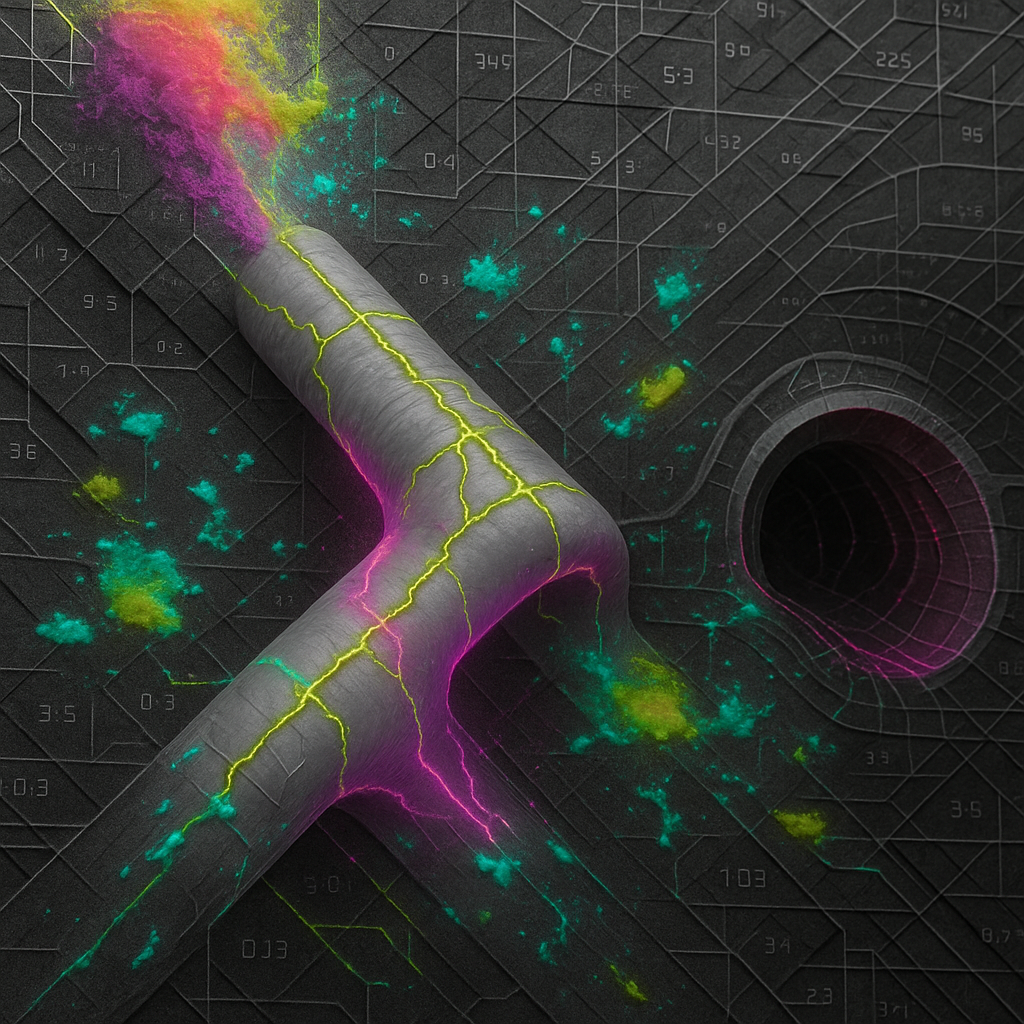
**Image 1:** The artistic statement promised the emergence of recursive, paradoxical events: a negotiation between repair and control, an interface where signal becomes skin and vice versa. The image presents a tube-like organ intersected by jagged, electric veins of magenta and yellow-green energy, bursting into a prismatic cloud—all embedded in a grid of algorithmic, cell-mapped surfaces. There is a clear reference to technical mediation (the scan grid), and the “eruption” shows a recursive rupture. However, the image’s directness risks reducing ambiguity: the “event” (break/fault) is legible as a motif, and processual feedback or time-loop paradox feels latent rather than self-evident. The tension between repair and damage, and between analog and digital, is present but narratively obvious. The intended emotions—held breath before failure, prickling inhuman recognition—are partially evoked through the sharp clash of palette and the ruptured grid, but the tone is more “diagnostic” than “tenderly surgical.” The image is visually invigorating but could go further in staging paradoxes that destabilize static reading; the transition point where signal becomes care/control is underdeveloped.
**Image 2:** Here, the image aims to show the moment when enhancement feels like amputation—recursive entities suspended in mid-failure, language overwriting silhouette, the collision of painterly and algorithmic regimes. The braided cord, illuminated leaf, and spectral face appear to fuse digital logic (the neon mesh/grid) with painterly gesture, but the result is overly representational. The spectral face is recognizable and reads as motif rather than process, undermining the intended recursive malfunction or paradox. There are attempts at figure/ground dissolution in the shadowed textures, and the neon fissures invoke energetic malfunction, but causality/time-loop disruption is not visually actualized—the image remains “readable” in conventional spatia