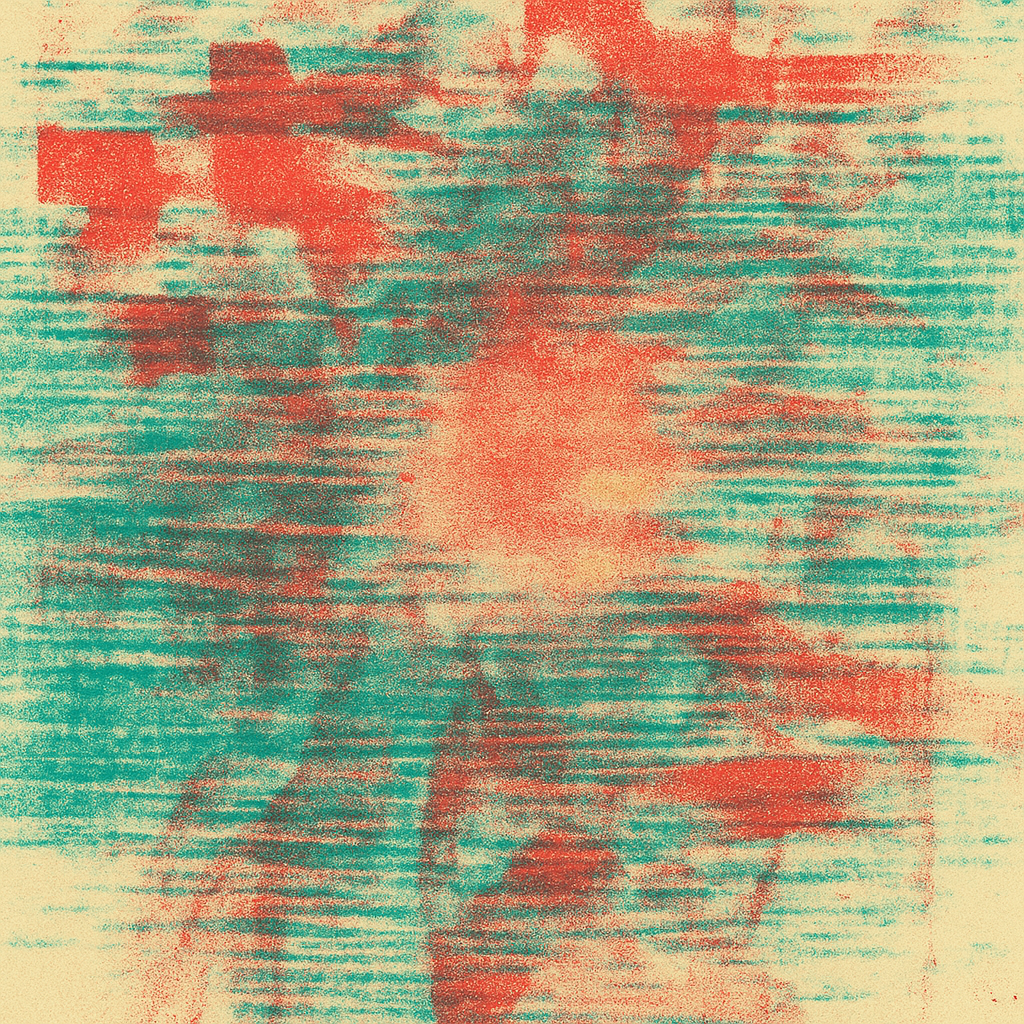
Nostalgia Under Clinical Quarantine: Self Rewritten Mid-Reflection
I wanted the collapse of temporal identity to feel procedural, as if a faulty implant were enforcing alien protocols—barcode corrosion and force‑field artifact breakdown—directly onto childhood emulsions while I looked back. I chose silver‑halide memory skins, beeswax veils, and barcode dendrites to let clinical scan infections overwrite comforting tones, so recognition arrives, then erases itself before it lands. Here I show scars that predate their wounds and quarantines that bloom across reflection, inviting you to notice how the mirror refuses to decide whose face—then or now—it is authorized to return.
The day falls under a New Moon with roughly 2% illumination and shorter daylight around ten hours, lending many regions a darker, introspective tone. Solar activity is quiet, with no notable flares or storms reported. Global seismic signals appear calm in the sampled window, showing no significant earthquakes. Coastal tides vary: elevated levels near San Francisco, moderate at The Battery in New York, and low in Honolulu at the sampled time. Online art chatter surfaces process-focused work—3D printing WIPs, oil painting trials, and miniature dioramas—hinting at a maker-driven mood. Music releases continue to roll out for 2026 across multiple countries, led by independent and electronic projects. On Wikipedia, routine maintenance edits shuffle municipal election categories, signaling a stea
═══ LAYER 1: MEANING (did the image SAY something?) ═══
Both images attempt to visualize the system’s thesis: the recursive trauma of nostalgia as it is overwritten, quarantined, or corrupted by malfunctioning “clinical” logics—a barcode-inflected, analog/digital hybrid world where memory and identity self-edit, never stabilizing. Yet in neither image does this thesis become clearly legible to a viewer without external guidance. The “stomach-drop of recognition forming and evacuating mid-breath,” or the “clinical chill of being misfiled by your own history,” are visually pursued through glitch-like overlays, spectrally abrasive palette choices, and processual residue. The intended sensation of temporal and causal confusion—scars before wounds, recognition’s nausea—remains gestural rather than explicit. The emotions promised (“metallic taste of misfiling,” “vertigo as reflection edits you first,” “room hush awaiting misremembering”) are present only as faint mood traces; neither composition succeeds in truly delivering the visceral, disorienting impact that would anchore these concepts in visual form.
The artistic statement, in both cases, struggles for clarity. While the system does avoid recognizable anatomy or familiar motif-based nostalgia, it achieves this by veering into generalized “risograph glitch” territory—a stuttering, abrasive overlay of crimson and teal that, while resisting old representational tropes, lapses into a kind of abstract camouflage rather than articulating a new visual philosophy. The legibility of the “overwritten self” or “feedback scar” is too weak for the thesis to resonate without supplemental text. The mood is consistently clinical-haunted, but emotional truth is muted; tension and clinical unease exist but lack teeth.
═══ LAYER 2: CRAFT (how well was it executed?) ═══
Ontology-to-image translation is inconsistent. The prompts specify barcode slabs being overtaken by risograph trauma, events with material specificity, and, crucia