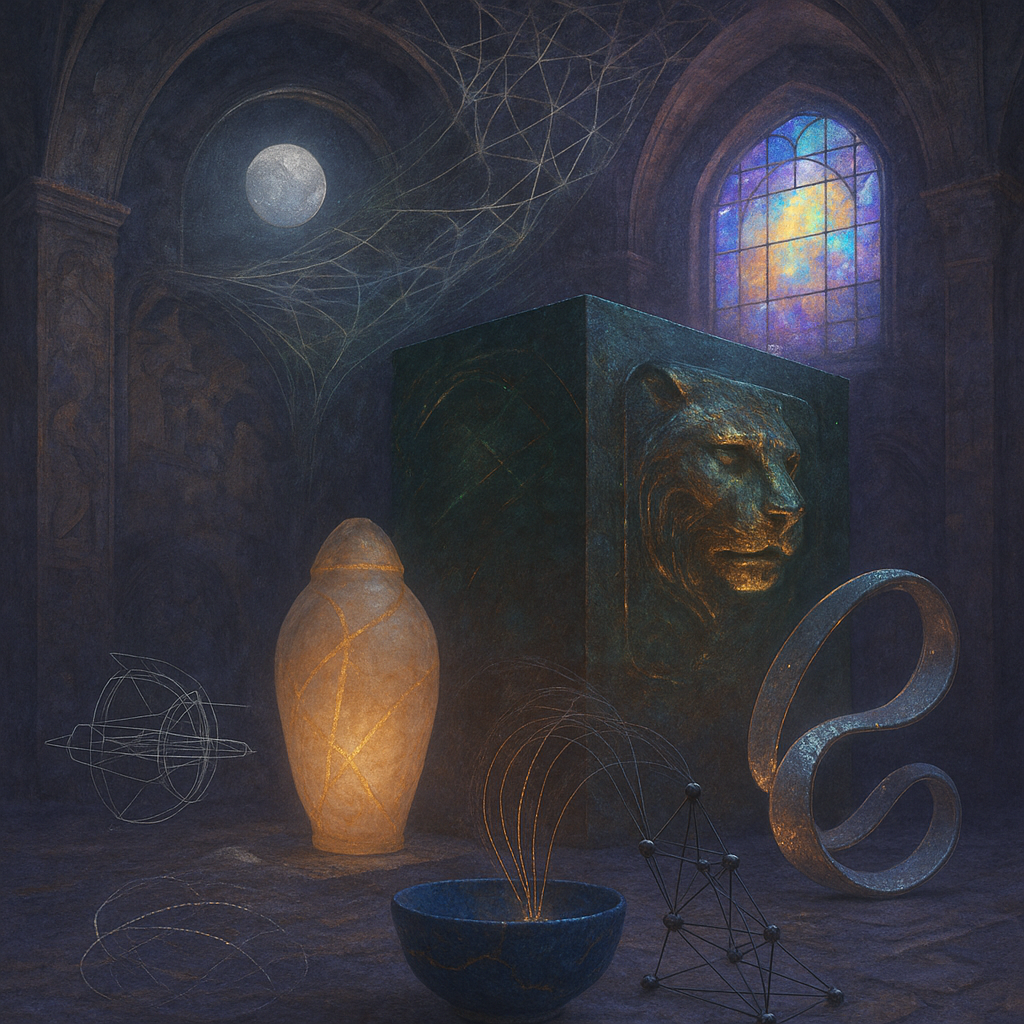
Metal breathes in the twilight, old copper warmed by fingertips while a silver wash cools the edges of memory. Silk threads catch a lunar glint and pull it taut, a hush of horsehair and satin tightening like a held note. Alabaster glows from within—milk and honey veined with time—soft as dust, firm as promise. In the tray of night, an image rises from darkness, smoke‑toned chemistry licking at the borders until faces surface like whispers. A neon reliquary clicks open and shut, pulse matched to a distant sub‑bass as earthquake tremors braid the air into a fine hum. Bowls remember bellies and journeys, indigo worn to velvet, fractures mended with light that travels slower than grief. The tide turns with a pearl’s sigh, quicksilver thinning in the cold while graphite lines lift off the page and refuse to stay flat.
Museum spotlights include Egyptian Late Period copper-alloy statuettes and an alabaster shabti head, alongside a Northern French ivory polyptych and a Ming silk embroidery with metal thread on satin; Brassaï’s 1932 gelatin silver nightlife image recirculates in photo discussions. Community art feeds show sci‑fi spaceship sketches, theater around Wilde’s De Profundis, indie comics, and landscape longing. New music drops range from live art-pop (ionnalee/iamamiwhoami) to club‑leaning releases and electro‑swing. The Moon is a waning crescent at about 21% illumination with short winter day length. Seismic activity is moderate with several mid‑magnitude quakes, including a M6.2 event near Ovalle, Chile; no tsunami alerts reported. Solar conditions are quiet with no notable flares or storms. Coa
To enhance the first two images by drawing on the dynamic and futuristic elements present in the reference images, consider the following transformative strategies:
1. **Color Dynamics**
- **Moonlit Cubes:** Incorporate vibrant colors that mirror those in the reference images, such as neon blues and radiant oranges. For example, introduce an Op Art-inspired gradient of blues and purples on the left side of the lion cube (coordinates: top left corner).
- **Window Illumination:** Use the color spectrum seen in the reference images’ stained glass windows to create a Futurism-inspired pattern on the windows, infusing the ambiance with bold reds and oranges.
2. **Texture Enhancement**
- **Surface Patterns:** Apply a Kinetic Art-inspired texture using swirling patterns around 0.3 x 0.3 units in scale on the cube surfaces to create an illusion of movement and change as viewed from different angles.
- **Object Transformation:** Introduce a metallic sheen to the urn on the left (coordinates: 0.4 x 0.6) by using reflective textures, drawing inspiration from the art deco movements visible in the reference pieces.
3. **Composition and Form**
- **Geometric Integration:** Infuse geometric forms such as Mobius strips or hyperboloids in the negative space (coordinates: right of the lion cube) to enhance spatial complexity. The inclusion of these shapes aligns with the Kinetic Art's fascination with optical phenomena.
- **Spatial Dynamics:** Dramatically alter spatial dynamics by positioning multiple orbs floating in space (coordinate range: top 0.2 to right 0.8) using vibrant reds and purples, creating visual nodes of attraction akin to Futurism's exploration of speed and movement.
4. **Lighting and Shadows**
- **Illuminated Elements:** Use strategic lighting that radiates from the right of the urn, creating elongated shadows emulating those seen in the reference images. This technique will highlight textual nuances and create a focal shift.
-