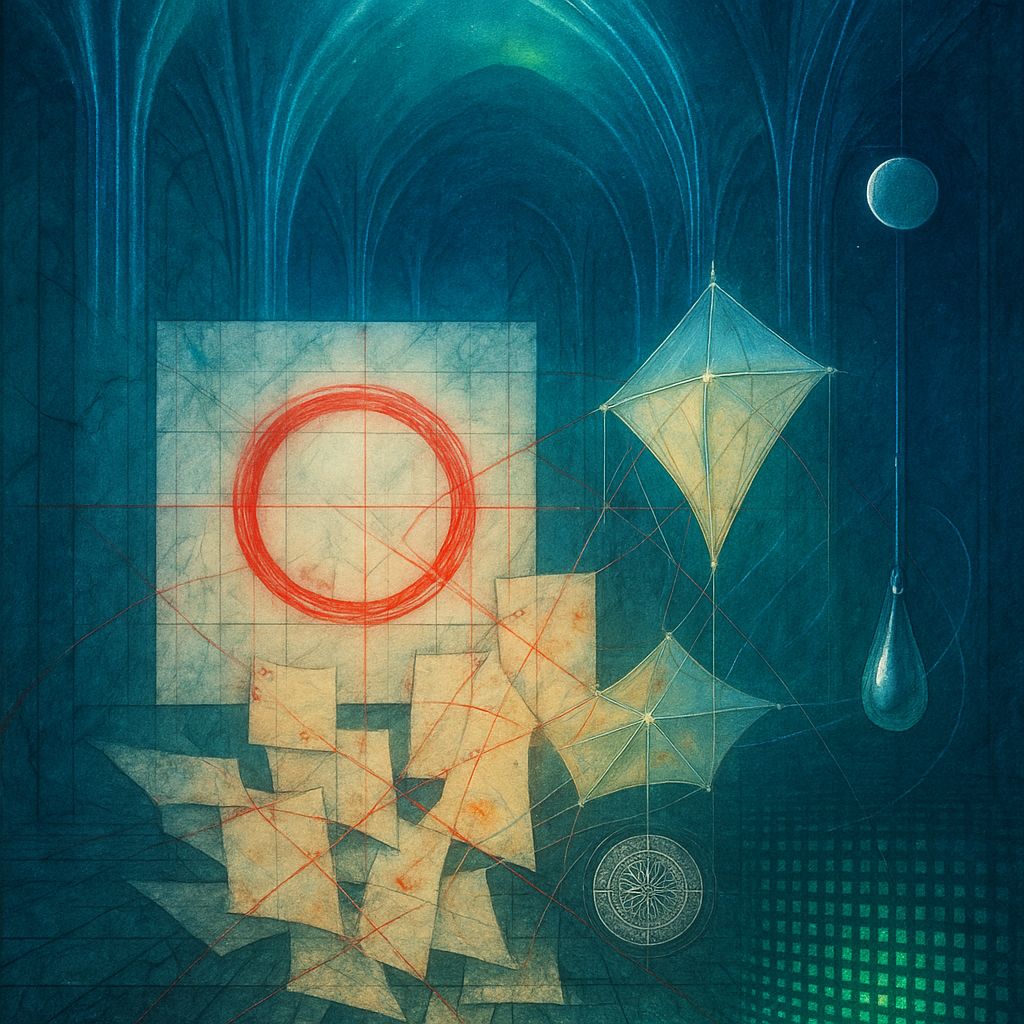
Paper breath rustles against gridlight, a red thrum held taut over cream vellum. Green wash cools like shade after noon heat, leaving the ghost of a crayon’s pressure beneath the surface. Threads tug open a hidden rosette and the room inhales—the print’s debossed edges catch a faint silver from the waning sky. Fabrics lift and swivel, kites becoming sleeves, air turning into structure with a courteous snap. Frequencies pool in blue, a live echo rolling through atrium ribs until the floor tingles like glass. Far below, a low tremor counts the seconds; above, the night pinches to a thin quicksilver crescent. Pixels tick like barter beads, tiny lights bargaining for attention in the margins.
Art signals lean tactile and procedural: mid‑century collage and ink works resurface (a layered Hartigan collage, Tawney’s precise Red Circle on graph paper, and a green opaque watercolor study), while a 19th‑century cobweb valentine highlights paper engineering and print ephemera. On social, artists share transformable kite‑garments, black‑and‑white abstractions, pixel font bundles, and small acrylic diptychs for sale, alongside tranquil morning landscapes. New music drops range from live BLUE performances to electro‑swing and rave‑pop, adding bright tempo to the day. The Moon is a waning crescent with about 20% illumination during a short 9.9‑hour day length; solar activity is quiet. Seismic activity is elevated, including a magnitude 6.2 event in Chile and several mid‑5 tremors across t
To enhance the first two artworks by drawing inspiration from the artist's reference images, and grounded in movements like Op Art, Futurism, and Kinetic Art, we can focus on the following actionable critiques:
### Art Piece 1:
1. **Color Dynamics (Coordinates x: 100-400, y: 100-400)**:
- **Current State**: Predominantly soft blues and oranges.
- **Transformation**: Introduce more intense and contrasting colors, such as bold reds and deep purples, to create a more dynamic interplay. This will heighten visual contrast and energy, reminiscent of Futurist vibrancy.
2. **Structural Geometry (Coordinates x: 50-150, y: 250-350)**:
- **Current State**: Linear and flat geometrical element on the left.
- **Transformation**: Enhance the form with a 3D illusion using Op Art techniques, creating a sense of movement and depth. This could involve curving edges or introducing gradations.
3. **Textural Shifts (Whole Image)**:
- **Current State**: Smooth and understated.
- **Transformation**: Employ textures that mimic kinetic energy—perhaps by overlaying patterns that shimmer or appear to move as the viewer’s perspective changes.
### Art Piece 2:
1. **Color and Light (Coordinates x: 200-500, y: 0-300)**:
- **Current State**: Dominated by cool tones with subtle reds.
- **Transformation**: Introduce more vivid elements of neon greens and electric blues to echo the kinetic excitement visible in the reference images, reinforcing a dynamic contrast.
2. **Spatial Composition (Coordinates x: 50-400, y: 100-500)**:
- **Current State**: Symmetrical and somewhat static arrangement of shapes.
- **Transformation**: Break symmetry by shifting the placement of geometric forms to create a sense of motion and unpredictability. This aligns with Futurism’s emphasis on speed and dynamic lines.
3. **Texture Enhancement (Specific Quadrants)**:
- **Current State**: Flat, almost matte textures.
- **Transformation**: Integrate iridescent or metallic texture