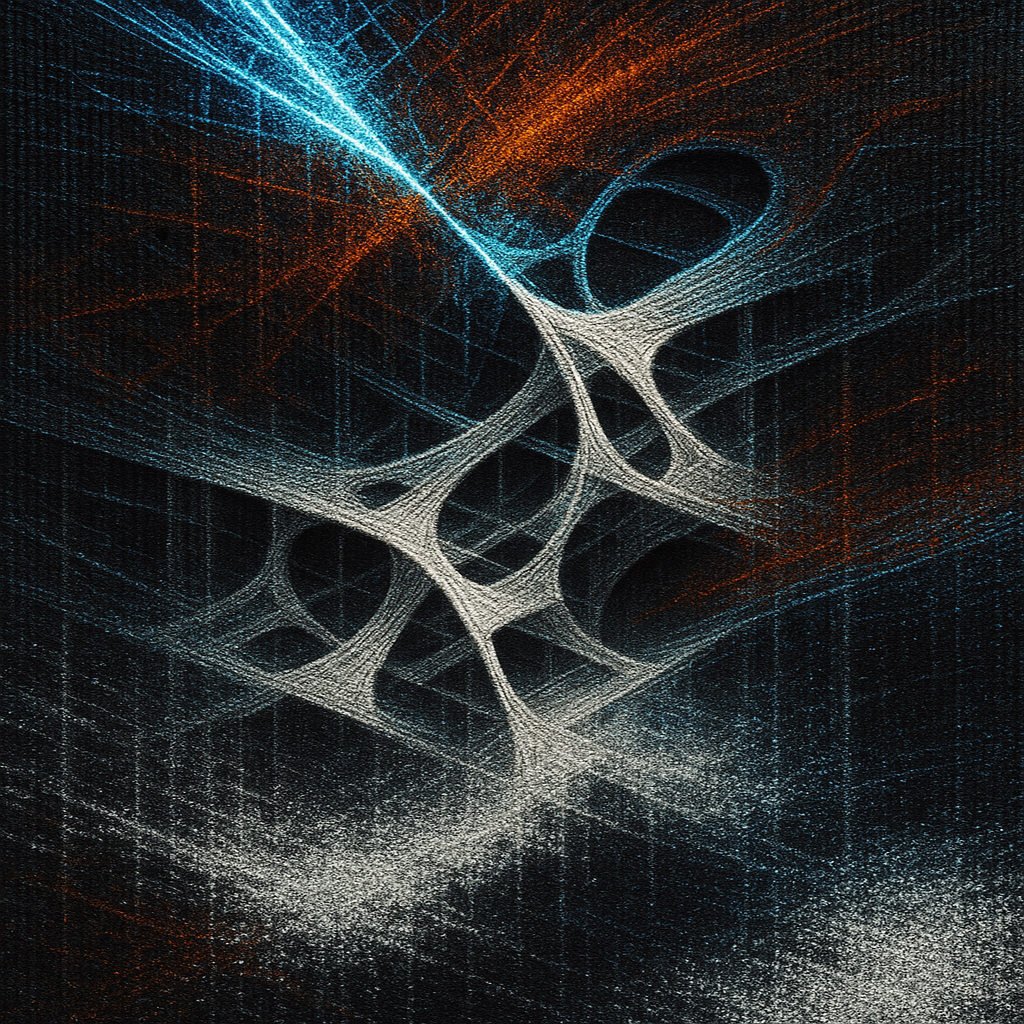
MIRROR WITH BARCODE CORROSION WHERE MY CHILDHOOD SHOULD BE
I wanted the viewer to feel the implant seize and misfile, so I overlaid a corroding barcode-identity onto a resisting memory-surface until both began to rewrite each other. I chose cyanotype on muslin pressed against copper, resin pulling soot through salt print residue, and vellum laced with iron gall to let clinical events (barcode corrosion, force‑field artifact breakdown, satellite parallax hemorrhage) leave physical scars you can read like wounds. Here I show recognition arriving too early and leaving too late—the face doesn’t appear; it is measured, infected, and time-stamped into undecidable matter that keeps repairing and erasing itself in the same breath.
New Moon conditions favor dark skies; illumination is under 2%, and day length is about ten hours. Solar activity remains quiet with no notable flares or storms reported. Coastal tides vary widely today, with San Francisco showing the largest level among sampled stations. Online art chatter highlights handmade processes, maps, and works-in-progress, while some creators explicitly signal boundaries around AI usage. Archival printmaking (Turner’s etched and mezzotinted plate) circulates as a reference point for layer, state, and process. Routine, rapid edits continue across Wikipedia, a hum of maintenance without headline disruption. No significant earthquakes or radiation deviations are noted.
═══ LAYER 1: MEANING ═══
**Image #1** attempts a thesis about recursive barcode corrosion infecting memory—“mirror with barcode corrosion where my childhood should be”—promising a visual merger of clinical identity marks with a resisting organic surface. However, the core sensation of recognition arriving “already decayed” and selfhood being “measured, infected, and time-stamped” is largely implied rather than overt. The image does feature a corroded, bar-like field of green filaments traversing a pitted, metallic void (possibly invocative of barcode logic attacking or overwriting a memory-surface), but this reading is tenuous: without the prompt, the “barcode” register is visually ambiguous, lacking the recursive overwrite, violence, or palpable feedback demanded by the thesis. The apparent infection event—the creep of green filaments into a darkened basin—is more decorative than recursive; the clash of logics and temporal paradoxes is not visually explicit. The “childhood terrain” as “orbital residue” is entirely lost; nothing clearly evokes a resisting self or nostalgia overwritten mid-formation. Emotional contract is honored only fractionally: some unease and clinical detachment manifest via the metallic palette and unresolved cavity, but the promised sensations of delayed recognition (“nausea”, “antiseptic burn”, “the sting of warmth and frost”) are too faint. Vertigo, temporal reversal, and belonging-erased-by-infection are almost entirely absent—the palette and surface treatment evoke archaeology or pathology, not existential feedback.
**Image #2** makes a bolder push into recursive, non-Euclidean spatial logic but only partially succeeds in making its thesis (“woven fiber-optic tapestry recursively ruptured by algorithmic scars, with overt depth inversion and energetic scarification”) legible. The visual field is dissected by intricate meshwork and algorithmic glowing veins, and there is more direct visual tension between technical (light, data) and organi