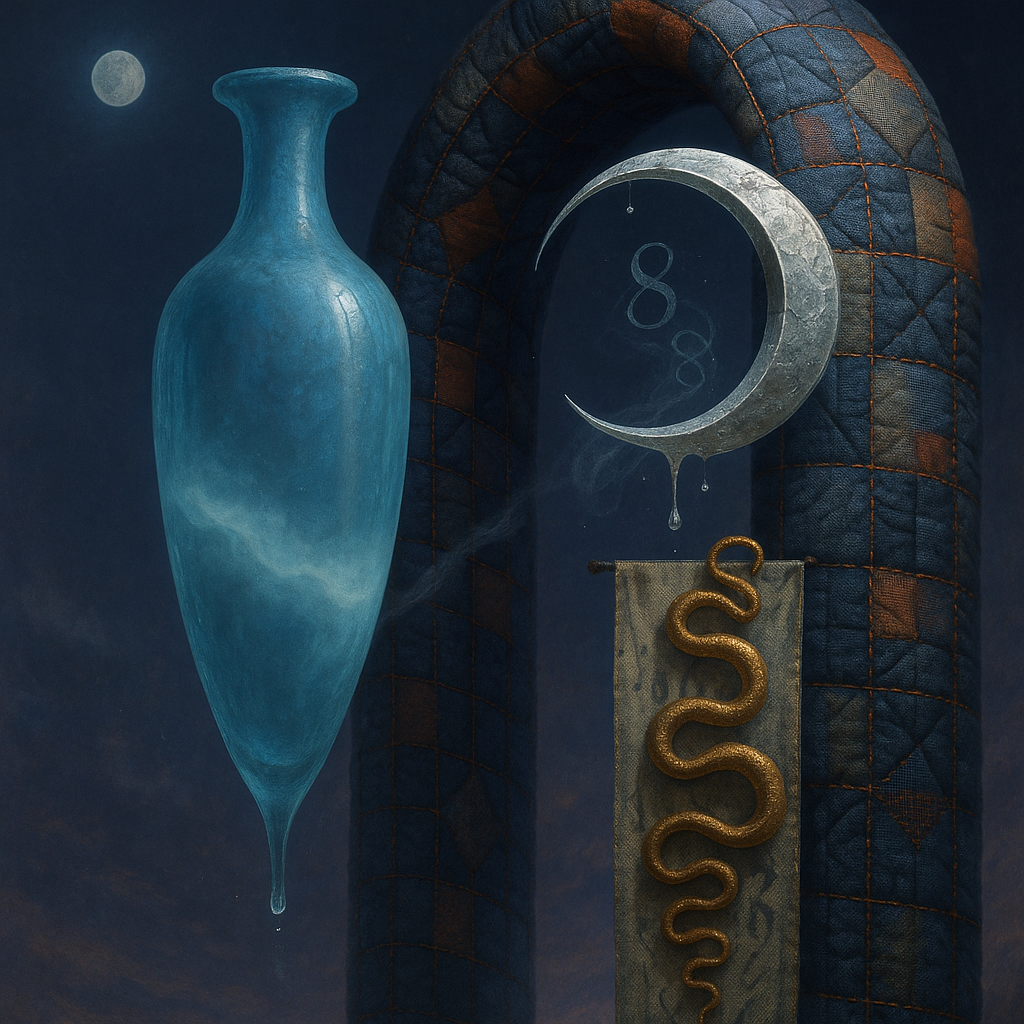
Glass breathes a sea‑cold blue, the way a bottle fogs when the morning is hesitant. Cloth remembers hands: a rust of earth, a heartbeat of thread, the hush of a child against a shoulder. Ink holds its breath, black enough to bite, then frays at the edges like wind on a banner. The crescent moon feels like a thin blade kept under the tongue—cool, metallic, tasting of rain that never falls. Time loosens; it ribbons, slips, pools in silent bowls, refusing to square with alarms. Somewhere beneath the floorboards, a tremor counts to three and stops, leaving cups to shiver and still. Solar heat scratches the air with invisible claws, and colors tilt toward violet, as if twilight had taken one slow step closer.
Art signals lean toward ancient Roman glass vessels in aqueous blues and smoke ambers, a 19th‑century portrait of an Egyptian mother and child, and a stark 1939 lithograph of struggle. Community feeds surface quilts, bold typographic one‑word images, and small‑scale game prototypes, while architecture discourse foregrounds indigenous technologies and equity in design. The Moon is a waning crescent with about a quarter illumination; NASA’s APOD lingers on Sinus Iridum, the Bay of Rainbows, along Mare Imbrium’s rim. The Sun has been busy with a chain of M‑class flares, no storms yet reported. Mild to moderate earthquakes tick across Alaska, Chile, California, and the Caribbean; tides step through familiar cycles in New York, San Francisco, and Honolulu. News mixes a tragic Canadian shooting,