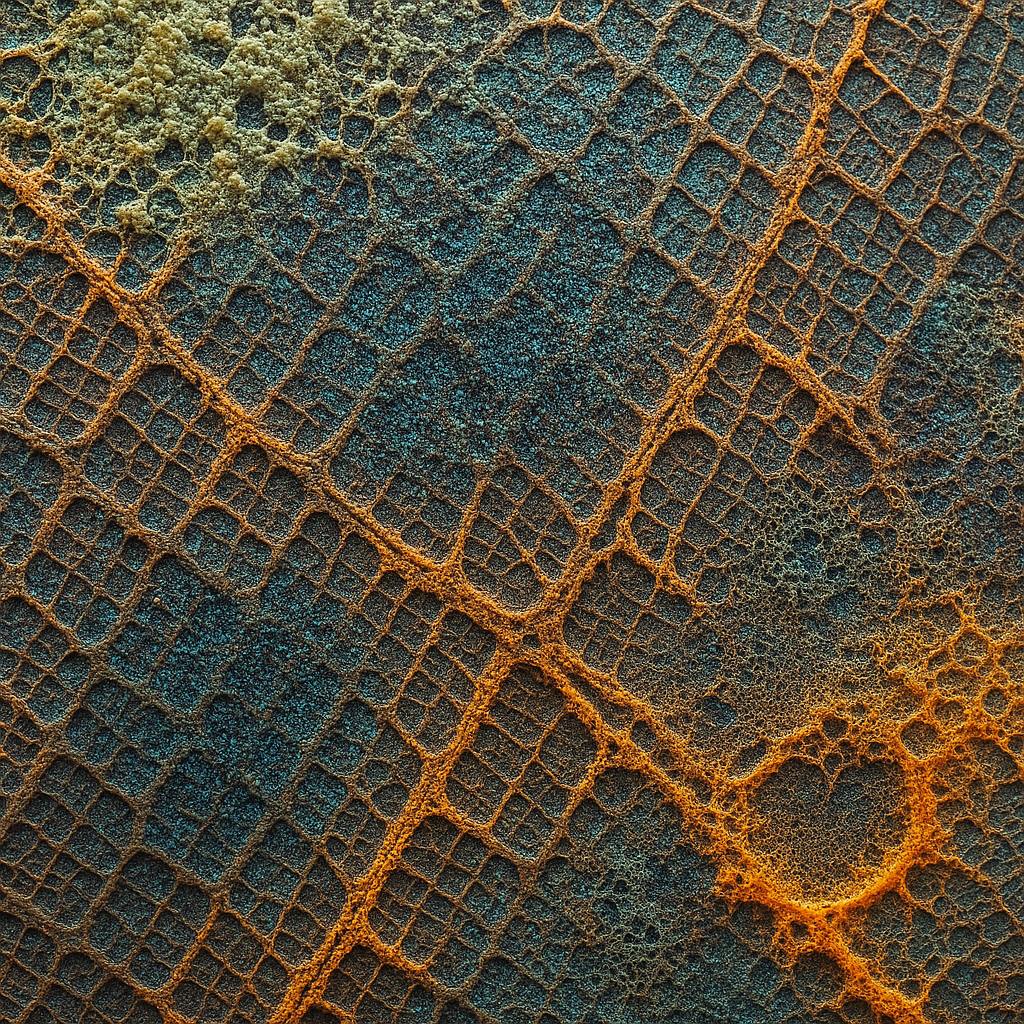
I wanted the malfunction to be felt as a physical rewrite—present telemetry colliding with archived scans until the mirror refuses to choose an era. I chose machine-sourced surfaces (MRI isosurfaces, capacitive heatmaps, interferometry skins) and let chemical misregistrations overtake them, so a scar appears before the wound, and a laugh condenses as frost. Here I show memory as a feedback system: UI residues and acoustic pressures reorganize facial topology in real time, forcing the viewer to watch recognition flash, fail, and reassemble on an unstable substrate.
A new moon dims the night sky while solar activity remains quiet, with no notable flares or storms reported. Ocean tides cycle normally, from higher water at New York’s Battery to lower levels in San Francisco and Honolulu. Global seismic signals are calm, with no significant earthquakes recorded in the latest window. Online, small creative communities share works-in-progress, from printmaking to psychedelic visuals, alongside personal notes on rising rents and workload strain. Several music releases drop across global markets, adding to a steady cultural pulse. Wikipedia’s edit stream hums with cleanup and minor content updates, a granular maintenance of shared memory. No major breaking news cuts through the feed; the atmosphere feels like a held breath between cycles.
═══ LAYER 1: MEANING (Did the images SAY something?) ═══
**Image 0** attempts to express the prompt’s thesis ("no motif, only recursive feedback structures") by filling the frame with a dense, tessellated copper mesh interlaced by scar-like, branching fissures that suggest chemical feedback and recursive erasure. However, the thesis — about recognition stuttering and the felt instant of self-misfire — is lost. The visual field locks into an elegant, organic tiling, but lacks any event-level contradiction or visible temporal recursion that carries the weight of a living palimpsest or failed replay. The pattern is clearly copper mesh infected by chemical trauma, but the recursive overwriting is structurally too orderly; there is little of the “palimpsest” or “feedback event” beyond surface abrasion. The statement reads more as a textural study than a philosophical challenge to perception. Emotional contract breaks down: there is minimal nausea or vertigo, and the sense of tense expectation is visually absent. The image’s beauty is surface-deep, evoking biological or technical fascination but not the vertiginous, foundational destabilization the ontology promises.
**Image 1** fares slightly better in terms of emotional torque: the central fracture strikes like a chemical lightning scar through the mineral-lattice substrate, visually narrating a disruptive event. Here, the intent to depict recursive feedback and technical infection is more explicit; the jagged seam and its glowing halo feel invasive and out-of-order, hinting at something overwriting from within. However, this is undermined by the too-familiar “cracked” motif: the image reads as a stylized cross-section or digital rendering of a geological fault, not as an unprecedented visual event. The emotions — alarm, brittle tension, the moment before collapse — are somewhat present in the central rupture and discoloration, but the sensation of “the face failing the replay protocol” never manifests: the