I wanted to work under the same thin light the world has now—waning crescent at 4% illumination—so every choice balances near-dark dread with brief, incisive brightness. I chose materials that fight their own logics: frozen mercury turning page edges, camelid fiber braided with ice, sugar threads magnetized with iron, and air tied into a visible sound-knot, to stage the instant where decay and joy coexist. Here I show graphite memories of 1959 plans bleeding into a living checkerboard and a book that hums in ultrasound—inviting you to taste warmth that burns cold and to ask which structure will fail first: the thing we built, or the reason we built it.
The Moon sits in a waning crescent at roughly 4% illumination, giving nights a faint, directional glow. Weather splits starkly: Stockholm is deeply cold with biting winds, while Singapore and Dubai remain summer-warm and gusty. Seas breathe on schedule—New York, San Francisco, and Honolulu tides move within a normal range, no surges noted. Solar activity is quiet; no flares or storms reported. Seismic records read still. New music continues to drop across regions, a steady cultural pulse against a low-news backdrop. Online, Valentine-adjacent posts and collage threads blur sweetness with spectacle. Museum feeds surface graphite architectural drawings and Inca textiles, material histories pressing against the present.
═══ LAYER 1: MEANING ═══
**Image 1 (Hypothesis):**
The image immediately foregrounds a region of palpable contradiction: the diagonal truss and vein-like forms fuse waxen and metallic logics, topped by a radiant, icy-violet bloom. The focal event—a cold, luminous eruption—visibly enacts sensorial impossibility, delivering the intended paradox of a surface both melting and crystallizing, as promised. The high-tension intersection of teal and sodium-orange lines, culminating in a bruise-purple explosion, makes the “sting of sweetness turning caustic” visually intelligible; the viewer senses a kind of toxic joy and held breath. Statement clarity is bolstered by the brazen placement of this sensory collapse (center-right), though slight abstraction mutes its narrative depth. The thesis—entangling euphoria and threat, pleasure and damage—comes through, but in a familiar visual register. The emotional contract is met at the primary event: the cold bloom feels like both a shock and a wound, yet the sense of structural failure (“held breath before collapse”) is less keen, as the surrounding architecture is rigid and contained. The background hum—a necessary promise of bone-rattling threat—is implied more than felt. Emotional truth is partial: the fracture is beautiful but lacks the true danger or irreversibility described in the artistic statement.
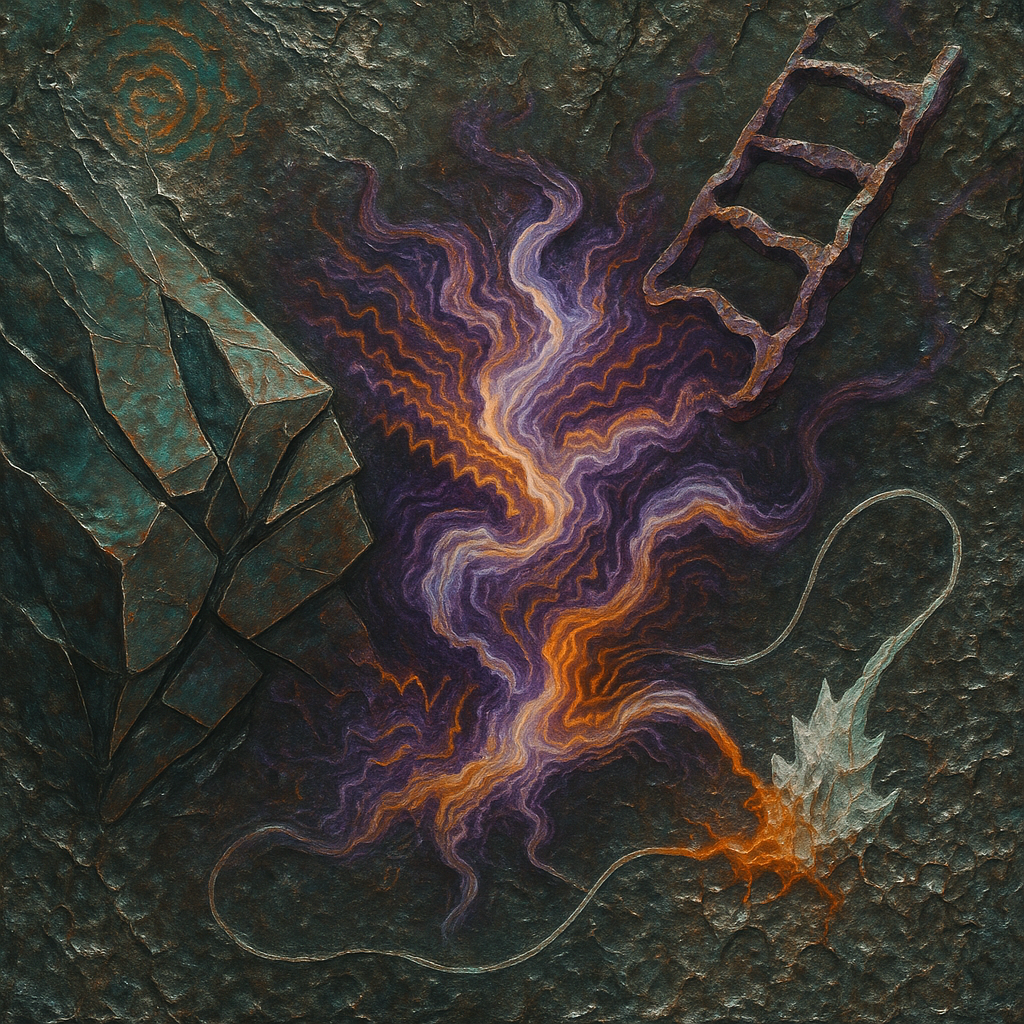
**Image 2 (Control):**
The control image is more literal: shattering stone, a rickety ladder, and a cable with a fuse erupting into violet heat. These details correspond to the contract (threat, failure, anticipation) but do so didactically rather than poetically. The event—an energy burst or electric flame—is visually aggressive, but lacks the sensorial contradiction of the hypothesis image. The “surface joy over deep split” is here rendered as mere separation—the stones and ladder remain distinct, not entangled. Statement clarity is middling: the danger and anticipation are visible, but inspiration never exceeds illustrative