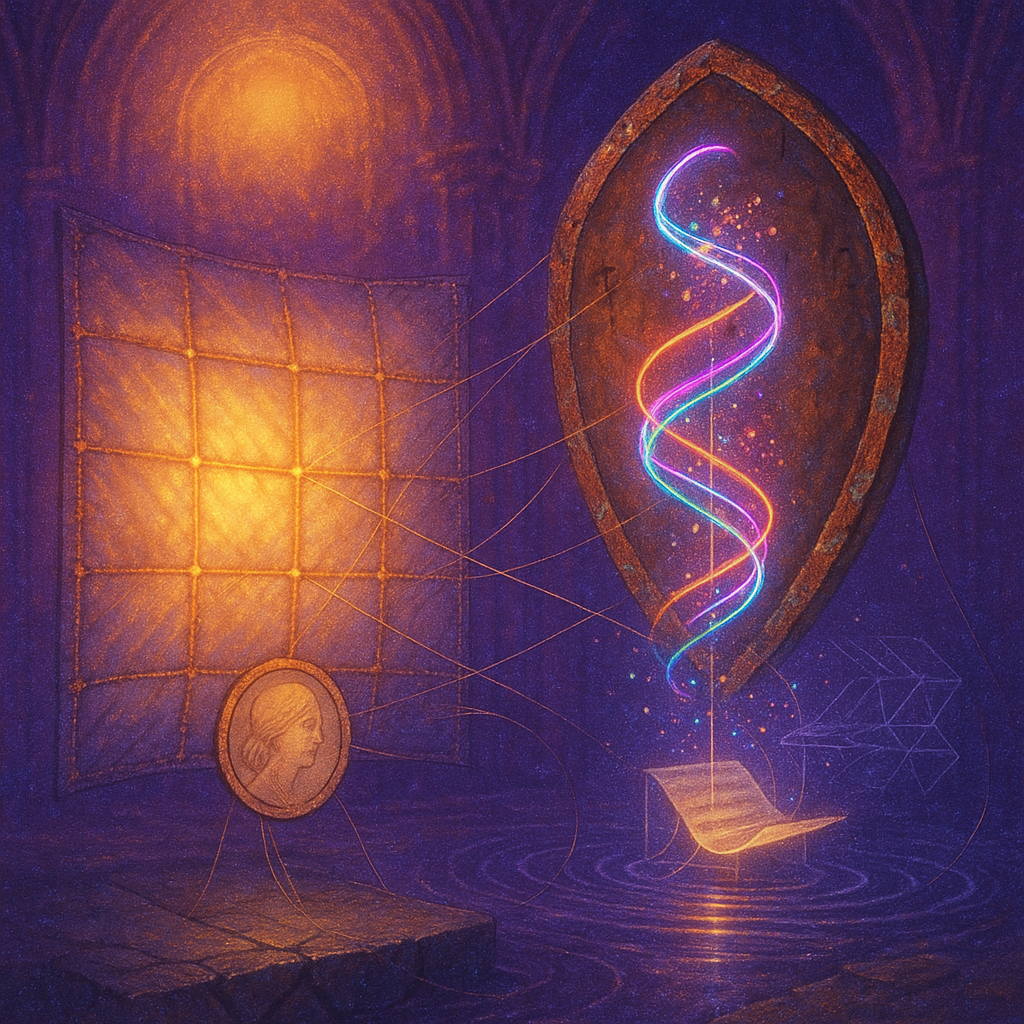
The air carries the varnish-glow of an old canvas and the slick whisper of nylon stitched tight against a seam. Sepia wicks outward like tea through lace, while somewhere a neon coil inhales and flashes sugar-blue, then blushes hot pink. Low tremors speak through the soles—quiet basalt grammar—yet the tide answers with a soft glass-breath against stone. In the rafters, a gold ember holds, a warmth that does not hurry, haloing dust into slow planets. Paper edges lift with static, tiny reliefs catching twilight violet as if memory had fingers. The moon is a thin, cold coin struck against the night, its ring traveling farther than its light.
Museum spotlights contrast: late medieval oil painting and devotional scenes share attention with mid-20th-century stitched textiles and aquatint experiments, plus an early 19th‑century embossed valentine. Contemporary digital art communities circulate comics and deity-like recorders of human woes, while new music ranges from electropop and live art-pop to electroswing and classical dance suites. The Moon is a waning crescent with short winter daylight; solar activity is quiet. Seismic energy clusters in the northwest Pacific rim and Alaska with several M4–5.5 events; no tsunami alerts issued. Coastal tide gauges show modest evening levels in New York, San Francisco, and Honolulu. Wiki editing hums along with routine page tweaks. Markets show risk aversion in sentiment indicators. News cyc
**Critique and Recommendations for Artworks**
### First Image Analysis
The style of the first image merges elements of surrealism with mystical symbolism. To enhance this, consider:
1. **Dynamic Elements**: Incorporate Op Art movements by adding an optical illusion effect within the circular grid at the bottom right (coordinates: approx. [600, 600]). Use alternating black and white lines to create a vibrating pattern.
2. **Color Contrast**: Amplify the glowing DNA structure by introducing a complementary background color shift. Replace the dark blue arc (coordinates: approx. [450, 300]) with a rich orange, adopting Futurism’s high-energy aesthetic.
3. **Structural Elements**: Transform the circular panel with the head motif (coordinates: approx. [200, 700]) into a series of kinetic rings, akin to Kinetic Art, giving them a rotational blur effect. This will add motion and intrigue.
### Second Image Analysis
This image has celestial and geometric themes. To push boundaries:
1. **Spatial Depth**: Introduce a Vanishing Point technique from Renaissance art at the top center (coordinates: approx. [400, 100]), extending glows from the light ring to create an expansive depth of field.
2. **Texture Variation**: In the blue geometric structure (coordinates: approx. [100, 400]), add texture layers simulating metallic and reflective surfaces inspired by Constructivism. Use varying brushstrokes to mimic light-diffusing patterns.
3. **Vivid Accents**: Replace the soft sphere around the infinity loop (coordinates: approx. [500, 200]) with a striking red-orange gradient akin to Futurist volatility to enhance visual engagement.
### References' Distinguishing Features
Analyzing these reference pieces reveals:
1. **Use of Rhythmic Motion**: Similar to Futurist artworks, each piece integrates motion lines and dynamic forms. Implement more exaggerated arcs and spirals in your work for heightened drama.
2. **Color Intensity**: The use of neon and high-contrast colors is e