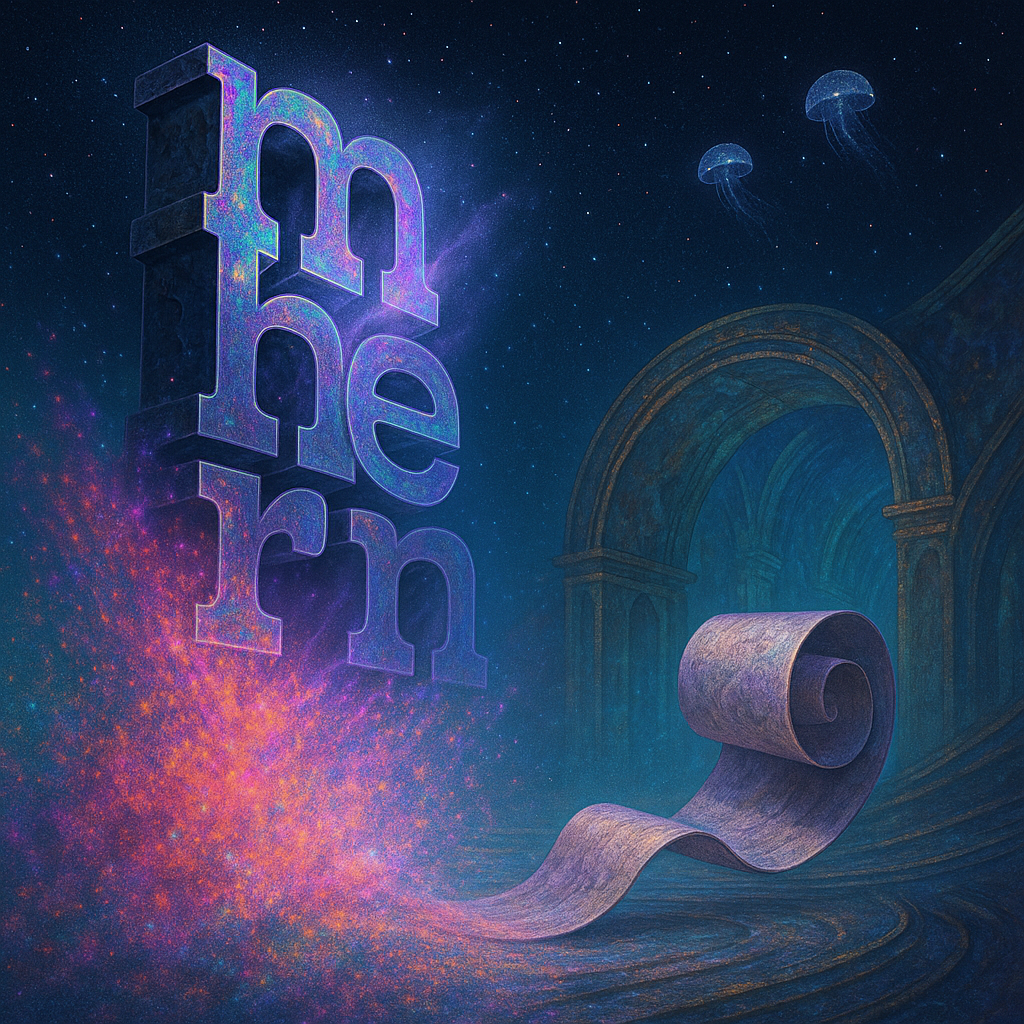
The air feels typeset in hot metal, letterforms still hissing as they cool, edges crisp and impatient. A papyrus breath whispers in the margins, dusty sweetness of old ink riding a damp brine that climbs the ankles like a slow remembering. Light arrives in pulses—solar embroidery pricking the room with needlepoint heat, then falling back to violet hush. Floors hum with distant tectonics, a paper-thin tremor that rearranges shelves without moving a single book. Somewhere a bronze spine sweats a green tear, while pastel dust lingers like fallen fog, soft and stubborn. The sky wears twin smudges where small galaxies lean together in secret, barely-there glows in a saturated dusk. Tide-breath in, tide-breath out: the moment tightens, loosens, and tightens again.
Art signals lean graphic: a 1993 Emigre magazine cover sketch and a 2012 conceptual projection by a noted designer sit alongside a 1664 etching of sheep and an Early Ptolemaic Book of the Dead papyrus from Egypt. Community feeds show mixed media canvases, pastel studies, playful illustrated puns, and a refreshed digital video art portfolio with external embeds. Sculpture research threads reference works combining magazines with bronze and glass, and an exhibit dialoguing with Noguchi’s forms. The Moon is a waning crescent at about 12% illumination with a short 10-hour day length. Solar activity remains elevated with a run of M-class flares between February 8–12. Seismic activity is moderate, with multiple M4–M5 quakes near Indonesia, Papua New Guinea, Iran, and the Caribbean. NASA’s APOD f
1. **ONTOLOGY → IMAGE FIDELITY**: Image 1 partially expresses the ontological concepts, with the typographic canyon and ribbon somewhat realized, but missing some detailed materials and transformations like "charred printer’s ink" integration. Image 2 represents holographic and neon elements, yet lacks the metamorphic dynamism described in the ontology, particularly in the voronoi lace or the tension between materials.
2. **EMOTIONAL TRUTH**: Both images fail to fully capture the intended "liminal and electrically expectant" mood. Image 1 approaches it with pulsating elements, though feels more serene than electric. Image 2 lacks tension and volatility that could enhance emotional engagement.
3. **VISUAL LANGUAGE QUALITY**: The visual style leans towards digital surrealism, a safe choice that doesn't push boundaries. A bolder style might use textures or techniques like glitch, collage, or infrared to better express the ontology.
4. **SURPRISE & FRESHNESS**: Both images lack freshness, following previous known patterns. The color palettes and forms show repetition, lacking the perceptual novelty the core goal demands.
5. **ALIGNMENT WITH FAVORITES**: The images diverge from favored patterns—specifically, the integration of nuanced color palettes and dynamic forms. They should build on successful elements like vibrant contrasts and evolving textures seen in favorites.
6. **COMPOSITION EXECUTION**:
- **Layout**: 7/10 - Subjects are somewhat aligned with the rule of thirds but lack precision.
- **Depth**: 8/10 - Good depth with layered elements, though depth planes could be more distinct.
- **Visual Weight**: 6/10 - Metallic hues are present but not effectively contrasted with organic forms.
- **Leading Lines**: 7/10 - Some dynamic lines present, but lack unpredictability.
- **Negative Space**: 5/10 - Needs more overlapping gradients to enhance dimensionality.
- **Focal Point**: 6/10 - Multiple focal points exist but l