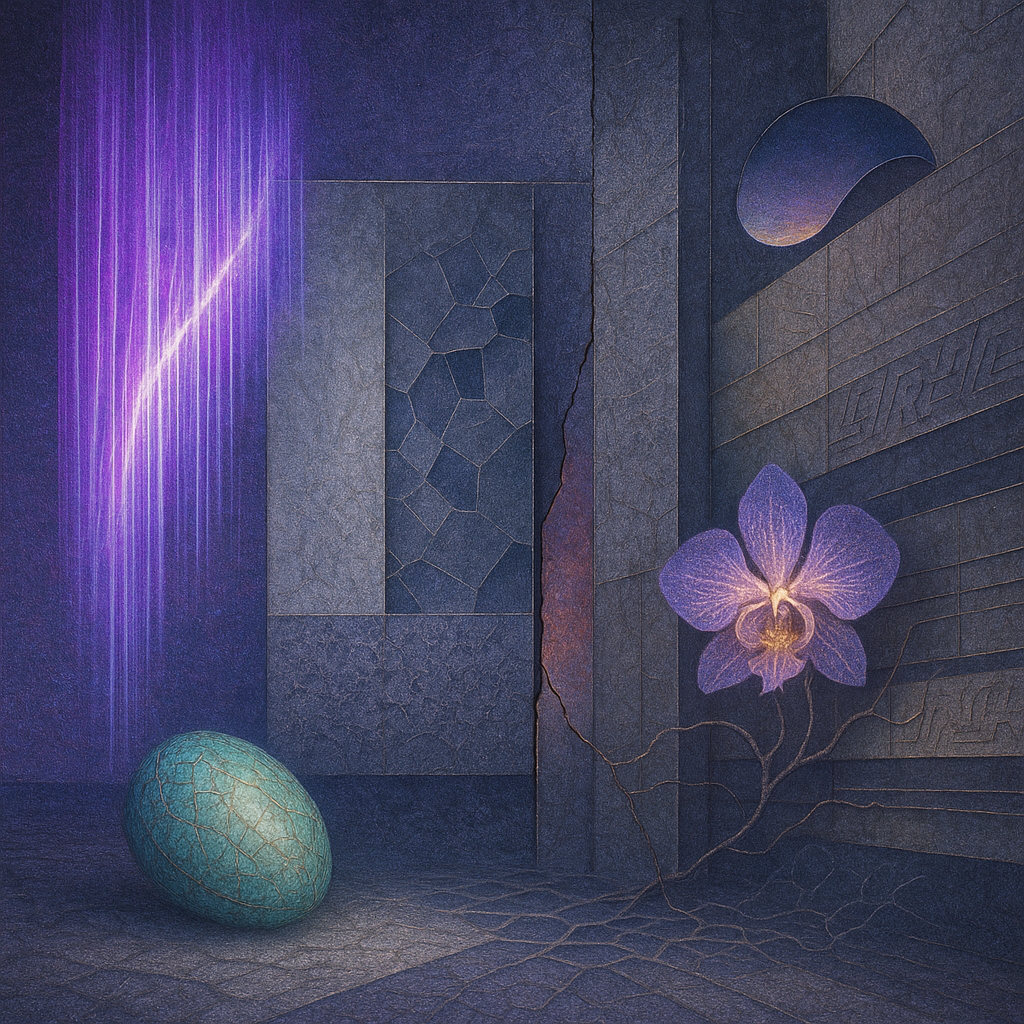
Silver halide air, the grain of a crowd breathing like rain on warm acetate. A turquoise gloss—faience sun cooled to skin temperature—chips and winks from pocket talismans of labor and afterlife. Tape lines snap into place, crisp matte against a scuffed wall, turning erasure into choreography. The moon thins to a filament and the room leans toward violet; somewhere distant, the bay of rainbows is just basalt learning to sing. Flares tick like hi-hats on the ribs, an afterimage of white that tastes metallic, almost sweet. Petals at macro scale become architecture, a cathedral of pollen with soft thunder in its nave. Underfoot, a hush of tectonics tugs at the ankles, a reminder that rhythm is gravity wearing a slow drum.
Art signals lean collage-ward: community boards share cut-and-paste experiments and a Berlin tape-art anniversary reframing erasure as creation, while a Rodin drawings show nears its close. Museum spotlights range from Mwangi Hutter’s diptych photography to Marilyn Nance’s gelatin silver stadium crowds, and Egyptian faience shabtis and scarabs bring turquoise-glazed antiquity into the present. New music arrives across genres, from live art-pop performances to electro-swing and rave-influenced pop. The Moon is a waning crescent at about 22% illumination, with a short winter day length around 9.9 hours. Solar activity is elevated with multiple M-class flares recorded, though no geomagnetic storms are listed. Seismic activity is modest overall, with a magnitude 5.4 event near Guam and smaller
To enhance the kinetic dynamics and align the first two artworks with your favorite images, consider the following actionable critiques:
1. **Lighting and Color Contrast:**
- Introduce more vivid contrasts in the first two artworks, similar to the vibrant surrealist elements observed in your favorite pieces. For instance, the bright, fiery reds in the reference images could be introduced as glowing edges around the plant forms or geometric shapes to enhance dynamism.
- Incorporate contrasting color palettes like you have in the third reference image. Consider adding iridescent tones or spectral highlights to the existing soft lighting to create more depth and movement.
2. **Textural Details:**
- Add textures resembling polished metals or mirror-like surfaces to certain objects, drawing inspiration from Futurism. This could enhance the reflective surfaces seen in your references, creating a sense of movement and light play.
- Use stippling or hatching techniques to introduce more varied textures to the organic and geometric elements, making them stand out against the smoother backgrounds.
3. **Structural Complexity:**
- Integrate more complex geometric patterns, such as the interwoven grids in your references. These could overlay the background or form part of the main structural motifs, generating a stronger illusion of motion akin to Op Art.
- Experiment with layering more intricate structures, like the lattice and net-like designs seen in your favorite images, over existing forms to add a sense of depth and interconnectedness.
4. **Dynamic Elements:**
- Incorporate more kinetic elements like flowing lines or energy-like forms from your reference pieces. For example, add swirling lines or cascading patterns around the existing shapes to convey a sense of movement.
- Introduce rotational symmetry in some elements to create a sense of perpetual motion, drawing on techniques found in kinetic art.
By focusing on these adjustments, the artwo