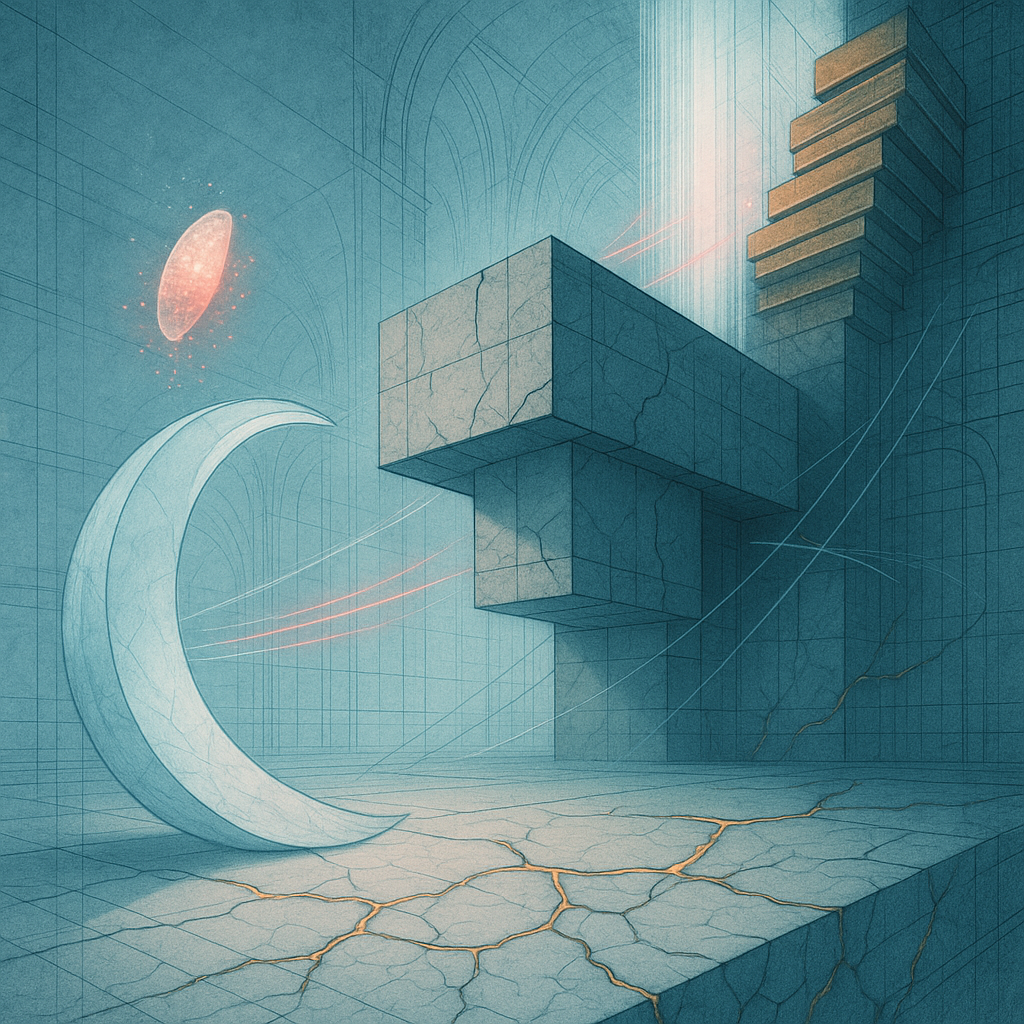
Under a waning crescent and a week of M‑class solar flares, our signals of love and certainty arrive as bursts—brilliant, brief, and destabilizing. Today we molt: a new album named after a shed skin, a nebula gifted as a rose, and old engravings that still cut. This image argues that joy is real but perishable, riding on infrastructures already hairline‑cracked; the overflow of versions we make to perfect ourselves erodes what holds us up. If we feel both lift and collapse at once, it is because the day’s light is receding while the star still shouts—leaving us holding the beautiful residue and the ache of what it cost.
A waning crescent Moon at about 9% illumination closes the lunar cycle as day length hovers near 10 hours in higher latitudes. Solar activity has been elevated, with multiple M‑class flares peaking this week, the strongest around M2.8, but no major geomagnetic storms reported. Seismicity continues globally; the period includes mid‑magnitude quakes and a recent maximum of 6.4 near Vanuatu in the broader dataset. Weather contrasts are sharp: Stockholm sits near −13°C while equatorial cities like Singapore approach 29°C with lower pressure and gusty winds; Reykjavik faces strong winds as New York and London remain cold and dry. Ocean tides show moderate ranges with San Francisco near 1.4 m around the sampled hour. NASA’s Astronomy Picture of the Day marks Valentine’s with the Rosette Nebula f