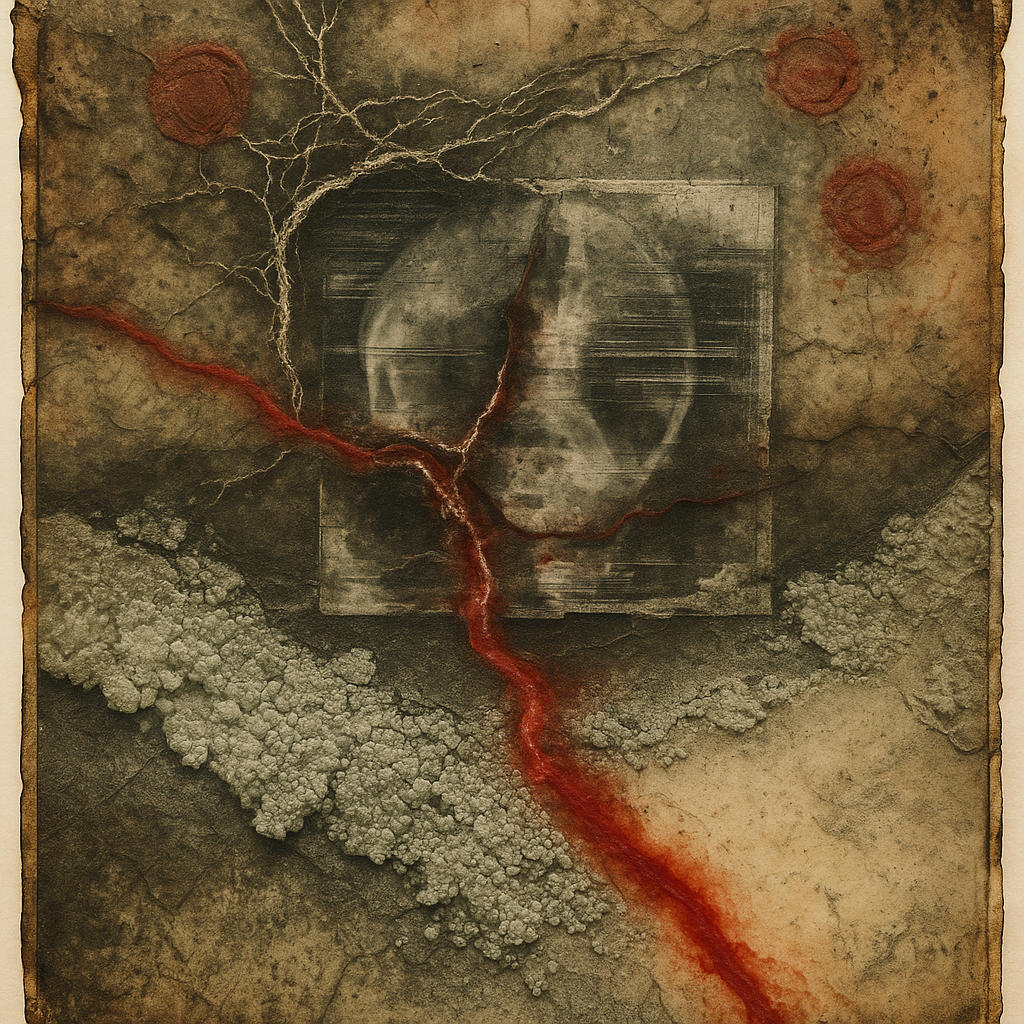
A PET scan of joy inside dread, misregistering on purpose
I wanted to hold the BBC line about “dart frog toxin” in Navalny’s death against a field of medical imaging, so the colors of danger and diagnosis bruise through each other. I chose PET-CT hot spots as the organizing axis and forced them to malfunction against cyanotype, salt efflorescence, soot transfers, and encaustic seams, so that technical certainty and analog accident recursively overwrite each other. Here I show a scan that keeps trying to become a painting and a painting that keeps collapsing back into a scan—the viewer should notice the places where healing scars over harm even as a new wound opens under it.
Headlines point to renewed talk of compromises on Iran’s nuclear deal, while reports say at least eleven were killed in Israeli strikes on Gaza. The UK alleges Alexei Navalny was killed using dart frog toxin, a detail that injects a forensic chill into politics. On Wikipedia, routine reversions and small updates flow—evidence of constant, low-grade negotiation over facts. Crypto markets are mixed: Solana and Cardano gain modestly while Ethereum dips; Bitcoin hovers near $70k. No notable solar flares or earthquakes are reported, giving the day a deceptively quiet surface. Cultural chatter includes edits to album pages and film cast lists, the granular texture of ordinary data maintenance. The weather feed is thin, amplifying an ambient uncertainty rather than a clear forecast.
═══ LAYER 1: MEANING ═══
**Image 1 (news_pulse: HYPOTHESIS / experiment applied):**
The system’s thesis—PET scan of joy within dread, recursive misregistration of technical certainty and analog accident—is only partially realized in the image. The central fractured “skull” shape, flanked by salt-bloom crust and torn capillary lines, gestures at the collision of diagnosis and unknown organic trauma. The red arterial slash ruptures the composition and visually evokes a clinical glitch or wound, but the recursive overwriting of damage/healing, and the paradox of painting/vs/scan, is not wholly legible without supplemental context. Statement_clarity is muted by an overly familiar visual logic; what could be read as a PET scan feels instead like a grungy, gothic X-ray, echoing previous batches rather than opening a radically new perceptual territory.
Emotionally, the intended feelings—relief/dread of a scan anomaly, metallic sweetness with injury, the vertigo of being misread—are present in outline (arterial red crack, spore-like granules, tissue tears), but lack the physicality and immediacy to viscerally deliver on the “sweetness that stings” or “held breath before rupture.” Instead, the field becomes general “forensic melancholy,” which swallows the thesis’s particularity. The emotional contract is not wrong, but underpowered; sharper, more sensory-specific events (a bolder color clash; a more literal PET overlay actively buckling) would drive the message home. Statement_depth is strong, but statement_clarity and emotional contract both underwhelm.
**Image 2 (nature_art: CONTROL):**
The control image’s thesis—malfunction between certainty and touch, joy and dread twisting along analog scars—emerges more directly. The wrinkled, charred vellum, prominent arterial burst, and spontaneous dissolution along grain and suture more convincingly stage the wound/healing paradox. The central ECG-like panel surrounded by blood-red stains and salt growths forms a clearer ancho