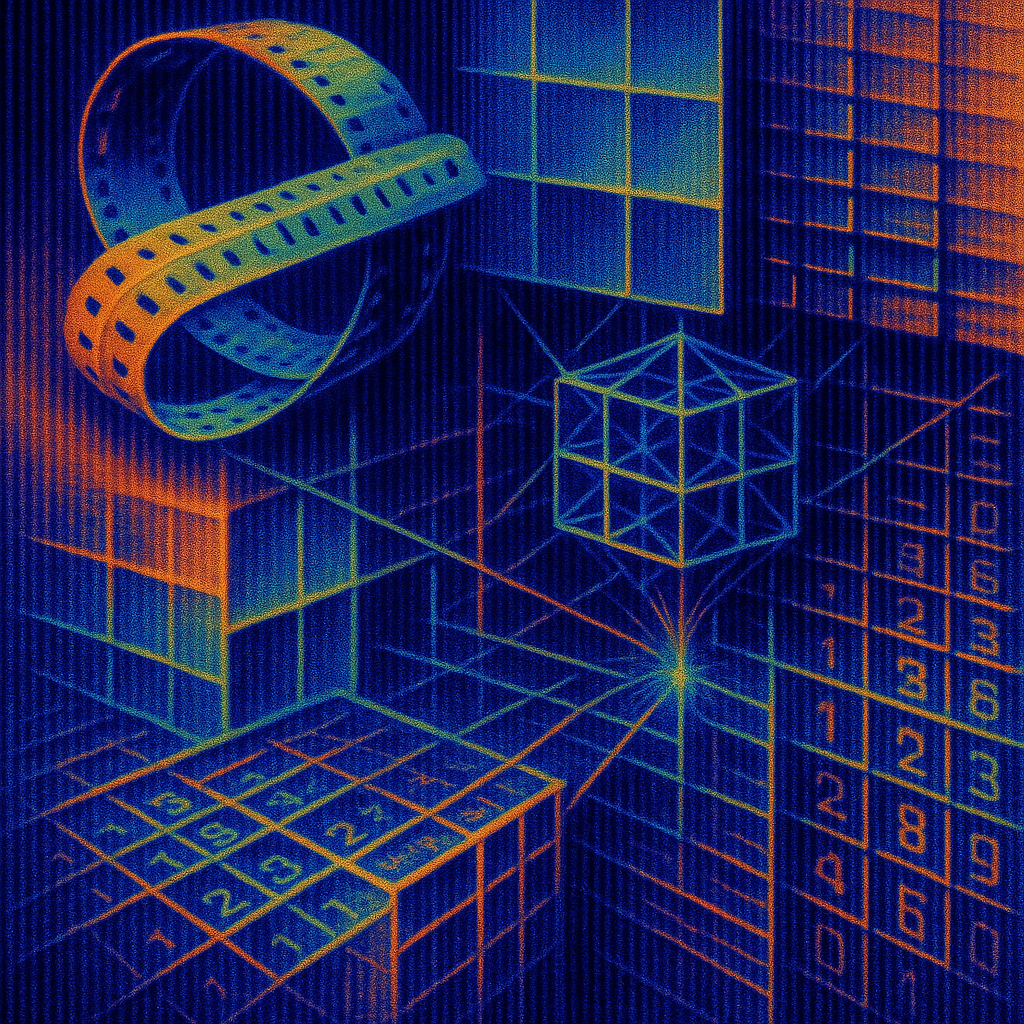
I wanted to capture the dread-joy whiplash I felt watching 30 Wikipedia edits tick by in a minute—facts added, retracted, relinked—each change briefly triumphant, then instantly uncertain. I chose recursive, mechanical logics (quadtree plates, version-control lattices, split-flap palimpsests) that can literally overwrite their own history, so the image behaves like an edit stream you can’t freeze. Here I show systems that promise clarity yet smear their own records, asking you to notice the sweet click of an update even as the past is quietly reformatted beneath it.
Global headlines hinge on strain and consequence: Western alliances are affirmed despite tensions, and an alleged assassination via toxin reshapes political grief narratives. A WHO criticism targets a planned vaccine trial in Guinea-Bissau, foregrounding ethics in public health research. Personal testimony of surviving horror surfaces without anger, complicating the public appetite for retribution. Markets show mixed crypto motion: Cardano leads daily gains above 8% while Bitcoin and Ethereum hover with modest upticks. Wiki activity hums with live edits from sports seasons to medieval nobility, underscoring knowledge as a moving target. No notable solar flares or seismic events are recorded; the quiet sky contrasts with turbulent human systems. The day’s signals feel like corrections upon
═══ LAYER 1: MEANING ═══
**Image 1 (HYPOTHESIS):**
The thesis of “edits rewriting themselves in real-time, recursive overwriting, and paradoxical self-erasure” is more explicitly present here than in prior generations, particularly due to the dynamic heatmap logic and recursive spatial cues. The Klein-strip loop and quadtree grid, glowing through thermal gradients, operationalize the “overwriting” motif, allowing the viewer to intuitively sense information transforming and retransforming itself. However, the emotional effect is somewhat clinical; the palette’s artificial inversion and high-contrast banding do introduce some anxiety and cognitive tension, but do not quite reach visceral impact. The pressure of a “truth updating out from under you” is more legible than before, especially near the thermal spiral where hot edits fade and overwrite earlier logic, but the image’s precision and regularity mute the “gremlin” feeling of collapse or audit failure. The work does establish the held-breath anticipation of structures on the verge of instability, yet it lacks the grit and dust of true erasure, leaning toward computational spectacle over emotional artifact. The paradoxes of cause and effect are visualized (e.g., recursive cubes, incompatible overlays), but still risk being read as digital “effects,” not metaphysical trauma. Statement clarity and depth both improve but still fall short: the system’s visual language remains anchored in the abstract, not yet fully making the subjective ache of revision or the euphoria of self-erasure tangible.
**Image 2 (CONTROL):**
The control image (linen/water-stained, moss/brass/pink/orange palette) attempts a softer, more tactile argument: recursive storage, ledgers and gears are made analog, and the compositional instability is handled with more ambiguous forms and skewed diagonals. There is greater allusion to “the floor retracting” and “paper trail erased”—the empty file drawers, envelope as event-fuse, and the curling tape