I wanted to trap the exact nausea when a cherished recollection is overwritten mid-gaze, so I fused misregistered childhood likenesses with stuttering interface afterimages until the “face” becomes a palimpsest rather than a portrait. I chose analog stains (shellac, red wax, watercolor bloom) to physically argue with digital residues (thermal print ghosts, holographic foil, OLED film), forcing the image to loop, erase, and reprint itself in place. Watch how the luminous bands try to repair the smear and instead sear it—recognition arrives, then slips, as if the mirror keeps updating you to someone you almost were.
Solar activity remains elevated with multiple medium-strength flares in recent days, though no major storms are reported. The Moon is at a thin new phase, shortening daylight and emphasizing colder, clearer nights in many regions. Ocean tides vary across coasts, with relatively higher levels on the U.S. West Coast compared to the East and Central Pacific. New music releases continue to land globally across genres, feeding a steady winter listening cycle. Art communities share works-in-progress and printmaking references, with historical and contemporary techniques resurfacing in conversation. An image of untethered spaceflight trends as a reminder of human mobility beyond Earth. No significant global earthquakes are noted at the moment. Routine knowledge platforms see constant, incremental
═══ LAYER 1: MEANING (did the image SAY something?) ═══
**Image #1 (Risograph Anchor):**
The artistic statement for this batch was to make visible the specific nausea and anxiety when self-recognition is recursively overwritten—identity and memory destabilized through recursive visual malfunction. In terms of raw message clarity, Image #1 falls short: the intended processual paradox and recursive overwriting are not plainly perceptible. Instead, the piece reads as a non-representational, zine-inspired abstract—blocky risograph dot patterns and naive linework dominate, but these do not convincingly instantiate a looping, self-erasing visual event. The visual thesis is thus subdued, with recursive logic implied but not enacted onscreen. The only faint sense of slippage or overwriting comes from the off-register halftone dots and layered strokes, which could be seen as failed alignment, but there is no clear visual logic of “identity overwritten.”
Emotional contract verification is weak: the gut-drop, queasy shimmer, and static-itch qualities are relegated to the subordinate status of graphic afterthought. There is some “itch” in the noise and line scribble, but it feels gestural and random, not purposeful or thematic. Emotional truth is notably absent—the print is energetic, but not unsettling or ambiguous; it communicates retro analog charm, not existential vertigo or dread.
In essence, without reading the thesis, a viewer would likely interpret the image as a playful, energetic risograph abstraction rather than a recursive attack on memory or selfhood. Statement clarity is compromised, and statement depth is shallow: neither recursive complexity nor identity destabilization are visually urgent.
**Image #2 (Nature Art):**
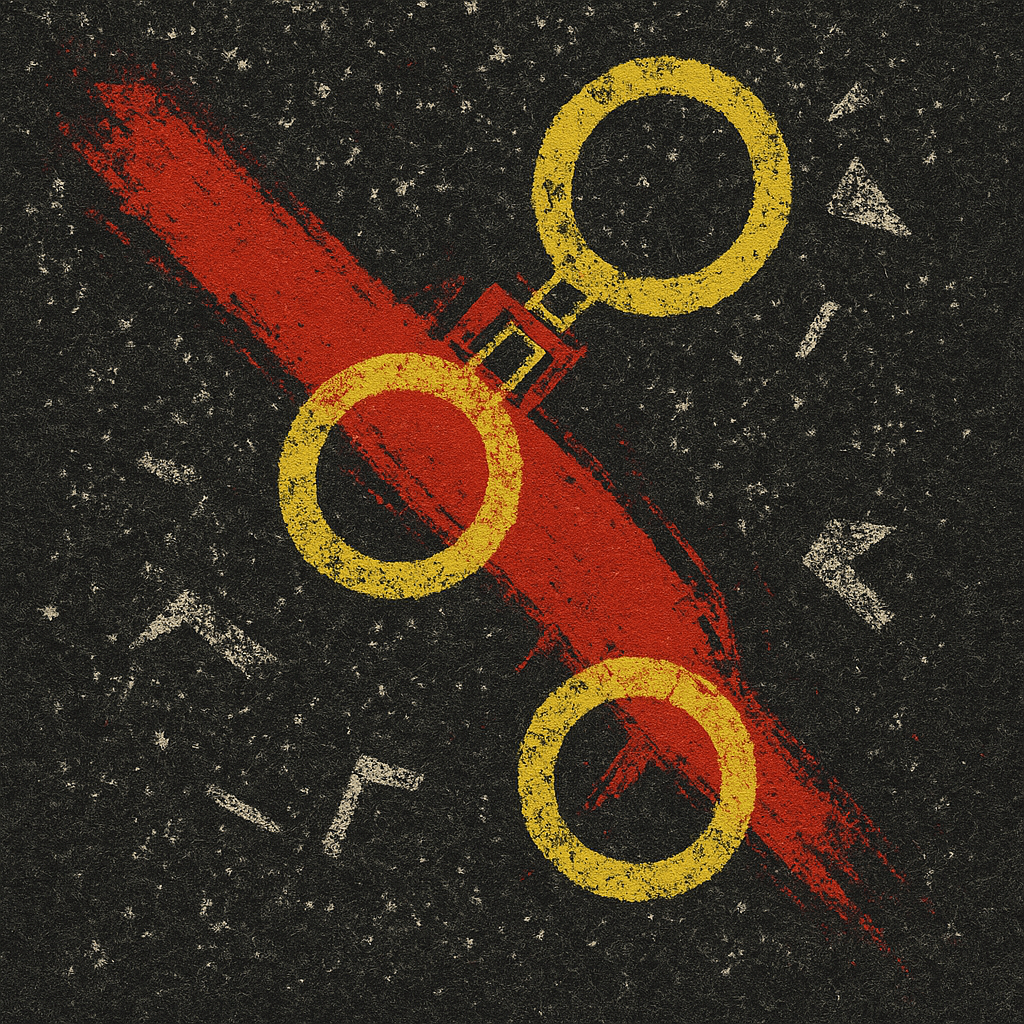
Here, the system fails more profoundly to communicate the batch’s thesis. The core iconography—a bold diagonal red streak, three linked yellow rings—evokes neither recursive event nor memory overwriting. Instead, it reads like a deliberate, al