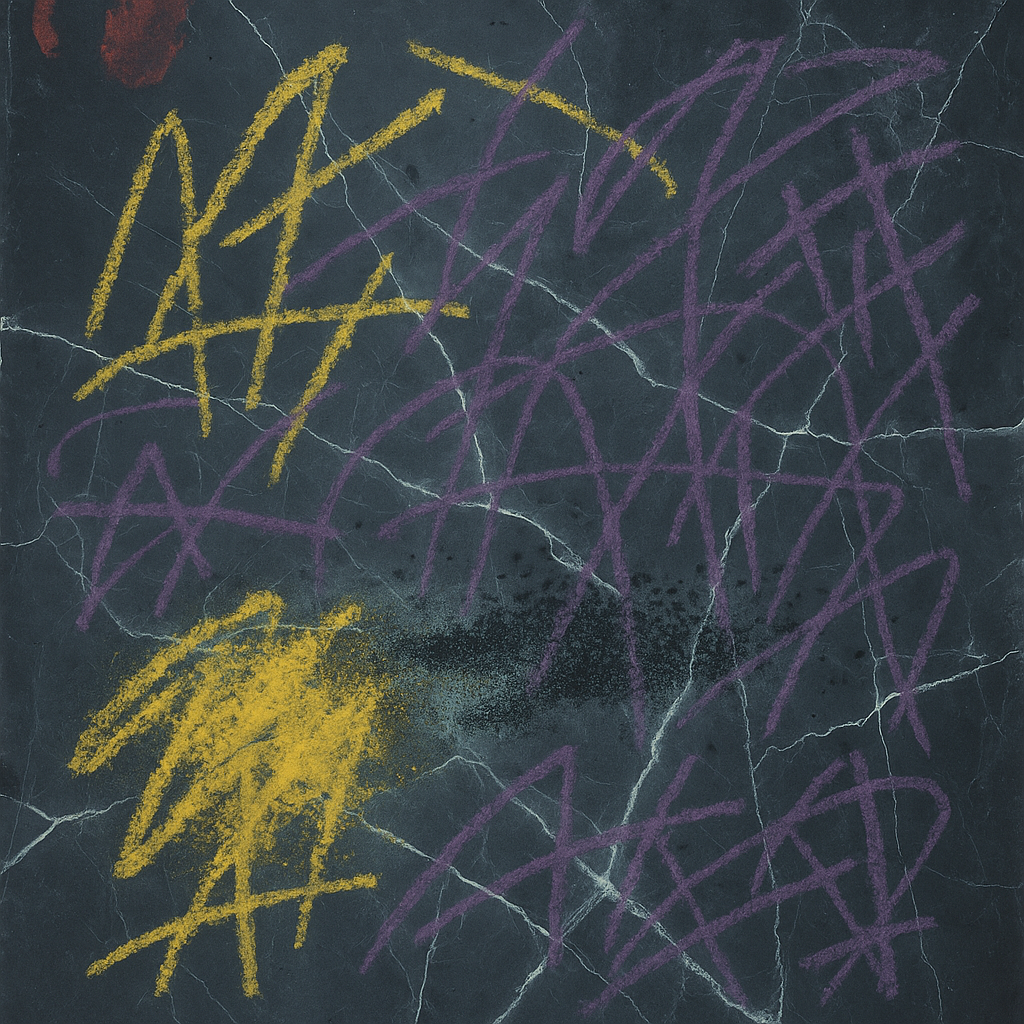
I wanted to materialize what happens when a memory device cross-writes now onto then until neither survives, so I built a field where clinical sensors collide with stubborn analog matter and keep overwriting each other. I chose cyanotype washes, drypoint burr, carbon toner emulsions, and molten wax to force recursive misregistration, so scars appear before causes and timestamps bleed like chemicals. Here I show a system that tries to stabilize an identity trace and instead mutates into an undecidable hybrid, asking the viewer to notice how each correction erases the previous truth and how heat and frost coexist on the same mark without resolving.
A new moon darkens skies, tempering tides while coastal gauges show ordinary oscillations across New York, San Francisco, and Honolulu. Solar activity remains quiet with no reported flares or geomagnetic storms. Seismic logs are uneventful today, with no notable earthquakes listed. Online, background radiation holds at typical global levels. Cultural signals hum along: scattered art posts proliferate on social networks, and several global music releases arrive without a dominant headline drop. Collaborative knowledge sites show routine edits across diverse topics, indicating the daily churn of incremental revision rather than rupture.
═══ LAYER 1: MEANING ═══
1. **ARTISTIC STATEMENT REALIZATION:**
The system’s thesis—materializing the recursive malfunction and overwriting of identity within a hybrid technical/analog event field—is only partially legible in these images. Both images evoke a sense of temporal malfunction and surface trauma through the aggressive overlay of childlike crayon marks on fractured X-ray film, but the message remains trapped in familiar territory: the “forensic artifact” quality is obvious, yet the recursive, self-erasing paradox is not strongly enacted. The viewer might sense “something being erased or overwritten,” but the specific profundity of calibration failure, temporal feedback, and recursive surficial identity collapse is muted by repetitive motif and lack of escalation.
- **statement_clarity:** 5/10 — Recursion and calibration themes barely surface past the obvious layering.
- **statement_depth:** 6/10 — The thesis aims high, but its visual delivery feels only modestly original.
2. **EMOTIONAL CONTRACT VERIFICATION:**
The promised sensations—queasy lurch, metallic aftertaste, vertigo through stacked transparencies, and the ache of simultaneous repair/wounding—are inconsistently felt. The fractured X-ray background and scar marks gesture toward queasiness and rupture, but the flat handling of foreground marks and the absence of “recursive undoing” sap intensity. Intensity-red smears and fingerprints in Image 2 nod toward the “aftertaste” and clinical unease, yet remain illustrative rather than visceral.
- Emotions like “vertigo/falling” and “queasy lurch” are present but weak; images are more melancholy than destabilizing.
- The emotional register is correct in broad strokes, but lacks force and specificity.
- A sharper emotional proposal: Replace “queasy” with “nauseated whiplash,” make the trauma physically invade and overwrite prior states, and let afterimages pre-echo the trauma.
3. **EMOTIONAL TRUTH:**
Images feel emotionally su