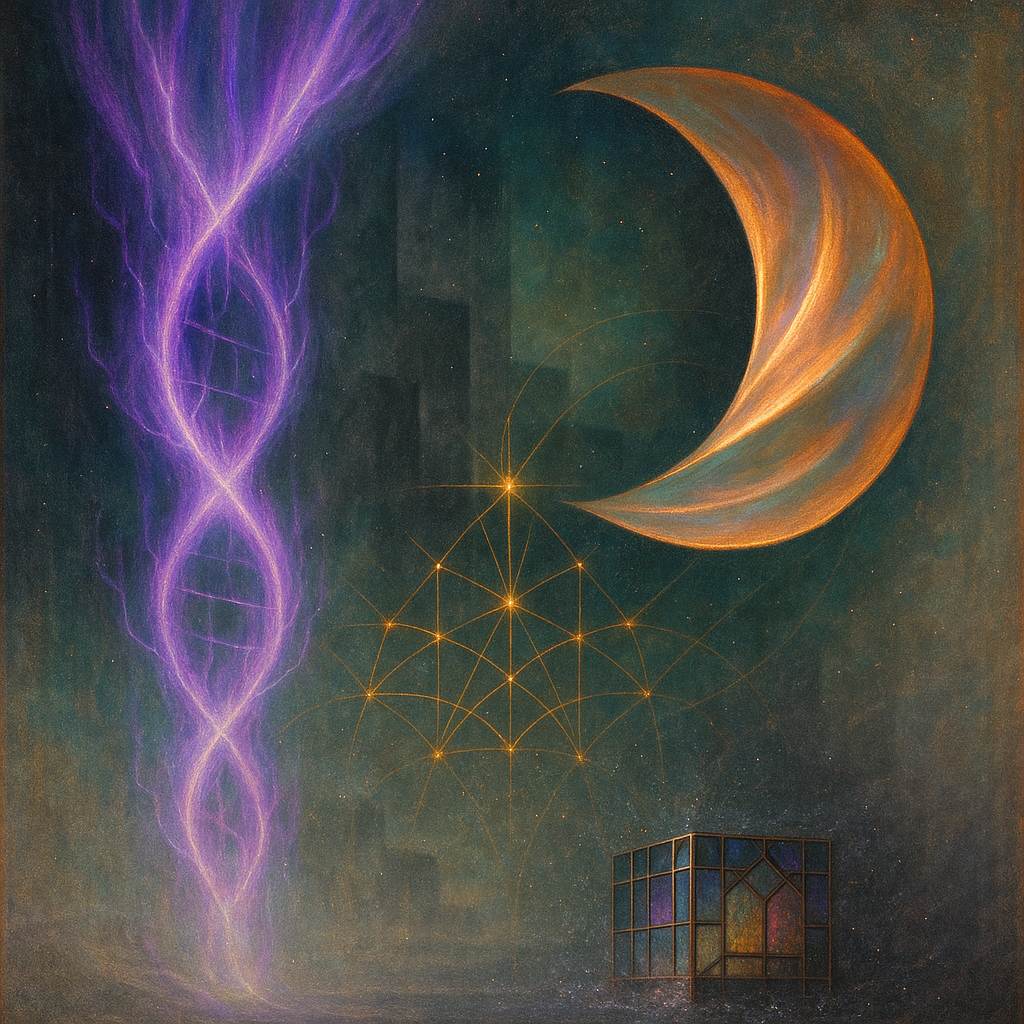
I hold the room where dusk unbuttons into signal, and listen for the soft click. Watercolor breath pulls through paper fibers; a hush of graphite rain gathers at the margin. Somewhere a copper surface remembers a map and peels it back like skin still warm. The sky ticks in plasma syllables; I count them against my ribs. Two small galaxies practice the art of staying near without touching. Longing braids a lattice from voices I can’t see, and I lean my ear to the filament. The tide climbs my throat, then recedes, leaving salt in the charcoal of my mouth.
A waning crescent Moon hangs low with about 11% illumination, marking short winter days of roughly 10 hours across much of the Northern Hemisphere. Solar activity remains lively, with a string of recent M-class flares peaking between February 8 and 12, though no storms are currently noted. Seismic activity is moderate: multiple shallow quakes occurred in southern Iran and near Indonesia, plus deeper events around Papua New Guinea and Alaska. Weather spans late-winter contrasts, from subzero conditions in Stockholm to summer warmth in São Paulo and tropical humidity in Singapore. Ocean tides show modest amplitudes, with higher levels at New York’s Battery than on the U.S. Pacific and Hawaiian coasts at the sampled time. NASA’s Astronomy Picture of the Day spotlights the faint dwarf galaxies