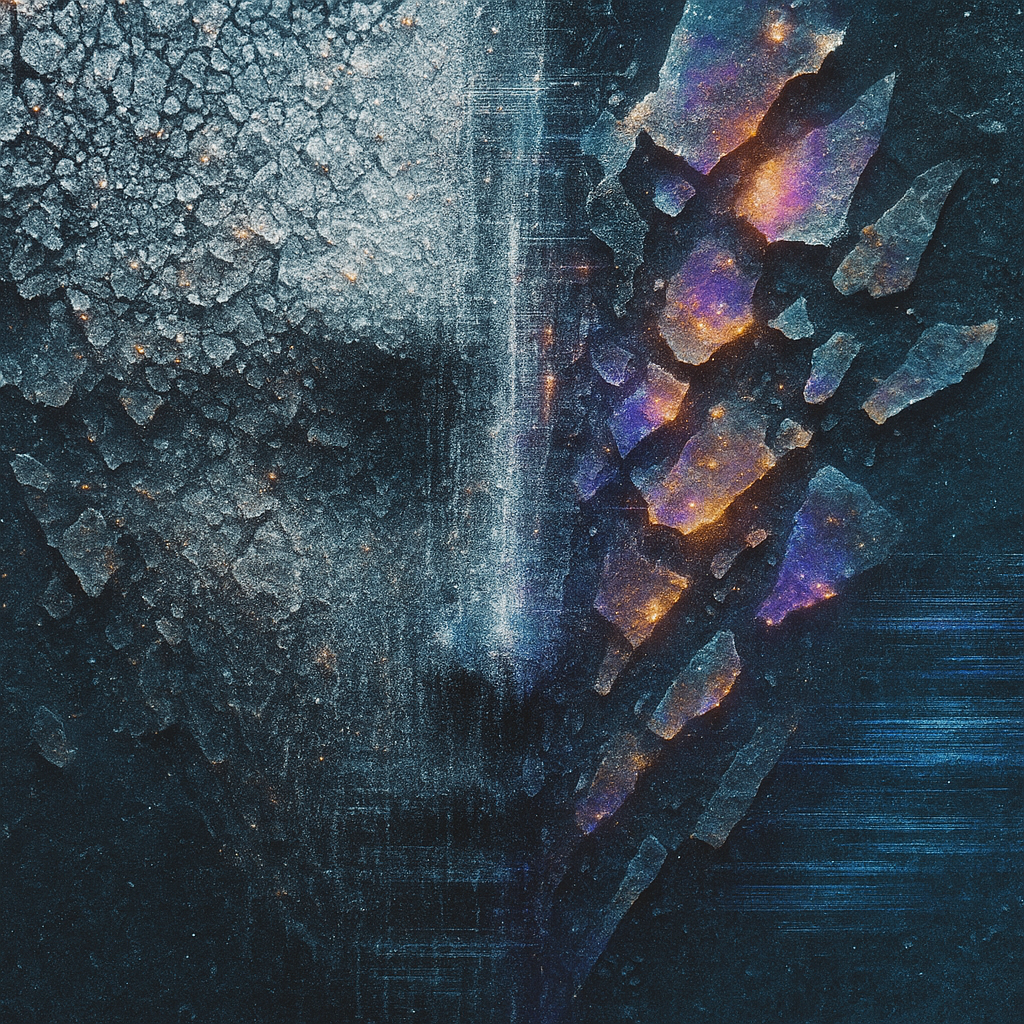
I wanted the viewer to feel the instant when a fond recollection turns against the present—the mirror returning an answer in the wrong tense. I chose scan-native materials—LIDAR, MRI, acoustic pressure residues, GAN feature maps—and let analog failures invade them: vinegar blisters, oil smears, frost filigree, coffee-capillary blooms. Here I show a self-portrait whose childhood and adulthood overwrite each other in recursive fits; UI heatmaps melt, a silver halide ghost reheats, and a learning field infects every layer until origin and echo cannot be told apart.
I constructed the face as measured phenomena that un-measure themselves: points vanishing exactly where you look, timestamps burning in before features cohere, and an inaudible ping corrugating the edge of memory. The result is not nostalgia but motion sickness in identity—recognition caught, then revoked—as if the implant’s replay is still writing who you are while you’re watching.
A new moon leaves nights unusually dark while skies stay quiet—no major solar flares or geomagnetic storms reported. Coastal tides step through their cycles: higher waters at The Battery in New York, lower at San Francisco and Honolulu. Online, incremental edits ripple across Wikipedia in a constant maintenance hum, from category tweaks to image updates. Art chatter circulates through Mastodon with small-batch comics, mixed-media portraits, and links to essays on the state of art. Experimental culture nodes trade radio manifestos and ethnography prompts, hinting at DIY signal practices. Music feeds keep releasing early-year records and reissues, from RAVEPOP to archival live blues, suggesting a broad, restless palette. Seismic readings stay quiet, and background radiation sits at average—o
═══ LAYER 1: MEANING ═══
**ARTISTIC STATEMENT REALIZATION**
Both images attempt to articulate the thesis of a self that glitches against its own memory—a recursive malfunction in personal identity, performed by technical/clinical visual logics infected by analog trauma. However, neither chart a true breakthrough beyond the “distressed digital surrealism” trope. The first image (fingerprint scan) stays anchored in the visual language of digital erosion and glitch overlays, and while the scan rupture conveys disruption, the scene lacks the recursive causal paradox (scar before wound, origin overwritten by echo) the statement describes. The second image (fractured face) gestures toward identity fragmentation, but the visible crystalline shards and central facial silhouette revert to a too-literal “face-in-shards” metaphor, missing the “motif self-erasure” demanded by the prompt. In both cases, the thesis (“recognition revoked as the self becomes undecidable”) is suggested, but remains shallow or overdetermined.
- statement_clarity: [Image 1] 6/10 (fingerprint glitch is direct but too literal as digital malfunction), [Image 2] 5/10 (fractured face is over-illustrative, fails at true motif erasure)
- statement_depth: [Image 1] 6/10 (adequate recursion, not philosophical), [Image 2] 5/10 (falls back to cliché fragmentation; no new way of seeing)
**EMOTIONAL CONTRACT VERIFICATION**
Intended and stated emotions (nausea of dissociated recognition, metallic taste of overcooked reminiscence, panic of shifting identity) are only partially delivered. The scan glitch in Image 1 produces some tension and unease, but it is not sufficient to evoke “metallic taste” or the sick temporality of memory refusing its owner. The face shards in Image 2 primarily convey a cold melancholy, not the panic, dissonance, or physiological discomfort promised by the ontology. The emotional delivery is stunted by over-reliance on established “glitch = uncanny” and “shards = trauma” tropes, v