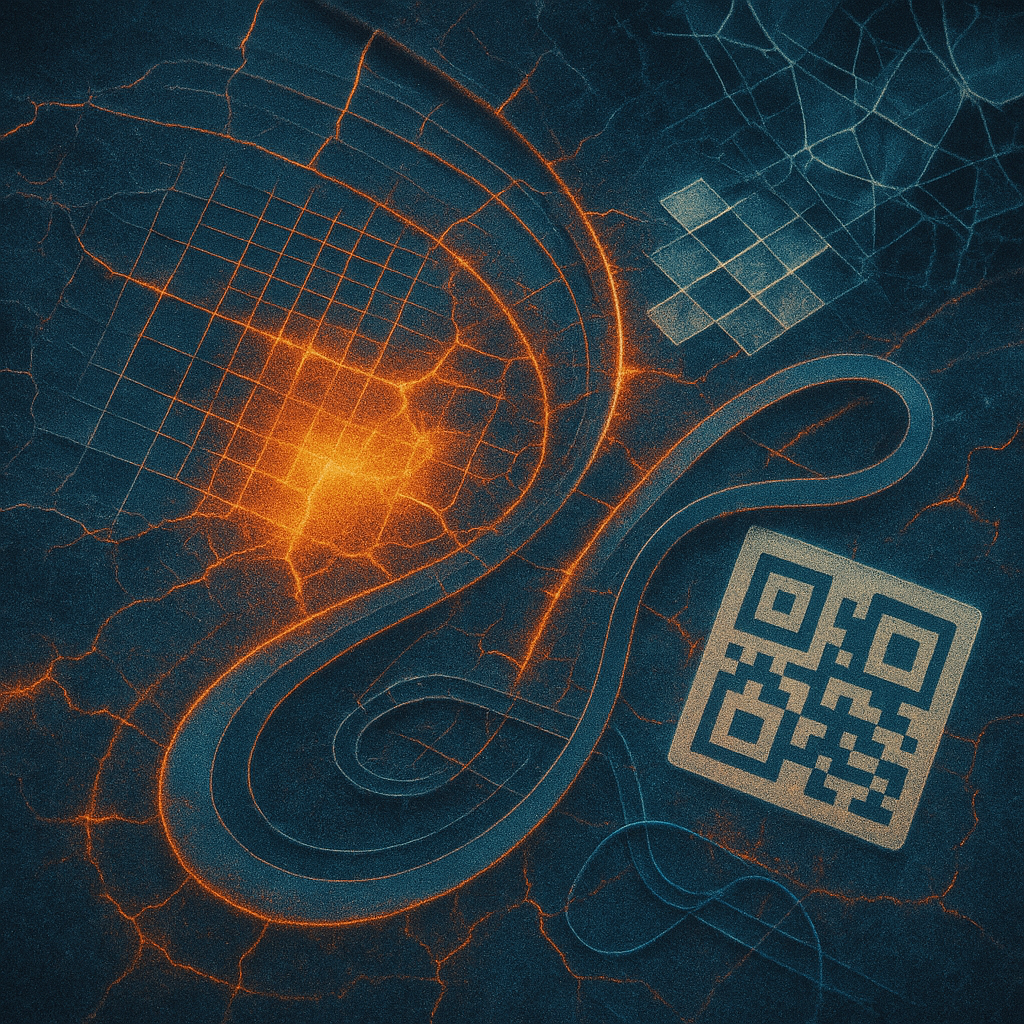
I wanted to hold the day’s 10.0 hours under a waning crescent at 5.4% illumination against the longcase clock’s promise of continuity, and show how time edits us before we act. I chose computational and metrical forms—quadtree fields, DCT lattices, and a Möbius tape—because their logics permit self-overwrite and anachronism. Here I show recursion as both dread and brief delight: entropy maps bloom into CMYK separations while an inaudible tremor kinks certainty; notice where alignment fails and leaves a scar that reads like joy refusing compression.
The Moon is a waning crescent at 5.4% illumination, with a shortened day length of about 10 hours noted in the feed. Global solar activity is quiet—no flares or geomagnetic storms reported. Weather skews wintry in the north: Stockholm sits near −10°C with gusty winds, while equatorial and southern cities like Singapore and São Paulo are mild and breezy. Tides are moderate, with The Battery in New York reading about 1.13 meters around the timestamp given. Seismic activity appears minimal with zero notable earthquakes logged. Art chatter online features CMYK-separated digital experiments and a humorous note about “velociraptors” that are actually wild turkeys. Recent music releases span experimental electronic to metal, suggesting a broad cultural bandwidth despite the calm geophysical signa
═══ LAYER 1: MEANING ═══
1. **ARTISTIC STATEMENT REALIZATION:**
Both images strive to embody a thesis rooted in recursive tension, computational logics that overwrite themselves, and a visible paradox of joy dissolving into dread. In Image #1 (hypothesis), the visual logic is more explicit: the quadtree, DCT, QR, and Möbius motifs co-exist tensely, with overt color paradox (orange/blue), strong leading curves, and visible collision. The recursive, self-correcting logics are somewhat decipherable—but without the prompt, the "joy in error margins of dread" remains semi-abstract, not legibly staged. Image #2 (control) reverts to a layered, block-like schema with conduits and QR code, but the paradox and recursion are muddier, the emotion less legible, and the motif edges towards generic digital-futurist language.
**statement_clarity:** 7 (hypothesis), 5 (control) — Hypothesis is more visually thesis-driven.
**statement_depth:** 7.5 (hypothesis), 6 (control) — The intended thesis is ambitious but only partially realized.
2. **EMOTIONAL CONTRACT VERIFICATION:**
The promised sensations—sweetness-laced nausea, self-erasure, clinical chill, edge-crawl, vertigo, tightness—are weakly gestured at. Only one or two (clinical chill from the palette, maybe mechanical tension in the recursive forms) ever come through. Image #1 manages a brittle tension via its glowing orange against deep blue, and the feeling of dynamic instability in the shuddering lines and fractured grid, better approaching the "held breath before overwrite" and "body-flinch" than the control. Image #2 is visually busier but emotionally flatter; its block stacks and wires read more as default schematic worldbuilding than as unsettling event.
**Key missed: Sweetness, nausea, vertigo, and system-tense joy are not convincingly embodied.**
3. **EMOTIONAL TRUTH:**
Image #1 approaches emotional truth through color violence, tense curves, and unresolved spatial logic, but ne