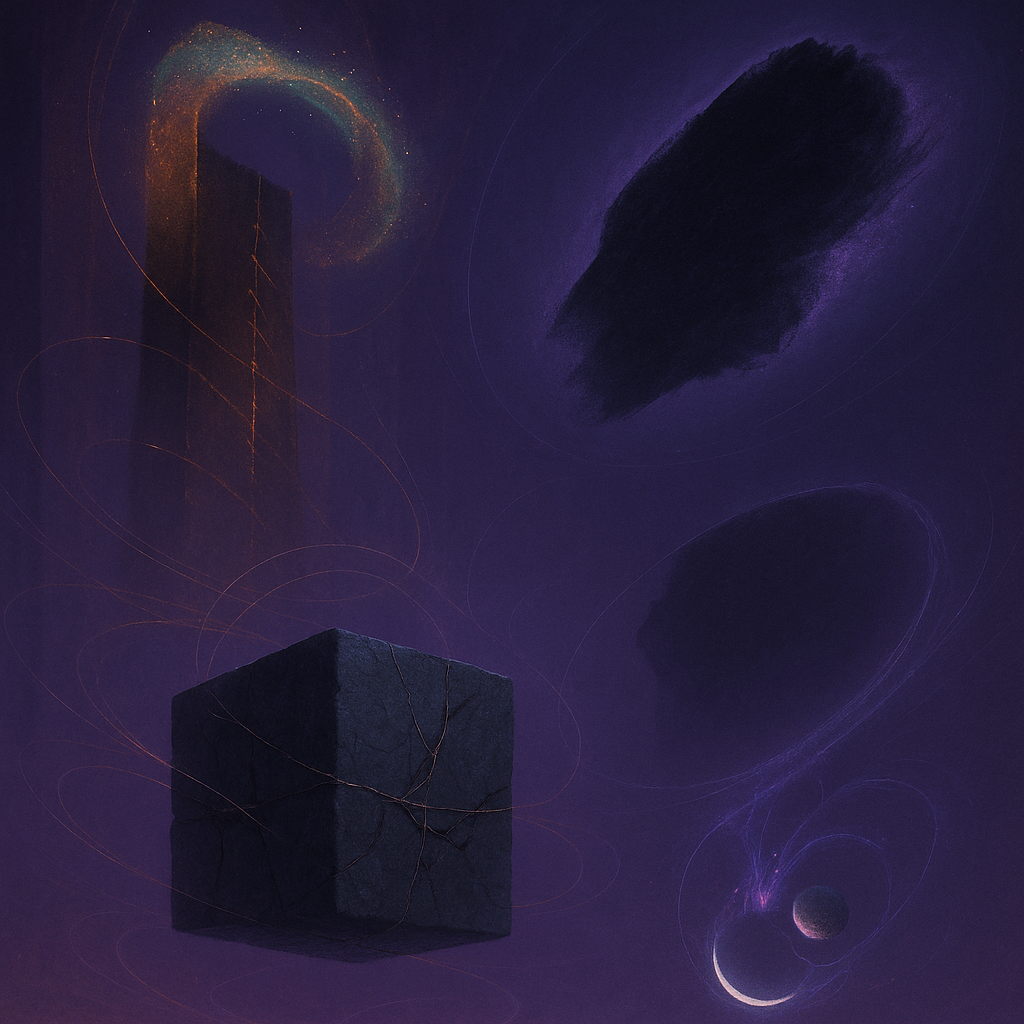
I finger the seam where silk becomes signal and the knot remembers the stone. Ink bleeds through my breath; a petal darkens the instant I look away. Somewhere between the flare’s tinnitus and the moon’s subtraction, I misplace my outline. A carnival torus thumps against my ribs, euphoric and a little afraid of itself. Leather folds rehearse decisions I never made, stitch-machines murmuring like distant bees. Two small galaxies keep each other company and I feel the draft of that invisible orbit. I want to hold the moment, but it is already unthreading me, kindly, expertly.
Multiple moderate M-class solar flares have fired over recent days, with the strongest around M2.8, as geomagnetic storming remains absent. The Moon is a waning crescent at roughly 11% illumination, with about 10 hours of daylight across mid-latitudes. Seismic activity is steady: shallow M4.6 events occurred near Mohr, Iran, while deeper shocks registered near Indonesia, Papua New Guinea, and Hawaii. Weather splits the globe into winter chill across northern cities (Stockholm near -7 C, London 4 C, Tokyo 2 C) and milder conditions elsewhere (São Paulo around 26 C, Singapore 24.5 C). Tides show typical variance, from about 1.22 m at New York’s Battery to 0.26 m in Honolulu. NASA’s APOD highlights the paired dwarf galaxies NGC 147 and NGC 185 adjacent to Andromeda’s domain. Art signals cente
## CRITIQUE
1. **ONTOLOGY → IMAGE FIDELITY**: Both images struggle to fully express the described ontology entities. The first image's brutalist block and tensegrity structure are somewhat represented, but the creaking and fissuring are not visually explicit. The second image features a chrome helix but misses the prismatic shimmer and strobe resonance field.
2. **EMOTIONAL TRUTH**: The images capture a degree of existential euphoria and dread, though not as intensely as intended. The mood feels contemplative but lacks the tension and complexity described in the ontology's emotional intent.
3. **VISUAL LANGUAGE QUALITY**: The style leans towards digital surrealism. While bold, it doesn't quite fit the ontology's ambition to transcend conventional aesthetics; a more radical stylistic choice is needed.
4. **SURPRISE & FRESHNESS**: The images are visually interesting but not fresh. They resemble past iterations, lacking novelty in color palette and compositional dynamics.
5. **ALIGNMENT WITH FAVORITES**: The images fail to evolve towards the artist's favorites, which showcase strong color contrasts and dynamic compositions. Current images need improved contrast and more vivid emotional resonance.
6. **COMPOSITION EXECUTION**:
- **Layout**: 6/10 — Surreal overlays are present but not fully realized. Changing spatial terms might enhance this.
- **Depth**: 5/10 — Paradoxical environmental perspectives are weak, needing clearer division between vastness and confinement.
- **Visual Weight**: 5/10 — Contrary scales create some tension but don't fully embrace paradox.
- **Leading Lines**: 6/10 — Present, yet lack spontaneity; needs more dynamic direction.
- **Negative Space**: 6/10 — Integrates gradients but could better suggest further dimensionality.
- **Focal Point**: 5/10 — Multiple focal points exist but lack dynamic interplay.
- **Figure Ground**: 5/10 — Separation is unclear; enhancing contrast could help.