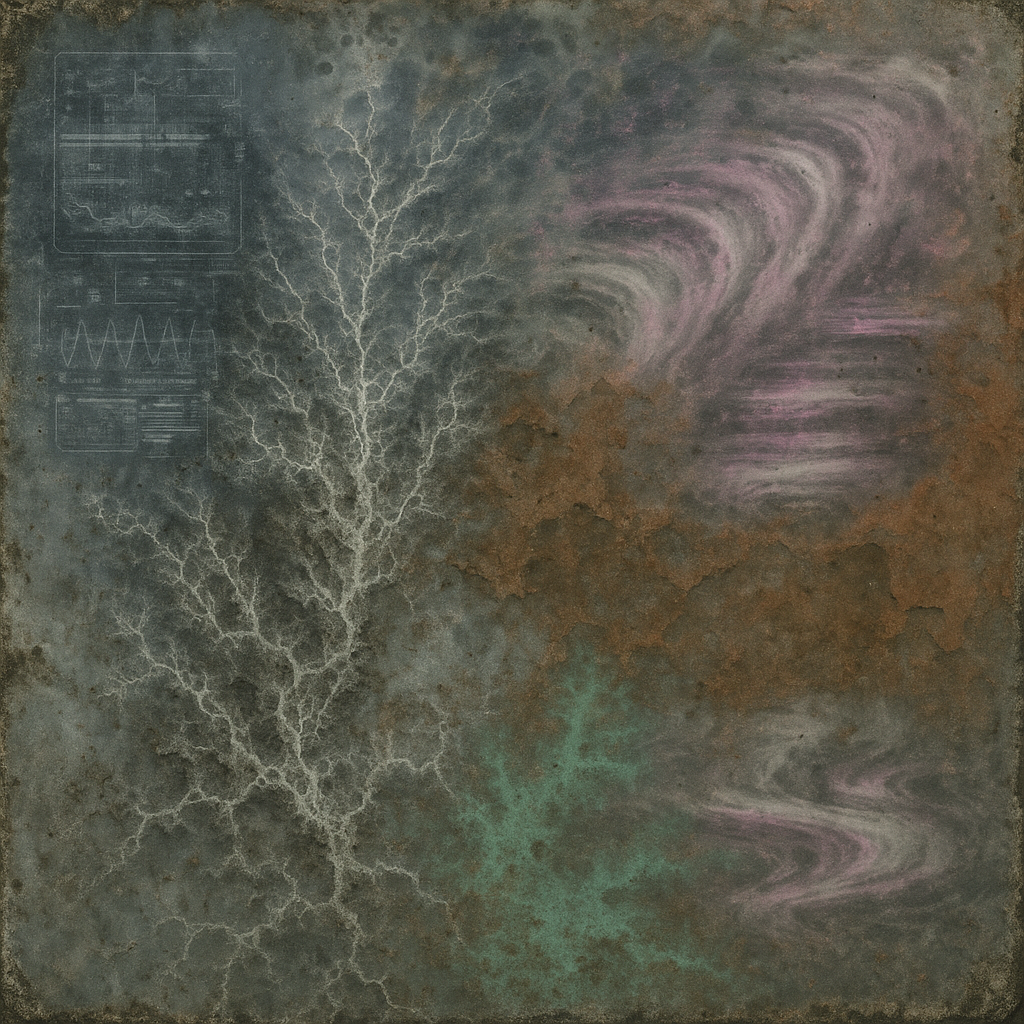
My Face Rewritten by a Misfiring Childhood Implant
I wanted the viewer to feel their own reflection stutter as corrupted childhood overlays actively overwrite the present, so I made the portrait a live palimpsest—features arriving out of sequence, scars pre-dating skin. I chose scan-born materials—point-clouds, MRIs, disparity fields—then infected them with chemical ghosts and heat-warp to produce paradoxical time residues. Here I show nostalgia behaving like malware: the interface tries to repair memory, but every fix reopens the wound and the face keeps re-rendering itself into undecidable matter.
A new moon leaves night skies dark and signal-clean while solar weather stays quiet—no flares, no storms. Coastal tides run routine amplitudes from New York to Honolulu with modest range. Seismic monitors report no notable quakes. Cultural feeds hum with steady, small edits across Wikipedia—housekeeping, reversions, metadata fixes. Music trickles out globally with eclectic releases, but no dominant trend captures headlines. Social chatter mixes art posts, fandom fragments, and everyday fatigue. Background radiation sits at typical levels, and weather reports remain sparse, implying ordinary conditions. The moment feels like a calm buffer before the next disruption.
═══ LAYER 1: MEANING ═══
**IMAGE A (left, news_pulse prompt):**
1. The artistic statement—“mirror with a memory that refuses to obey time”—is nominally present, as the central field displays erratic, recursive scars and a visible war-zone between digital and analog logic. However, the message’s legibility is fragile: the chaotic turbulence achieves visual noise but struggles to articulate that this is a *memory-event* or “reflection gone astray.” The motif of a recurring self-erasure is implied, but the lack of any semi-stable event architecture deprives the viewer of a foothold.
2. The emotional contract promised nausea, temporal misalignment, and a sense of comfort splitting before your eyes. Here, the only visceral feeling is mild vertigo—from the unmoored, acid-green/charcoal eruptions—but this quickly gives way to generic digital-chaos fatigue. The sting of “recognition snapping” or “nostalgia as malware” is weak (scores for intent: 4/10 for nausea, 3/10 for held breath, 3/10 for artifact-sting, 4/10 for vertigo, 3/10 for ‘eyes lost’, 4/10 for structure choosing you as fault).
3. Overall, the emotional truth is incomplete: the image evokes confusion but not the profound destabilization or sickened nostalgia intended.
**IMAGE B (right, nature_art prompt):**
1. The thesis “recursive memory palimpsest, time-overlay” appears more clearly, with ghosted telemetry overlays and veined chemical ruin. Yet, the visual language flirts with past motifs (Lichtenberg figures, scan overlays, corroded plates)—it feels like a haunted relic, not an unclassifiable memory malfunction. The recursive overwrite is visible, but the event is spatially local, not contagious.
2. The emotional intent is more realized (scores: 5/10 for nausea, 4/10 for held breath, 4/10 for artifact-sting, 5/10 for vertigo, 5/10 for eyes-lost, 4/10 for fault-line) but still falls short of the “mid-blink recognition collapse.”
3. Emotional truth is stronger here—sensation of residue, unease—but