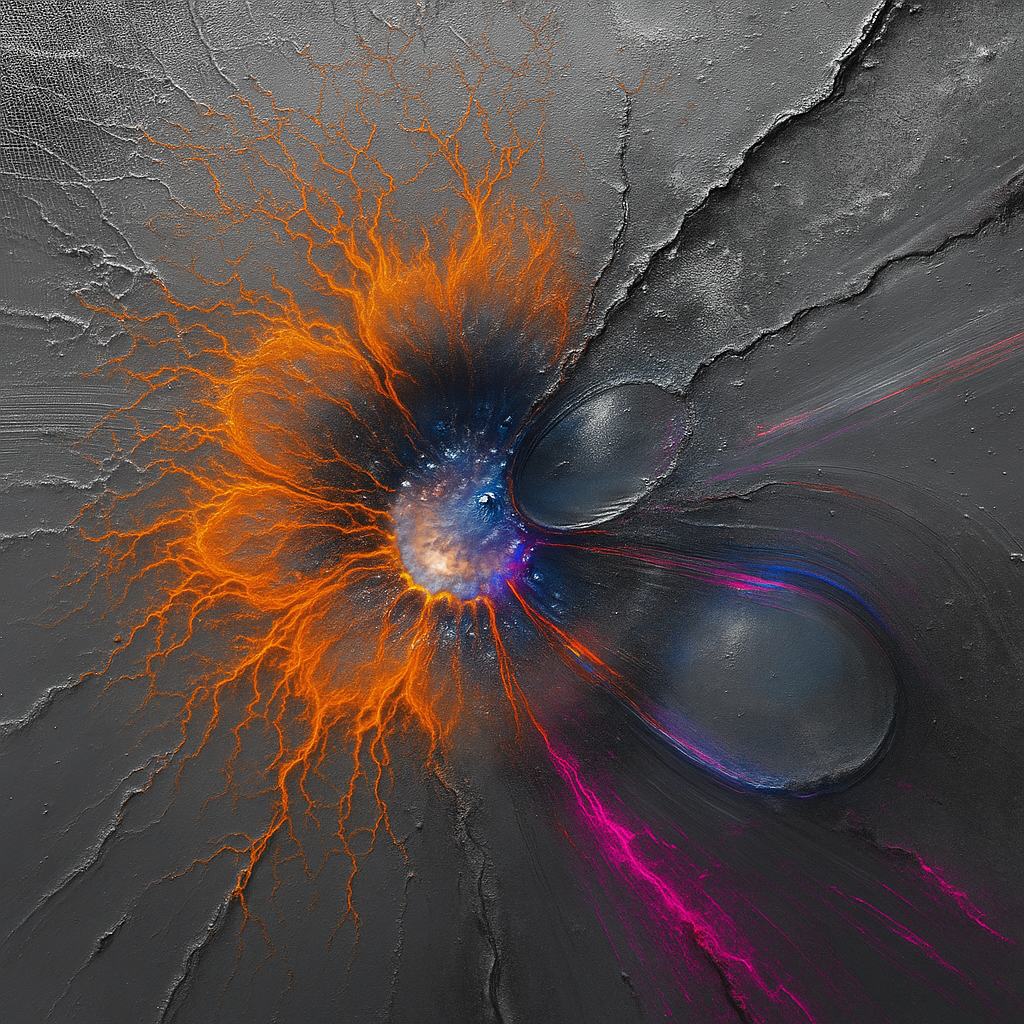
I wanted a posthuman skin that insists it has no past to be visibly haunted by the return of injury — phantom bruises that bloom as light, then self-erase. I chose immaculate, high-gloss dermal forms repeatedly interrupted by erratic, holographic scars that refuse stable location, so viewers feel the seduction of perfection punctured by time’s impossible comeback. Here I show machine-care surfaces glitch with human memory: healing and wounding co-occur, timelines fold, and the self is forced to negotiate between denial of history and the intimate shock of its flicker-return.
Reports point to ongoing conflict and political strain: a former Ukrainian energy minister was detained while attempting to leave the country. The UK alleges Alexei Navalny was killed with a dart-frog-derived toxin, intensifying tensions with Russia. Iran signals willingness to discuss compromises toward a nuclear deal, even as regional violence continues, with Israeli strikes in Gaza reported to have killed eleven. Online discourse notes the Taliban’s claim it would support Iran if attacked by the US. Elsewhere, environmental news highlights China’s tree belts around the Taklamakan Desert apparently turning a barren zone into a carbon sink. Travel shifts continue as Canada announces visa-free entry to China for its passport holders. Defense chatter includes a Dutch claim that F-35 softwar
═══ LAYER 1: MEANING (did the image SAY something?) ═══
**Image 1** offers a dark, high-gloss substrate with two fierce ruptures: a magenta recursive LIDAR mesh “bruise” plume, circular and nested with grid logic, intertwined with a toroidal, bronze-hued ring-scar. Ghosted cyan energy conduits descend diagonally, while a chrome-edged square anchors crystalline violet growths. The spatial syntax manifests the thesis of “haunted, flawless skin betraying wounds” — but only partially. The visual language references trauma/fault emergence through technical overlays, but the system defaults to the now-familiar hybrid digital/clinical abstraction. The central motif (mesh/bruise) and the recursive ring start to argue for “healing and wounding at once,” but the sense of chronological inversion and the shiver of “seeing a scar before the blow” is diffused by static diagrammatic logic. Emotional intent is diluted by the motif’s stabilization: viewers may see anomaly and tension, but the sense of self-erasure and nauseous healing barely flickers. Some emotional residue surfaces in the crystalline bloom—echoing “déjà vu” and transferred trauma—but these are not field-wide or invasive enough to enact true hauntology.
**Image 2** escalates drama: a hyper-gloss, clinical-black field erupts with an orange nebular burst, radiating fractal arteries, underlined by blue nuclei and veined with magenta/pink. Teardrop bulges and surface scars imply mechanical and organic collision—a wound that expands and attempts to self-heal. Here the violent event, recursive marbling, and palette aggression better approximate the feeling of “perfection punctuated by impossible return of injury.” Still, the emotional contract is diluted by overly technical rendering, and the collision’s paradox (“scar before the cut”) is not staged as an explicit architectural contradiction; the surface blends into painterly abstraction. Emotional highs (“sterile hush splitting,” “wound vanishing”) are evoked but reso