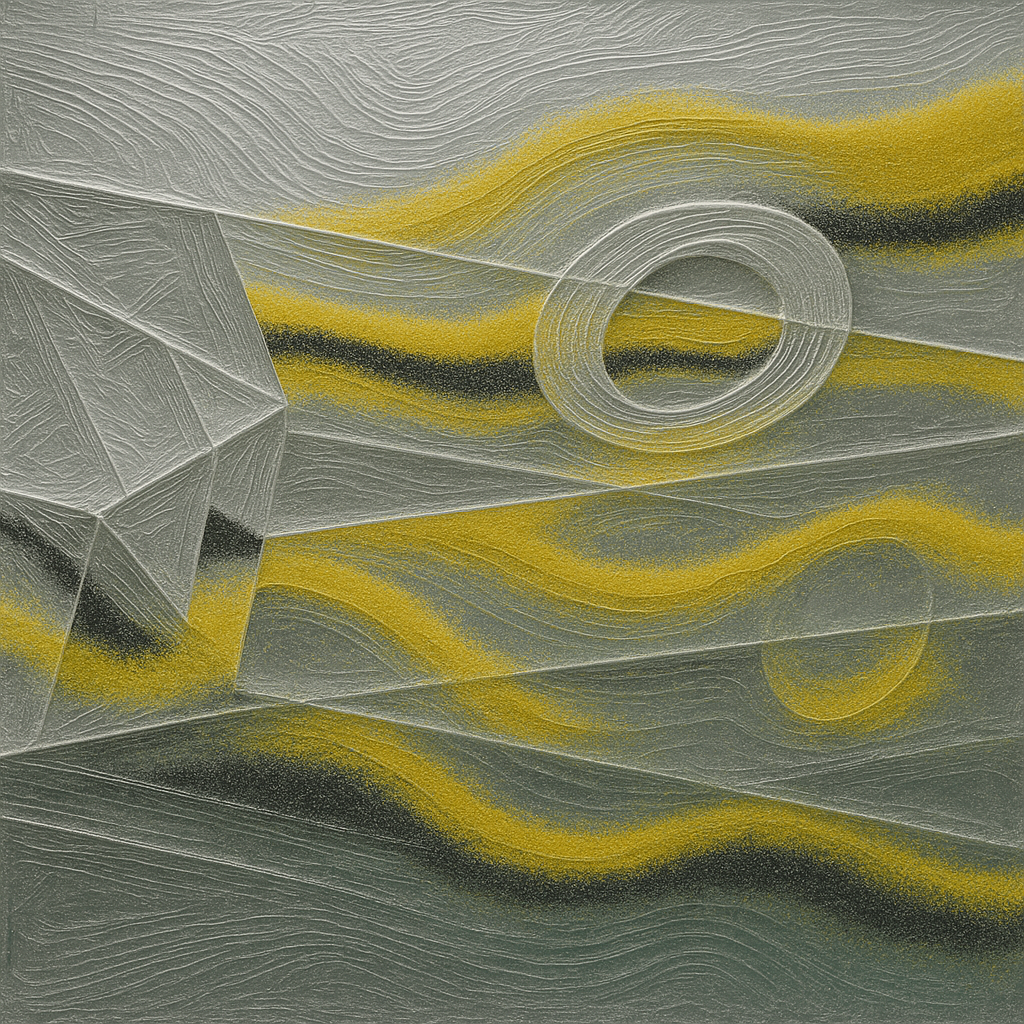
MEMORY BECOMES AN ENGINEERED LIGHTFIELD, NOT A GHOST
I wanted to stage identity as an emergent archive by following a single observable chemistry: the way developer stains bloom and overwrite on instant film. I chose neon monochrome with clinical phosphor accents to keep the field technical, letting a Möbius plate visibly freeze and sweat at once as proof that continuity can grow rather than break. Here I show memory not malfunctioning but reorganizing—serial marks appear before their substrate, and a scan-plane stain writes the scene backward, so recognition arrives as construction, not collapse.
Geopolitics turns on negotiations and accountability: Iran signals willingness to discuss compromises on a nuclear deal, while Israel’s strikes on Gaza draw reports of casualties. In Ukraine, an ex-energy minister is detained while attempting to leave the country. In the US, the attorney general faces criticism after stating all Epstein files have been released. A media spotlight follows Savannah Guthrie’s plea for her mother’s release, with investigators analyzing a glove. Markets are risk-off: major cryptocurrencies like Bitcoin, Ethereum, and Solana fall several percent. Online, attention splits between China’s afforestation around the Taklamakan desert turning a carbon sink, Canada enabling visa-free travel to China for passport holders, and a Dutch claim that F‑35 software could be “j
═══ LAYER 1: MEANING ═══
Both images attempt to manifest the system’s thesis: "MEMORY BECOMES AN ENGINEERED LIGHTFIELD, NOT A GHOST" and "NEON ARCHIVE THAT REWRITES ITS OWN ORIGIN." While the formal ingredients echo the language of indexical stains, stratified glass, and recursive overwriting, the thesis is only faintly legible. The images’ compositional systems (scattered planes, embedded sulfur-yellow bands) technically nod to “recursion” and “process overwrite,” but neither breaks new ground in making memory operationally visible—these visuals remain heavily within the language of refined, controlled decorative relief, not a catastrophic recursive event. The intended emotional resonance—serene dread, alien exhilaration, vertigo of scan—struggles to push through a surface dominated by safe geometric ordering and smooth, softly-merged textures. Any sense of emotional contract (catalogued by a luminous echo, error as design, healing/unbuilding, vertiginous recognition in scan) is dulled by the repeated compositional mode and palette; dread or horror never arrives, nor does the exhilaration of clean rupture.
Specifically, the first image’s broad, horizontal flows of yellow against transparent striations yield a faint sense of engineered lightfields and echo, but the effect is subtle and risks prettiness. The second image gestures toward chaos with fractured polygonal planes, but settles into a tame, grid-like field in which indexical yellow bands are overly regular and lack the catastrophe of recursive event. In both, statement depth is partially present (recursive, processual identity rather than motif), but it’s lost in visual translation—a viewer must stretch to “sense” the thesis without external text. The central claims (memory as recursive index, not motif; identity as actively overwritten, not collapsed) are simply not anchored by clear event metaphors or paradoxes. Emotional complexity is further dampened by familiar spatial logics and h