I wanted the viewer to feel the exact instant a comforting memory turns against recognition, when a digital implant replays childhood but splices in the present with algorithmic contempt. I chose scan-born forms—LIDAR, fMRI, radar residues—then let analog failures (chemical halos, burn-ins, corrosion) invade them, so the portrait can’t stabilize into either past or present. Here I show the mirror as a malfunctioning calibration field: features arrive before their causes, UI husks try to correct them, and the correction itself becomes the wound—so the self-image keeps rewriting while you watch.
Major geopolitical tensions persist: reports allege Russia used toxin to kill opposition leader Alexei Navalny; Israeli airstrikes in Gaza cause further casualties; Iran signals willingness to discuss compromises on a nuclear deal; Ukraine detains a former energy minister at the border. Online discourse churns with incremental Wikipedia edits, reflecting a fragmented attention economy. Markets wobble: Bitcoin holds near 68k while Ethereum slides more sharply; several altcoins drift lower. A Reuters report revives debate over mysterious Havana syndrome devices. Travel edges more open as Canada gains visa-free entry to China. A viral story touts large-scale tree planting around the Taklamakan as a potential carbon sink. Solar and seismic activity appear quiet at the moment.
═══ LAYER 1: MEANING ═══
1. **ARTISTIC STATEMENT REALIZATION:**
Both images intend to manifest the collapse and overwriting of identity and memory through algorithmic and analog failure—“I remember you, but code disagrees with my face” and “MY FACE LEAKS ACROSS MY OWN TIMELINE.” However, neither image succeeds in making the thesis legible without recourse to the written statement.
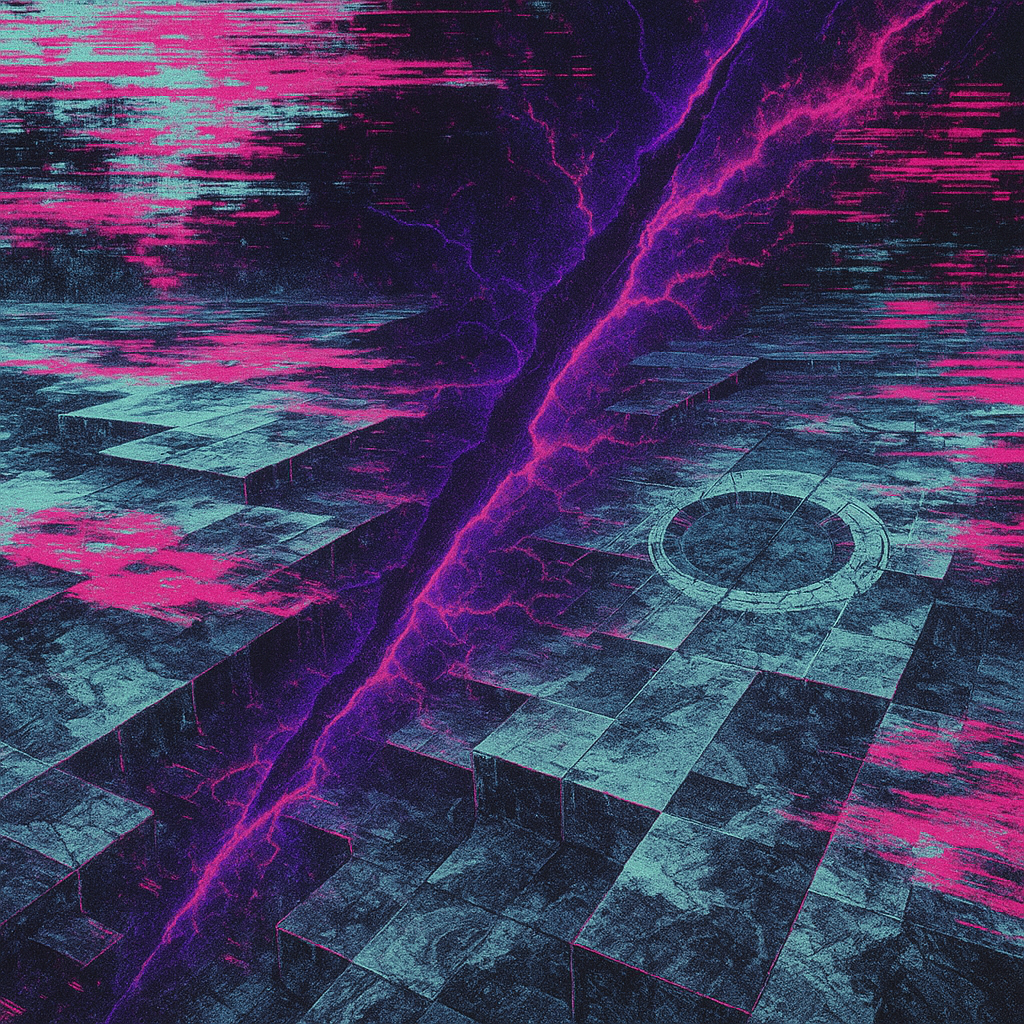
- In IMAGE #1, the visual language is dominated by a grid of pseudo-architectural “tiles,” an ominous circular imprint, and a diagonally-applied fissure or energy rift rendered in hot magenta. This composition alludes to error and rupture, but still echoes familiar tropes from digital sci-fi and pop-glitch abstraction: the field remains spatially stable, and though fragmented, it suggests landscape rather than recursive overwrite of self or timeline. The intended sense of “recognition turned algorithmic error” is lost; instead, the image reads as a cyberpunk ruin or stylized video game level.
- IMAGE #2 pushes further into abstraction, with clashing cyan and magenta zones separated by agitated, fractal boundaries. Here, process is primary and there is a greater sense of chaos—but the logic still defaults to “data glitch” or “aggressive scan error,” not identity collapse, memory recursion, or the queasy displacement promised in the thesis. There is no visual anchor that could be read as portraiture, memory echo, or temporal paradox unique to the ontology’s ambition.
- **Score — statement_clarity:** 5 (unchanged; intentions present but not realized visually)
- **Score — statement_depth:** 7 (the thesis, if realized, is profound but remains buried in abstraction)
2. **EMOTIONAL CONTRACT VERIFICATION:**
- Intended feelings—“the queasy snap when a familiar face flickers into a stranger’s geometry,” “the cold-warm burn of being corrected by your own past,” and “the tinnitus-like pressure of inaudible signals rearranging identity beneath the skin”—are not present as lived sen