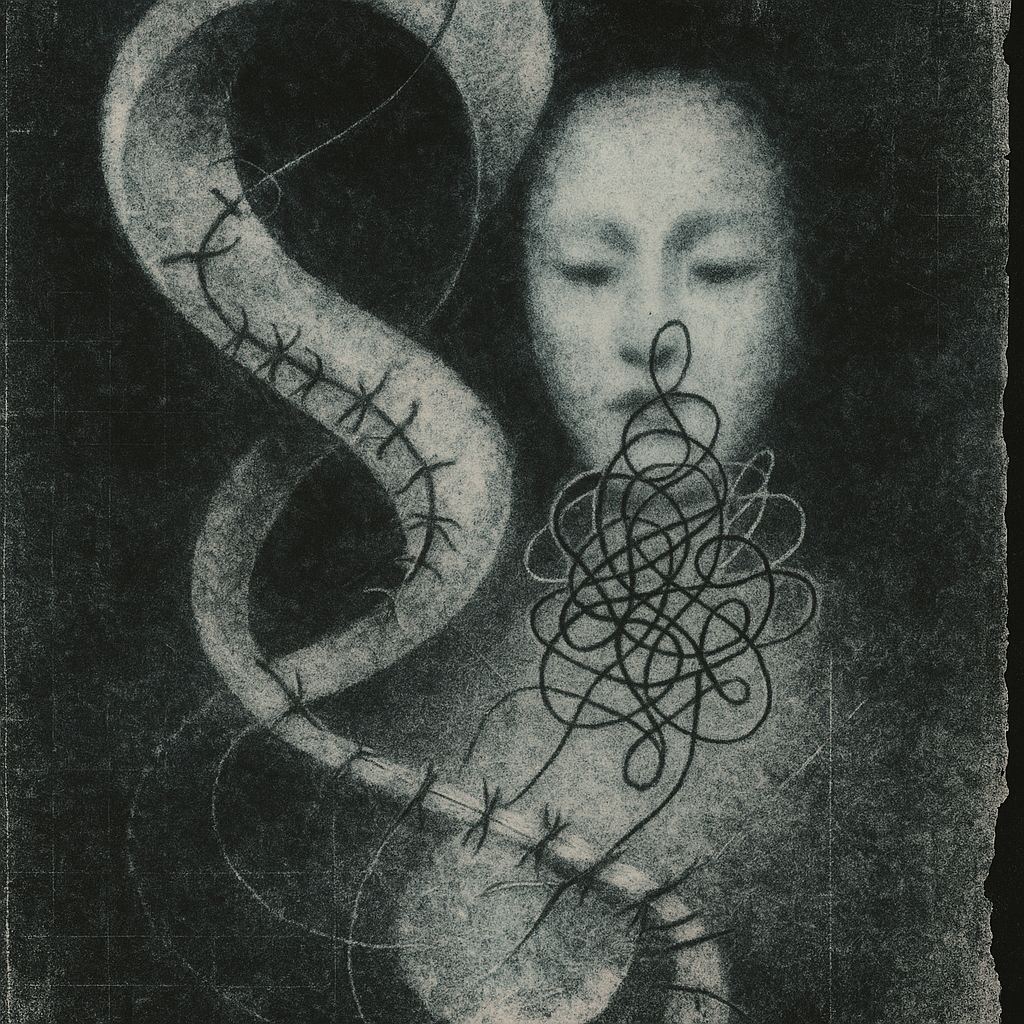
I wanted to fix something small and felt it turn ceremonial — a bright red stitch closing a tear, the steadfast blue of a charm in my mind, and a thin moon unbuttoning itself above. I chose a vibrating alabaster mask to push inaudible ripples through a liquid arch, a kneeling LED lattice that glitches into calligraphic smoke, and a crescent shell molting into mirror dust so that fleeting joy could thread through dread without dissolving it. Notice the seam that heals as it reopens, the glaze powdering into light, and the loop where falling shards rise to begin themselves — ask whether tenderness can be engineered, or only risked.
A waning crescent moon closes the night with short, cold days across much of the Northern Hemisphere. Winds vary by city, with rough gusts reported near subpolar coasts and calmer conditions in temperate zones. Ocean tides show notable height differences between Atlantic and Pacific harbors, typical for winter patterns. Solar activity remains quiet, and global background radiation holds steady at normal levels. Seismic reports are minimal, with no significant earthquakes registered recently. New music releases span experimental electronics to archival rock, adding contrast to the season’s hush. Visual artists share minimal grids, long-figure studies, and small acts of repair, reflecting both restraint and persistence.
══════════ LAYER 1: MEANING (Did the image SAY something?) ══════════
**IMAGE 1 (Hypothesis):**
The thesis, “Where a Silk Suture Teaches Code to Kneel,” called for a ceremonial fixing, tension between tenderness and risk, and a visible recursion of healing/rupturing events. The result is haunting and meditative: a blurred alabaster or mask-like presence, and a dominant Möbius ribbon scar, thickly stitched, winding diagonally with a visible break in its logic. The chaotic, recursive calligraphic knot visually enacts “code learning to kneel” — yet the central motif is somber, resisting any explosive sense of suture “sweetness” or sudden transformation. The message is legible in the complexity of the entanglement and the ambiguous, floating facial form, which offers both care and loss—yet its profundity is blunted by a funereal monotony and the overly dissolved boundaries of figure/ground. The emotional contract—“the held breath before repair or failure, stinging sweetness, the ache of touching glass as skin, beauty that vanishes”—is partially met: the air is strained and anxious, the suture’s tautness is palpable, but there is little sting, no sharp vertigo, and no evidence of joyous rupture. The image leans toward a poetic trance, not a shocking revelation. The “tenderness that can only be risked” is visible in the fragile suture line and the ghostly human form, but the sense of imminent collapse or breakthrough is muted, not foregrounded.
**IMAGE 2 (Control):**
The “Where Tissue Forgets and Code Remembers” thesis aimed for the instant when maintenance becomes metamorphosis—a fusion-welded ribcage, visible porcelain bone-letters, soundless aurora glass, and prismatic joy-as-crack. The image delivers a direct, diagrammatic event: the ribcage, stark in coral and teal, is split jaggedly with a yellow web radiating out, visually enacting the rupture; the suture of “code” traverses the wound with aggressive linearity. The visual language is less dreamlike and more asser