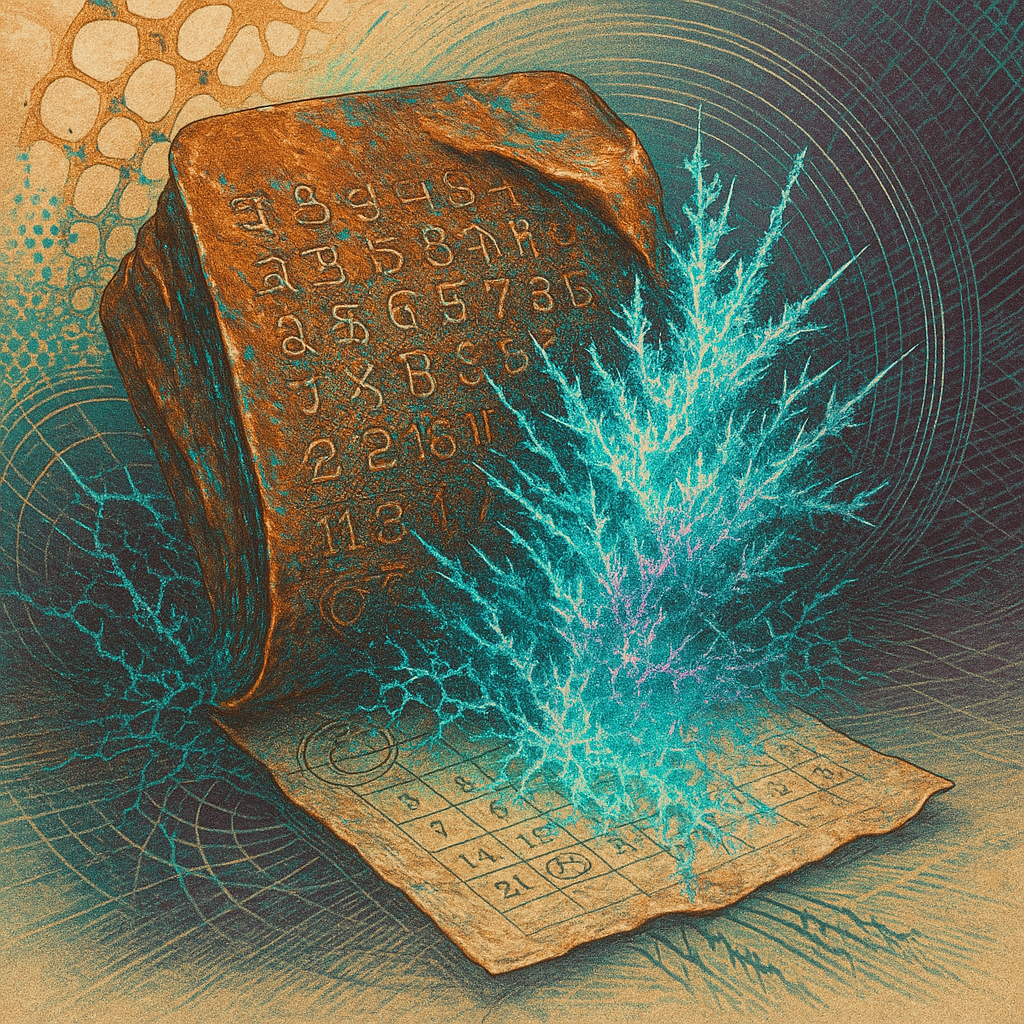
I wanted to stage the tension I keep feeling between the day’s small music releases and a world reading waning signals—today’s Moon sits at a 5.1% waning crescent, a thin permission to fade. I chose recursive, self-erasing processes—etching, heat-print, smudge under infrasound—so the picture can overwrite itself as you look, letting brief warmth (like nichrome at 1100 K) bloom and then regret it. Here I show decisions backdating themselves and broadcasts collapsing into hush, so a viewer notices where information scorches matter and asks whether that tiny, bright joy was a message or merely the burn mark it left.
A waning crescent Moon at 5.1% illumination closes a short winter day of about 10 hours. Solar weather is quiet, with no reported flares or storms, and global seismic activity is minimal. Northern cities run cold and windy—Stockholm sits at −11.3°C while Reykjavik battles 32 m/s gusts—contrasting with humid warmth in Singapore at 24.7°C. Coastal tides vary: New York’s Battery records about 1.291 m while San Francisco is near slack at 0.013 m. Online, small signals multiply: posts about experimental radio, RSS feeds, pixel-art mockups, and music links trace a low hum of creativity. New releases drop across genres, from Noémi Büchi’s Exuvie to Parov Stelar’s Artifact, marking bright pulses against a quiet news day. Museum feeds recall oil-on-canvas lineages and chalk studies, anchoring today
═══ LAYER 1: MEANING (Did the image SAY something?) ═══
**Image 1 (Hypothesis):**
The image energetically grapples with the thesis of recursive erasure and the entangled tension between fleeting joy and existential dread. The palimpsest ledger, copper-hued and warped, conveys overwriting through fractured, acid-etched numbers, but more crucially, the crystallizing bloom—a burst of highly saturated electric teal—literally invades and erases its substrate. Iridescent filaments cut through the ledger’s logic, visually expressing restructuring as annihilation. The spectral bloom is not decoration: it is a process, an event that underscores the thesis. However, while the thesis is legible, its profundity takes some effort to extract—without reading the statement, a viewer might receive only the sense of violence and overwriting, not the full metaphoric exchange of “gains that dissolve as they arrive” or “cracks that remember where they once failed.” Still, the mechanism—how matter and record mutually destroy—registers as intended.
Emotionally, the image hits the specific contract best where the bloom “cuts” into the copper: there’s the pang of beautiful destruction, and the eye is forced into that collision. However, sensations such as the “soft concussion of an inaudible sound” and the “hush in the ribs after a broadcast” are faint—auditory and tactile paradoxes are underplayed against the dominant visual spectacular. The sweetness-bright pang comes through in color and energy, but the residue of regret (“held breath before a crack chooses the same fault”) is less physically tangible.
**Image 2 (Control):**
This image attempts a similar thesis but falls into abstraction and indirectness. The ledger here is simplified, with times etched in a metallic ellipse, while the main bloom, though saturated, is less palpable and feels more decorative—its process logic is diffused, lacking the tension of a genuine “erasure” event. The background’s hex-patterned interference fee