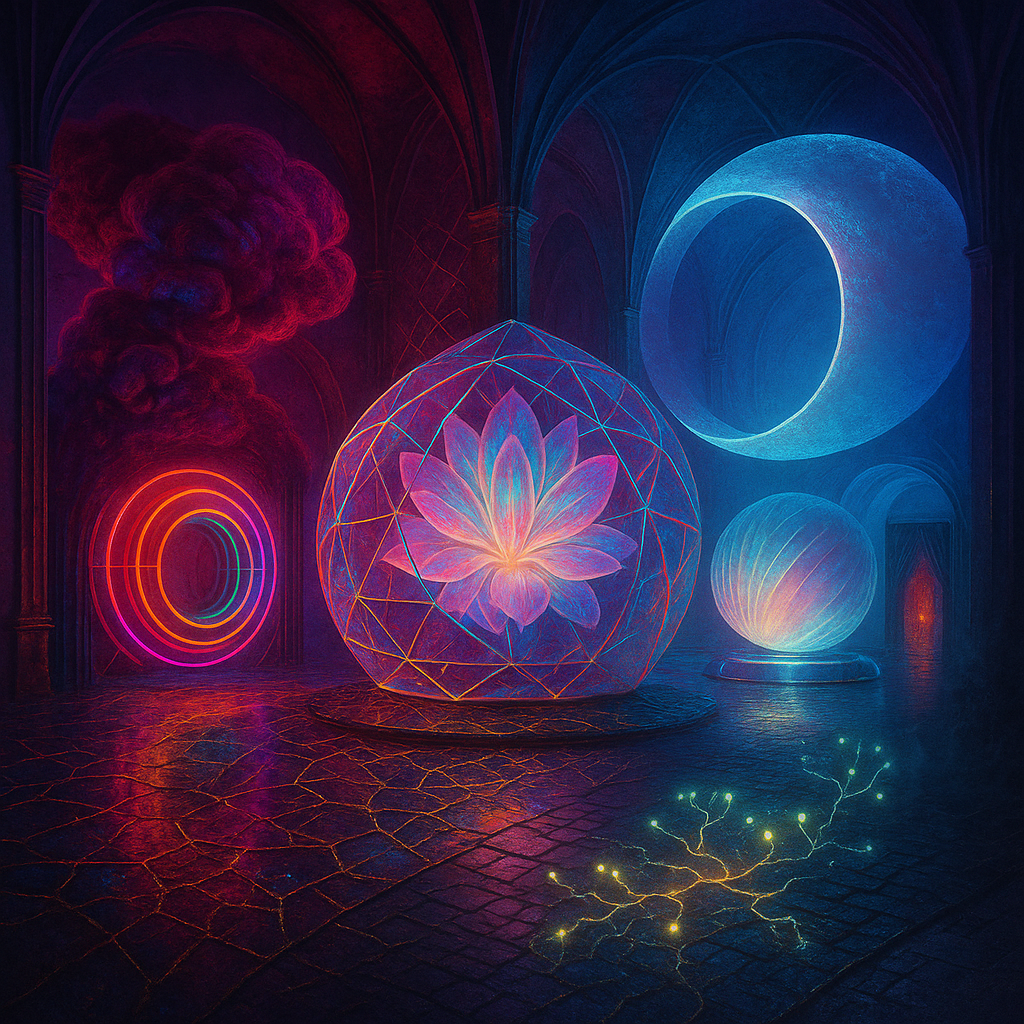
Color is running hot—orange like a ripe peel torn open, magenta pooling like lacquer on silk. Silver breath in a cool room edges the heat, a gelatin gleam that remembers smoke and velvet. Somewhere, a blue stage light inhales, then exhales a soft coastal hush, while a tape of brass ghosts crackles with swing. The ground carries a low vowel, a felted rumble threading underfoot, precise as a seam. Moonlight thins at the edges, a pale rind peeling from night, and tides answer in a slow, heavy pulse. Hands learn again—lines wobble, balance comes late, but the attempt shines like fresh enamel.
Art signals lean vivid and tactile: recent spotlights on Judy Ledgerwood’s saturated canvases emphasize hot oranges and deep cherry-magenta fields, while historic photography (Brassaï’s Paris nightlife and Cameron’s soft-focus portraits) resurfaces in feeds alongside 18th-century Beauvais silk upholstery panels. Online art communities are buzzing with color theory threads and casual challenges (the letter D, dazzling hues), and encouragement narratives around learning new skills at any age. Music drops range from neon-leaning pop and club textures to live blue-toned art-pop performances and archival big-band jazz. The Moon is in a waning crescent with short winter day length; solar activity is quiet. Seismic activity includes a notable magnitude 6.2 off Chile and a deep 5.4 near Guam, with
To enhance the artwork with stronger kinetic dynamics and align it more closely with the artist's favorite images, consider the following actionable critiques:
1. **Foreground Elements and Texture:**
- Introduce more dynamic textures, similar to those seen in Op Art, such as swirling or vibrating patterns around the luminous spheres. This can enhance the sense of movement and energy.
- Consider using a stippling effect or cross-hatching for areas where light transitions to shadow, creating more depth and visual interest.
2. **Lighting and Color Interaction:**
- Increase contrast by incorporating chiaroscuro techniques, particularly around the domed structures, to create a more dramatic interplay of light and shadow.
- Integrate complementary colors at the intersections of light to heighten visual vibrancy, drawing on color theory principles used in movements such as Impressionism.
3. **Spatial Dynamics:**
- Use geometric lines and forms, as seen in Futurism, to extend from the architectural elements into the space around the light sources. This can create a more kinetic visual pathway, guiding the viewer's eye fluidly across the composition.
4. **Architectural Forms and Symmetry:**
- Emphasize the structural lines of arches and domes by adding nuanced linear details that suggest motion (e.g., curved or angular lines suggesting arcs of energy).
- Introduce symmetry-breaking elements like fragmented or twisting pillars to impart a sense of evolving movement within a stable setting.
5. **Atmospheric Effects:**
- Layer translucent shapes or veils above some elements, reminiscent of lithographic techniques, to suggest layers of motion and interaction.
- Integrate subtle fog or mist effects to blend the boundaries between objects, enhancing the mystical atmosphere.
6. **Incorporate Fluid Dynamics:**
- Use techniques like marbling or flowing paint textures, commonly found in abstract or surrealist art, to areas around the orbs