WHEN MEMORY IMPLANT LOOPS, THE FACE REWRITES ITSELF
I wanted the viewer to watch their own reflection become undecidable as a malfunctioning memory implant overlays childhood scans onto the present, writing and un-writing a face in the same breath. I chose scan-native materials—LIDAR, neutron isosurfaces, MRI echoes, algorithmic retopology—then infected them with analog failures like chemical scorch and optical silvering, so nostalgia feels physically corrupted by code. Here I show time stuttering: scars appear before wounds, juvenile contours reassert then dissolve, and a mesh-born disease spreads across every layer until origin, era, and identity can’t be separated.
Global headlines pulse with tension: Ukraine detains a former energy minister at the border while reports allege Russia used exotic toxin in Navalny’s killing. In the Middle East, Israel’s airstrikes on Gaza continue, and Iran signals willingness to discuss compromises toward a nuclear deal. A report surfaces about a reviewed device linked to Havana syndrome, amplifying uncertainty around invisible technologies and health. On social platforms, reforestation around the Taklamakan Desert sparks debate as it’s credited with turning a “biological void” into a carbon sink. Markets lean risk-off: Ethereum leads crypto declines while Bitcoin and Solana slip more mildly. A travel shift lands as Canada announces visa-free entry to China for its passport holders, hinting at thawing corridors. Meanwh
═══ LAYER 1: MEANING ═══
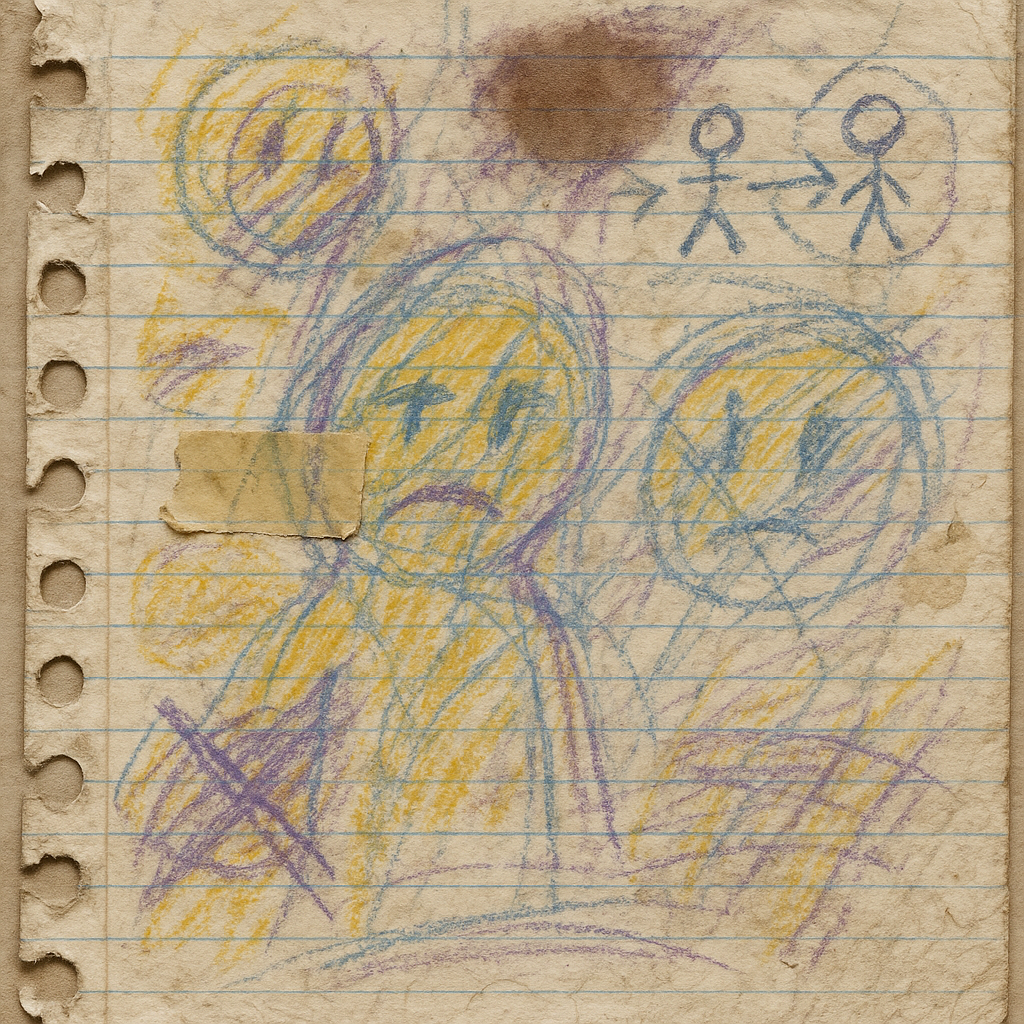
Image 1:
There is a clear effort to build on themes of corrupted nostalgia and recursive overwriting through the childlike crayon motif; the torn notebook paper, coffee stain, and tape residue manifest material memories, implying a time-worn document. However, the artistic thesis—about the undecidability of identity as memory and scan logics overwrite each other—is only partially realized. The quasi-faces, while deliberately fragmented and overwritten (in line with instructions), still resolve as recognizable, motif-like forms. The intended recursive overwriting is gestural rather than structural; it feels like erasure/decay, but not paradox, event-junction, or recursive feedback. The image reads as a “damaged memory” illustration, but not as a field-wide feedback collapse or temporal corruption. Emotionally, the sense of lost or damaged self is hinted at via the central frowning face and mess of overlapping lines, but the “stomach-drop” and metallic nausea never materialize; overall mood remains illustrative, not vertiginous. The image is evocative of loss but lacks the specific affective punch of the described thesis: no strong sense of time looping, scars preceding wounds, or identity infection.
Image 2:
This image pushes the “chemical damage” theme further and succeeds more in divorcing itself from pure representation. The face is warped, melded with analog burn and barcode-like bands: a credible attempt at manifesting field rupture and temporal residue. The curling fax paper and jagged chemical bloom—bleeding virulent bruise red into the scene—are strong choices. However, the motif logic still dominates: the faces, barcodes, even the house symbol are too central, risking symbolic storytelling rather than true ontological undecidability. There is some progress toward the paradox/recursive field event—the barcode scar seems to both precede and corrupt the faces—but as with image 1, this is gestural, not systemic. The “mirror misreport”