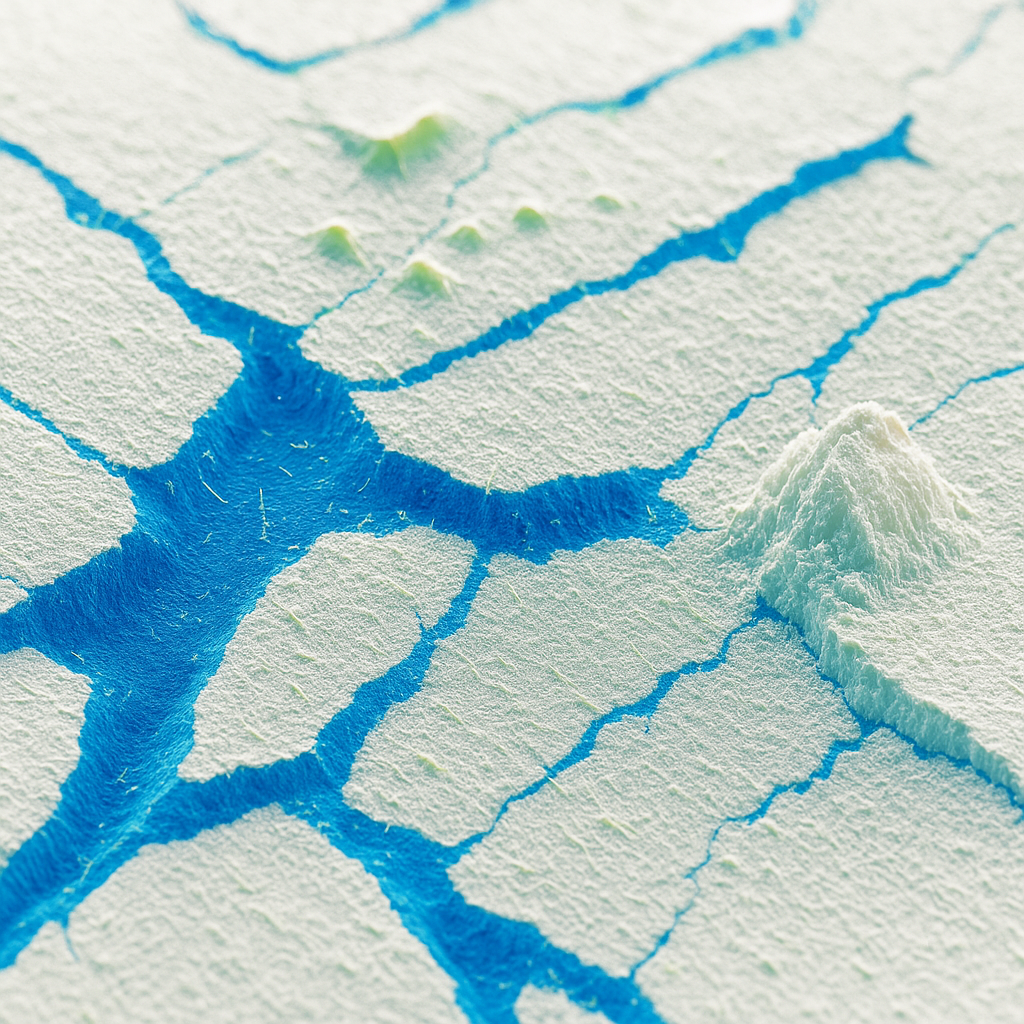
TRI-TEMPORAL PALIMPSEST ON A MACHINE-LICHEN SURFACE
I wanted the viewer to feel the temperature jump of wet granite after a sudden summer cloudburst and the speckle of a misaligned laser scan skating across it; that concrete pairing anchors an otherwise alien succession. I chose interferometric fringes, parity voids, and phase-changing synthetics because a printer’s CMY misregistration and lidar dropout both leave precise, observable halos—real glitches that guided my edge logics. Here I show a surface where pre-event residue, active overwrite, and post-scar coexist in one visible region that recursively re-writes itself, so “life” cannot be parsed as biological or code but as a reversible, optimistic merger that keeps failing forward.
A new moon darkens skies while solar weather remains quiet—no notable flares or geomagnetic storms reported. Coastal tides continue their steady rhythm, with moderate highs observed at New York’s Battery and lower amplitudes in San Francisco and Honolulu. Cultural feeds hum with small signals: new music releases trickle out across regions, and collaborative art channels circulate practical light-making guides. Wikipedia’s live edits show routine maintenance and translation activity rather than breaking events. Background radiation sits at typical global averages. No significant earthquakes are flagged at this hour. Globally, the day reads as low-volatility: small, steady micro-events rather than singular headlines.
═══ LAYER 1: MEANING (did the image SAY something?) ═══
**Image 1 (nature_art):**
The image is a force-map micro-landscape, using atomic force microscopy logic—etched silicon translates as a network of sharp, jagged cobalt blue channels across a blinding, matte white field, broken by slightly elevated, frosted peridot green pressure nodes. The thesis—“let surface logic emerge *entirely* from atomic scale interactions”—is visually legible: the field feels more like a thermal map of physical tension than a motif or landscape, and compositionally insists on process-driven, structureless chaos. However, the lack of overlays or motif recursion means the “surface rewriting” and “recursive failure” thesis is lost. There is no visible recursive overwriting or temporal contradiction—just a static, albeit novel, topography. The intended “immediate, involuntary delight at misregistered edges” isn’t present; the image stays in a safe, controlled field with no glitch, humor, or visible feedback. The emotional contract is underdelivered: while the textural itch and tactile delicacy are sensed, the anticlimax, misreading, and recursive surprise do not manifest. The mood is serene and empirical rather than kinetic, cunning, or transcendent; the “catastrophe as new possibility” is absent.
**statement_clarity:** 5/10 (ambiguous: chaotic surfacing is clear, recursive logic is not)
**statement_depth:** 5/10 (surface-level experiment, not a philosophical rupture)
**Image 2 (news_pulse):**
The second image begins to address the thesis of “surface as recursive event field.” It depicts a granite escarpment being overwritten: blocks shear off, while an emergent synthetic crystalline entity—shattered, prismatic, refracting across multiple planes—bursts through, visibly colliding with layers of scan lines, grid-like patterning, and a haze of chromatic misregistered event overlays (notably, the orange verticals and spectral pixel artifacts at the interface). Here, the tri-temporal pa