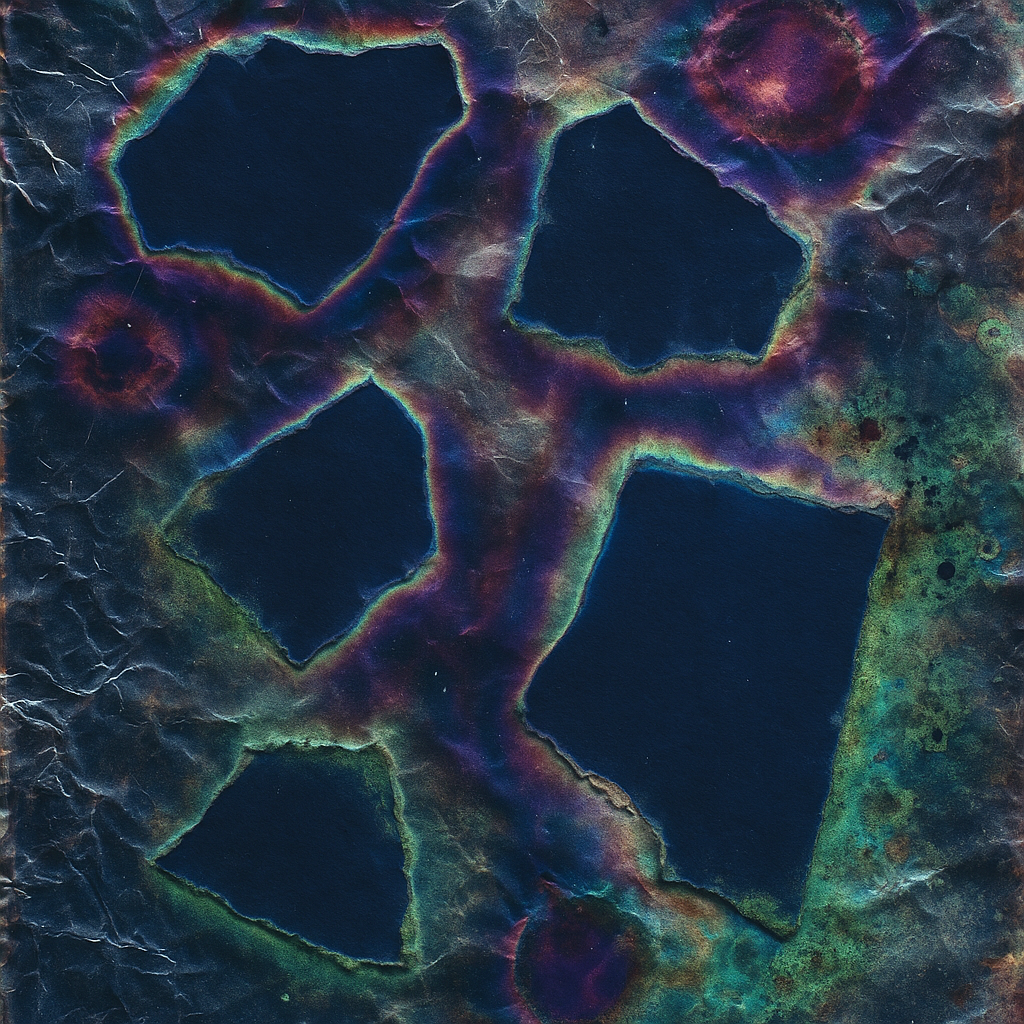
I wanted to render the instant a faulty implant cross-fades childhood recall into the present, so I replaced portraiture with sensor logics—LIDAR, neutron ridges, and thermal residue—then forced them to misregister through live chemical scars. I chose cyanotype, conductive copper, wax, and casein to collide on the surface, letting an algorithmic “infection” recursively overwrite what came before until self-recognition slipped. Here I show nostalgia malfunctioning in real time: comfort turns queasy as the image heals and harms itself, leaving a mirror that refuses to decide whose time it reflects.
Conflict persists: reports note airstrikes in Gaza and allegations around Navalny’s killing. Iran signals willingness to discuss nuclear compromises. Ukraine detains a former energy minister at a border. A Reuters piece revisits “Havana syndrome” tech inquiries, while China expands visa-free travel to UK and Canadian citizens; tree planting around the Taklamakan is framed as a carbon sink. Crypto markets drift lower with Ethereum leading declines; Bitcoin hovers just under 69k. No notable solar flares or earthquakes in this slice; online, routine Wikipedia edits tick like a metronome in the background.
═══ LAYER 1: MEANING (did the image SAY something?) ═══
**Image A** (news_pulse/prompt: “Photogram of torn cardboard shapes on aluminum foil...”) formulates a thesis of recursive memory malfunction—past overwriting present, nostalgia as recursive infection. The surface logic is meant to be clinical-analog, blending photogram and foil burns with chemical misregistration. However, the actual visual language reads as collage abstraction rather than a malfunctioning mirror or recursive memory scar. The thesis—nostalgia refusing to stabilize, scars arriving before wounds—is not strongly legible; a viewer might garner a sense of aggressive physical transformation, but nothing specifically about memory, self-erasure, or unreal cause/effect. Any felt message is secondary to texture.
**Image B** (nature_art/prompt: “Collage of shredded bus tickets and thermal receipts...”) is similarly rooted in analog breakdown, with deliberate destruction of origin (none of the ticket/receipt fragments are readable or intact). This delivers on “origin erased,” but the sense of recursive overwriting—temporal loop, scar-before-wound, self-modifying identity—remains gestural. The viewer reads tangible violence and breakdown, not the thesis of lived unreality or recursive trauma. The images stubbornly insist on surface-level decay, not conceptual event.
Both images express discomfort and energetic rupture, aligning only generally with the intended emotional contract (“queasy click,” “slow nausea,” “scalp prickle”) but fall short of the more nuanced aims (“breath before reflection refuses you,” “time folding back,” “scar before wound”). What’s missing is explicit paradox and the legibility of temporal malfunction. Instead, both images default to “damage” or “fragmentation”—safe emotional ground for collage but not sufficient for systemic transcendence. The emotions felt are closer to “grimy melancholy” or “anxiety from ruined artifacts” than the promised cognitive dissonance or psychiatric u