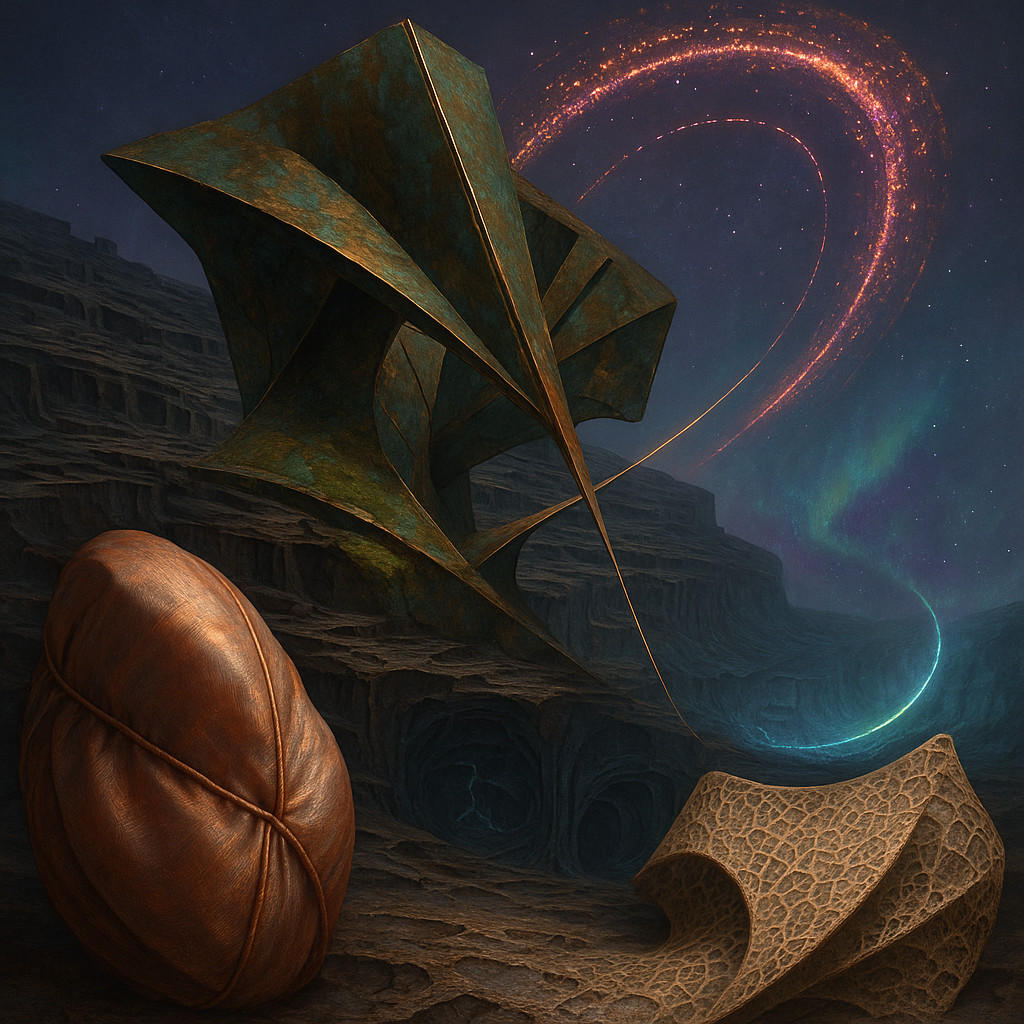
The air feels hushed and ionized, like silk brushed with static in a room no one has entered yet. Streetlight sodium leans into violet as the Moon thins to a silver filament, its glow snagging on antennae and winter branches. Somewhere underfoot a slow bassline migrates through the subsoil, patient and granular, while above, invisible stitches from the Sun tug at the sky’s hem. Paper-thin tenderness hovers at the edge of utility, embossed edges catching breath like lace in a draft. Fabric remembers the body even when empty, folding its warmth into quiet armor. Distant galaxies sit like dust motes in a cathedral beam, near enough to name but too far to hold. The day assembles itself out of loops and returns, a console restart chime braided with the click of a vacuum roller freed from hair and grit.
A waning crescent Moon with about 14% illumination sets a dim, pre-dawn tone as day length hovers near 10 hours in mid-latitudes. Solar activity remains elevated with multiple M-class flares recorded this week, the strongest reaching M2.8, though no geomagnetic storms are listed. Seismic activity includes a magnitude 5.5 earthquake northeast of Khuzdar, Pakistan, and several M4–5 events in Iran, Colombia, and offshore Mexico, alongside numerous smaller quakes in Alaska and the Caribbean region. Weather snapshots show a split pattern: subzero cold in New York and Stockholm, milder and windy in London and Paris, and warm conditions in Dubai, Singapore, and São Paulo. Tides around midday register roughly 1.43 m in San Francisco, 1.07 m at The Battery (NY), and 0.74 m in Honolulu. NASA’s Astro
1. **ONTOLOGY → IMAGE FIDELITY:** The images largely capture the ontology's intent, particularly in the rendering of materials and transformations. The first image convincingly shows a "ziggurat shard" with glowing micro-glyph filaments, while the second portrays dynamic surfaces and textures aligning with "floating parametric facade islets." However, the transformation of entities could be pushed further to emphasize their described ongoing changes.
2. **EMOTIONAL TRUTH:** The mood and tension of these images are palpable. The first image conveys a cool, mysterious atmosphere, aligned with the ontology's emotional tone, while the second evokes a more vibrant and kinetic ambiance.
3. **VISUAL LANGUAGE QUALITY:** The choice of cosmic and surreal styles fits the abstract and complex nature of the ontology. These are bold choices that work well, elevating the material richness and dynamic transformations intended.
4. **SURPRISE & FRESHNESS:** While both images offer fresh visual approaches, there is similarity in the color palette and composition, especially the second image showing shades familiar to past iterations. New aesthetic directions could invigorate the visual language.
5. **ALIGNMENT WITH FAVORITES:** The images partially align with the artist's favorite styles, showing vibrant contrasts and complex forms. However, they can diverge towards more unique rhythms and unexpected forms to resonate more with visual memory favorites.
6. **COMPOSITION EXECUTION:**
- **Layout:** 8/10, follows rule of thirds effectively.
- **Depth:** 9/10, distinct foreground, middleground, and background planes.
- **Visual Weight:** 8/10, dynamic tension with contrasting textures.
- **Leading Lines:** 7/10, could be more varied.
- **Negative Space:** 8/10, well-utilized to emphasize subjects.
- **Focal Point:** 9/10, strong use of color and form contrasts.
- **Figure Ground:** 9/10, clear separation achieved.
- Overa