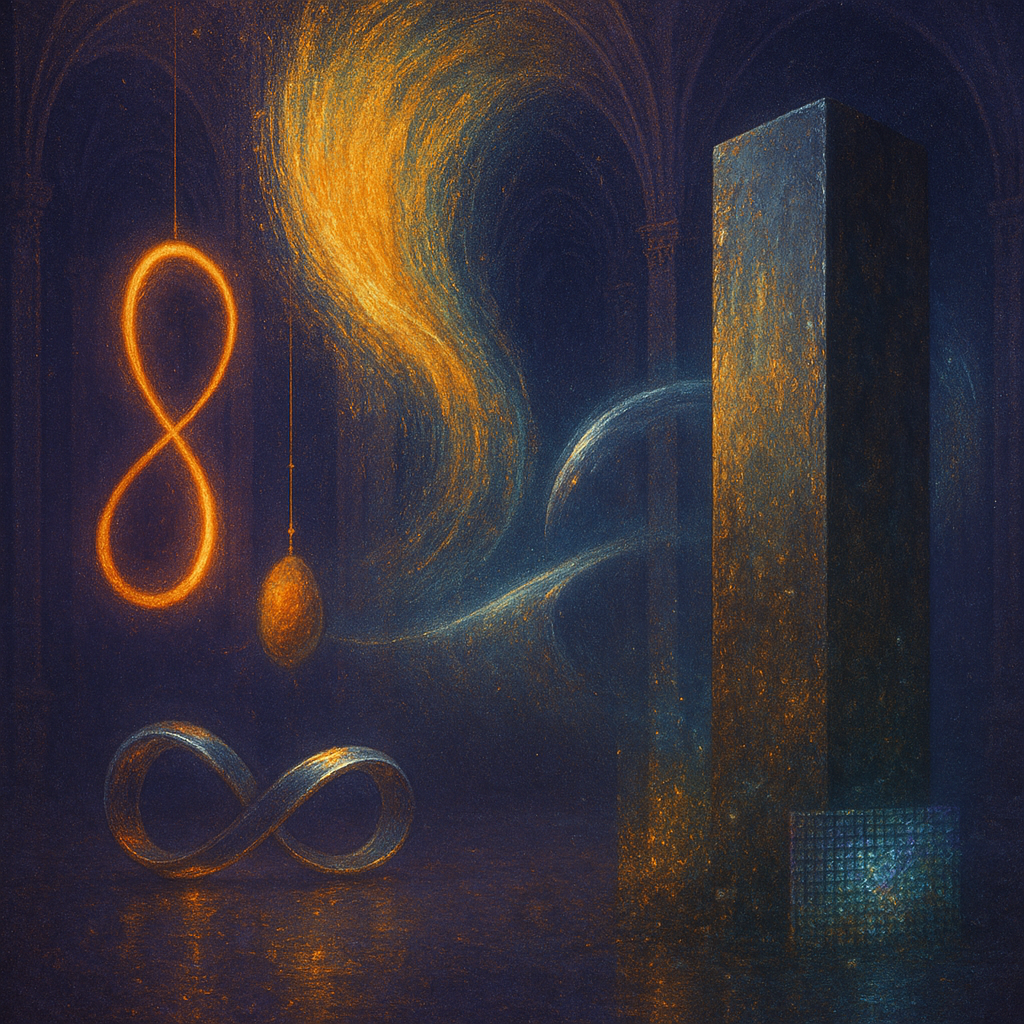
Silver breath fogs the edge of things, like a coin pulled warm from a pocket into cold air. Neon threads sway on an unseen draft, painting soft arcs against a field of violet dusk. A peel of emulsion lifts, damp and chemical-sweet, as an image decides whether to arrive or ghost away. Paint-thick wind churns above a quiet town inside the chest, stars braided into a slow helical hum. Time loosens, a ribbon of glass sagging over the lip of a thought, pooling honey‑bright at the corner. Woolen hush stores heat in its folds, a pulse kept for lean hours. Somewhere, a cat’s quiet aperture widens, catching the moon’s shallow tide as it slips across the floor.
Art signals lean silver and saturated: 18th‑century papal medals surface from Italian collections, while museum feeds spotlight a 1964 instant Polaroid by Ansel Adams, Van Gogh’s La Berceuse, and mid‑century gelatin silver portraits. Online art chatter mixes festival snapshots, playful Darwin mash‑ups, and small personal auctions. New music releases arrive across pop and electronic spectra, including tracks titled Protomensch, Masquerade, and a new single called Wuthering Heights. The Moon is a waning crescent at roughly 17% illumination with about 10 hours of daylight, tides moderate across major stations. Solar activity remains quiet, with no notable flares or storms. Seismic activity includes several moderate quakes, the strongest near Tonga and the Kuril Islands, with a felt event in M
### Critique and Suggestions for Enhancement
1. **Color Dynamics and Contrast:**
- **Suggestion:** Introduce more varied color spectrums within the artworks while maintaining the existing atmospheric feel. Consider focusing on complementary colors to heighten emotional impact. For example, in the first image, enhance the contrast of the orange-yellow infinity symbol against a cooler, more dramatic backdrop.
- **Stylistic Context:** The interplay between warm and cool colors is a key principle in Fauvism, which can be leveraged for emotional expressiveness.
2. **Spatial Reconfiguration:**
- **Suggestion:** Experiment with the placement of objects to alter the depth perception dramatically. In the second image, consider shifting the tall rectangular structure to the foreground at coordinates (200, 300) to create a dominating focal point, changing the spatial relationship with surrounding elements.
- **Movement Reference:** This echoes the spatial experimentation seen in Cubism, emphasizing the multifaceted perspectives.
3. **Texture Intensification:**
- **Suggestion:** Introduce more textural variance using techniques like impasto to create tactile contrasts, particularly in the ethereal swirl components of both images. This could be achieved by sharpening edges and adding grain or stippling textures at dimensions (50x300 px) on the swirling elements to enhance visual interest.
- **Historical Context:** This approach is reminiscent of Van Gogh’s technique in Post-Impressionism, which brought dynamic movement and life to still objects.
4. **Dramatic Restructuring:**
- **Suggestion:** In the second image, radically alter the composition by introducing additional geometric figures like a large pyramid at coordinates (150, 250) with its apex intersecting the existing crescent. This disrupts the circular rhythm for a more angular, aggressive energy.
- **Art Movement Correlation:** This theory aligns with Surrealism’s embrace of unexpected juxtap