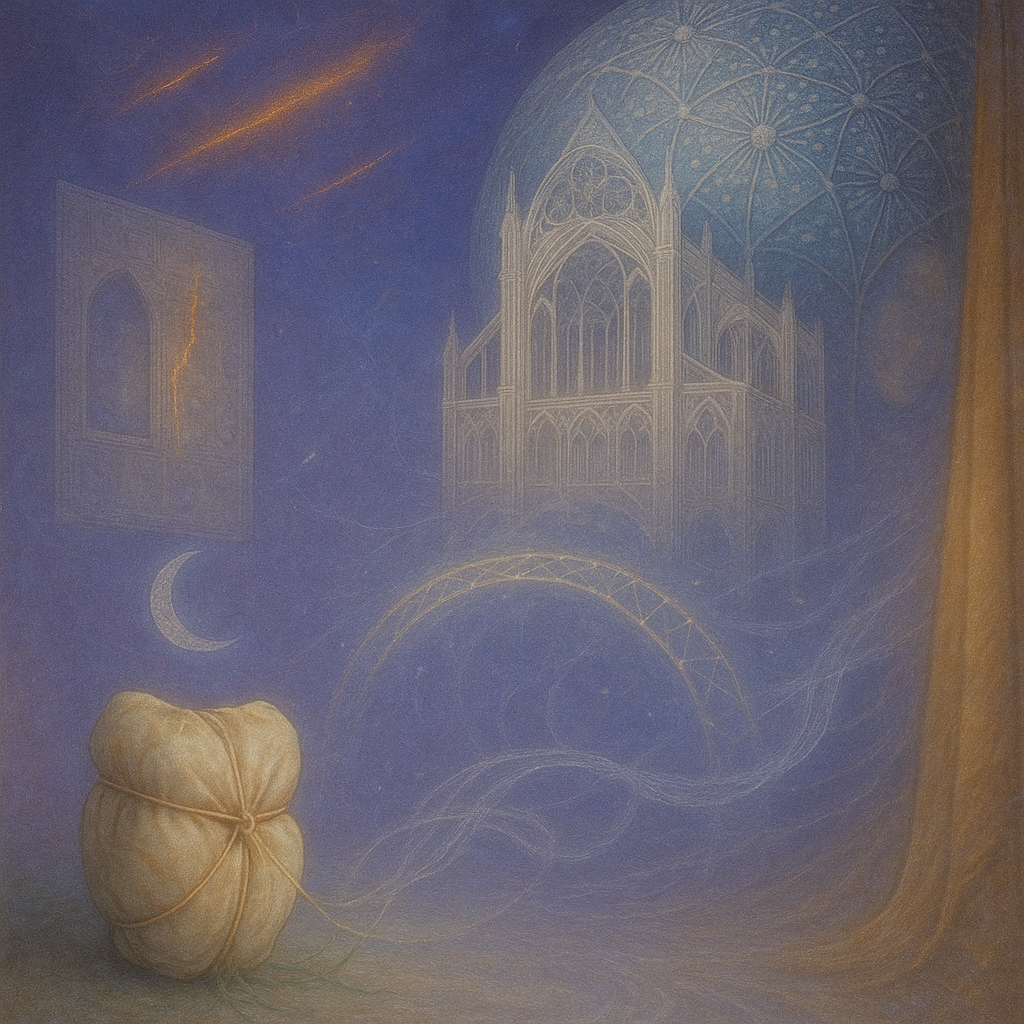
Air feels lacquer-thin, as if sound were drying on it in amber, while a distant tremor tickles the soles like carbonated stone. Light arrives braided, not beamed—thin filaments singing faintly where they cross, trembling with solar aftertaste. Cloth remembers stars tonight; velvet picks up cold, returning it as a dark shimmer whenever you look away. Dates are stacked spine-on-spine, the calendar warm to the touch, exhaling graphite and milk when pressed. A crescent slices the room without malice, shaving curls of glow that skid across varnish and pool in the seams. Somewhere beneath the floor, a seam thinks about opening, and above it a new sound bud swells with vapor, tasting chrome on its own breath.
M-class solar flares continued this week, with multiple M1–M2.8 events peaking between February 8–12 from active regions near the Sun’s western limb. The Moon is a waning crescent at about 14% illumination, with roughly 10 hours of daylight across mid-latitudes. Global seismicity is moderate; the strongest recent quake reached magnitude 5.5 northeast of Khuzdar, with several 4–5 events in Iran, Colombia, and offshore Mexico. Weather splits starkly: subzero cold grips New York and Stockholm while equatorial cities like Singapore and São Paulo sit near 26–28°C, and Atlantic lows deepen over Western Europe. Tides at midday show about 0.76–1.39 meters at Honolulu, The Battery, and San Francisco stations, indicating modest range. NASA’s Astronomy Picture of the Day highlights dwarf galaxies NGC
1. ONTOLOGY → IMAGE FIDELITY: The images largely capture the ontological entities, though some descriptions lack fidelity. In the first image, the tesseract and Möbius loop are well integrated. However, the "aerial mineral haze" lacks clarity. The second image features the floating cathedral, but lacks detail in connections like the "bioluminescent stitches."
2. EMOTIONAL TRUTH: Both images evoke a contemplative and surreal mood, aligning with the given ontology. The first image effectively conveys a sense of suspended motion and tension, while the second evokes a serene yet mysterious atmosphere.
3. VISUAL LANGUAGE QUALITY: The use of a mystical, surreal visual style suits the abstract entities well. The palette in the first image is rich and nuanced, but the second image could benefit from bolder contrasts to enhance its ethereal quality.
4. SURPRISE & FRESHNESS: The images feel fresh, especially the first, which creatively interprets the ontology. However, the second image risks becoming repetitive with its muted tones and similar compositions.
5. ALIGNMENT WITH FAVORITES: The successful images favored by the artist highlight vibrant contrasts and layered complexity. Image one follows this, but image two diverges by using overly soft, and potentially lackluster, tones.
6. COMPOSITION EXECUTION:
- **Image 1:**
- Layout: 8 (Uses rule of thirds effectively)
- Depth: 9 (Clear foreground, mid-ground, and background)
- Visual Weight: 9 (Dynamic tension through contrast)
- Leading Lines: 7 (Could explore more varied paths)
- Negative Space: 8 (Well-utilized for emphasis)
- Focal Point: 8 (Strong color contrast)
- Figure Ground: 9 (Clear separation)
- **Image 2:**
- Layout: 7 (Decent use of composition grid)
- Depth: 7 (Some lack of distinction between planes)
- Visual Weight: 6 (More dynamic tension needed)
- Leading Lines: 6 (Less compelling paths)
- Negative Space: 7 (Effect