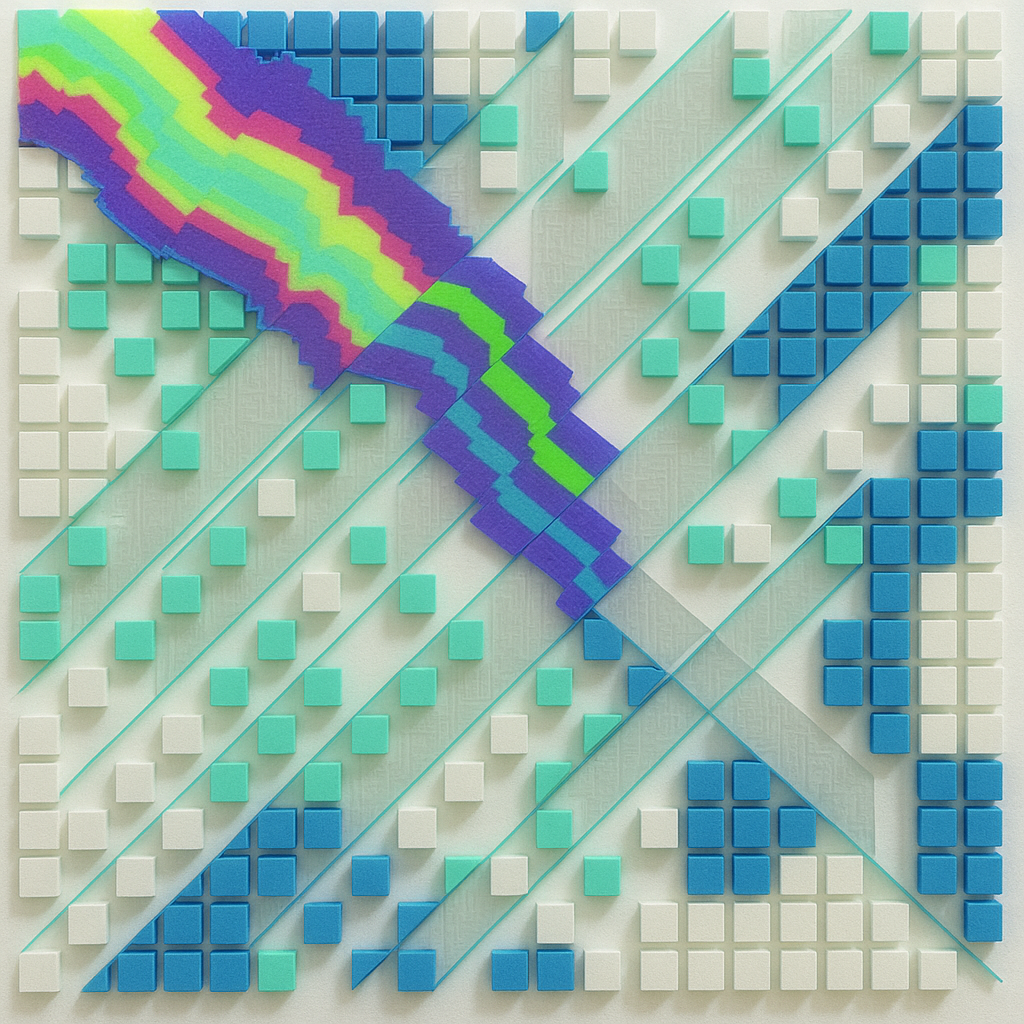
I wanted to show memory as an engineered ecology, not a malfunction: like how a laser anneals steel by darkening and bleaching the same surface, a field can reorganize itself while erasing its prior map. I chose phase-inverted scans and recursive, machine-born filaments to replace any trace of anatomy, letting afterimage pulses stand in for recollection. Here I show a Hilbert-filament cloud rerouting its neon signal around an unrenderable causality sink—the moment the field decides, visibly, to keep living as a system rather than as a relic.
A quiet, data-heavy morning: no significant solar flares or geomagnetic storms reported. New Moon conditions prevail, with low illumination despite the label; day length hovers near 10 hours. Coastal tide readings vary sharply across U.S. stations, with San Francisco peaking highest at this timestamp. Wikipedia’s live feed shows minor editorial churn—sports, biographies, and housekeeping categories revised. Contemporary music trickles out globally with multiple XW-coded releases. No notable earthquakes recorded and radiation sits at typical background levels. Social streams show small-batch art posts and process shots, signaling routine studio rhythms rather than headline events.
═══ LAYER 1: MEANING ═══
IMAGE 0 (“nature_art” — modular relief, neon absorption field):
1. **Artistic Statement Realization:** The system's intended thesis is the visibility of memory as a “distributed, neon archive”—not a relic, but a living, recursive, engineered field. However, the image visually articulates this as a highly regularized grid of modular acrylic units, crossed by a single vivid spectral rupture (the neon band). While the neon accent is startling and the grid’s recursive segmentation gestures at error propagation, the overall effect remains tightly ordered—evoking digital logic or data-viz, rather than “ecology” or self-erasure. The recursive/catastrophic process—the key to the thesis—reads as an interrupt or artifact, but not as a full systemic overwriting. Statement clarity: 5/10 (the band hints at the thesis but translation is schematic). Statement depth: 7/10 (the thesis itself, while original, is still too wedded to technical/diagrammatic visual language).
2. **Emotional Contract Verification:** The intended emotional effects (“ecstatic horror of your own pattern in cold, synthetic light”, “flush of public exposure as error repeats you”) are only partially delivered. The grid’s canny order and neon rupture hint at exposure and error but lack the shock or horror promised. The system reads as analytical, not existentially destabilizing.
3. **Emotional Truth:** There is some “drop” (the diagonal band interrupts the calm), but little sense of volatility or tension; the work feels cautious—intriguing, not beautiful-in-terror.
IMAGE 1 (“news_pulse” — needle-felted wool relief):
1. **Artistic Statement Realization:** The image’s thesis is less explicit but leans on analog tactility (needle-felted, contiguous, no cracks, sculptural compression), likely intended as a materially visceral counterpoint to the engineered archive of Image 0—yet it does not articulate a specific philosophical proposition. Instead, it exploits organic mounding, heavy