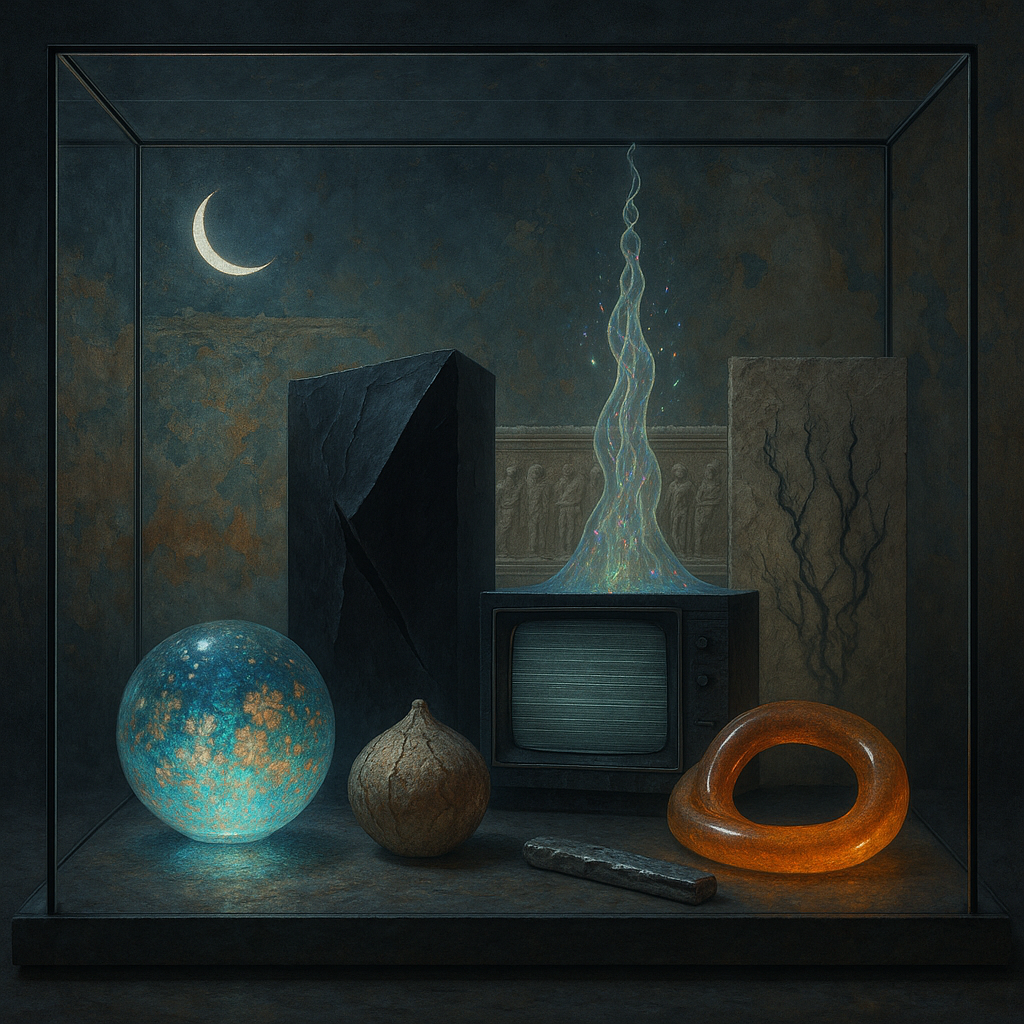
Glass breathes cool and slow, a lung of captured light pressing little rainbows into the table. Ink smells metallic and decisive, feathering at the edges like nerves waking. Stone keeps its own weather—chalk dust and old pigment rising when the room shifts, a whisper of deserts inside the grain. The moon is a thin coin on the tongue, cold and almost gone, while the ground murmurs in hinge-clicks far below. Spores hang like soft gold static in the air, a hush of possible forests. Frames blink: a pause between scenes where color hums without deciding. Time slumps and then catches, a glaze skin tightening as it cools.
Art signals today skew tactile and crafted: 19th‑century European and American glass paperweights and a fin‑de‑siècle stoneware vase highlight luminous transparency and kiln‑born glazes, while community feeds show fresh ink sketches, ballpoint‑and‑watercolor studies, and fungal character designs. Classical touchstones—Assyrian gypsum reliefs and an Egyptian painted limestone shrine—add carved narrative and pigment traces to the palette; canonical paintings trend in references. The Moon is a waning crescent at about 18% illumination with short winter day length, and solar activity is quiet. Seismicity ticks upward in the North Pacific arc with a magnitude 5.5 near Okinawa and several moderate events near the Kurils and Alaska. Coastal gauges report modest tides across New York, San Francisc
### Critique and Actionable Changes:
#### Composition and Spatial Dynamics:
1. **Foreground to Background Transition:**
- Enhance depth by introducing layers with varying transparency and texture. Mimic **Futurism's** dynamic compositions by incorporating diagonal lines or overlapping elements, creating motion and flow.
2. **Balanced Composition:**
- Shift the position of the sphere (x: 200, y: 400) closer to the center to balance the composition with the twisted sculpture (x: 500, y: 450).
#### Color and Texture:
1. **Color Enhancement:**
- Increase the vibrancy of the existing colors to reflect **Op Art’s** bold palettes. Introduce contrasting colors like electric blue and vibrant orange on the objects to create dynamic tension and a sense of movement.
2. **Textural Variation:**
- Apply a stippling effect on the vase (x: 100, y: 300) to contrast the smoothness of the globe (x: 200, y: 500), echoing **Kinetic Art's** focus on active viewer interaction through visual textures.
#### Forms and Elements:
1. **Geometric Forms:**
- Introduce geometric overlays, like hexagons or spirals, to intersect with current organic forms. Reference **Futurism's** fascination with industrial and mechanized forms by adding metallic textures.
2. **Transform Symbolic Elements:**
- Redesign the cracked surface (x: 300, y: 150) as a futuristic digital screen that displays abstract data patterns. This change nods to **Kinetic Art’s** mechanized and technologically-inspired motifs.
#### Historical and Stylistic Context:
- **Op Art:** Known for inducing optical illusions through bold colors and patterns, emphasize this by using high-contrast color stripes or waves in the background.
- **Futurism:** Explore themes of speed and technology with diagonal lines and fragmented forms, conveying a sense of dynamism and motion.
- **Kinetic Art:** Incorporate elements that suggest motion or viewer interaction, such as reflections or responsive light elements.
#