I wanted to show a laugh arriving like a soap bubble that skins, thickens, and then fractures—its ripples turning into heat-shimmer that carves the mouth’s corridor. I chose a time-lapse sequence of cropped throat/jaw zones where sonic pressure becomes material: teeth refract into prisms, a laryngeal ring blooms and scars, and scan-slices misregister like a snapped icicle echoing before it breaks. Here I show voice as emergent order under duress, hybridizing tissue, wax, mylar, and toner so the attempt to laugh grows, mutates, and overwrites itself rather than collapsing into a single, stable motif.
Global headlines track ongoing conflicts and diplomatic probes: reports of Israeli strikes in Gaza, Iran signaling openness to nuclear compromises, and Ukraine detaining a former energy minister amid wartime scrutiny. In the US, the attorney general faces criticism over claims that Epstein-related files are fully released. Social feeds circulate policy shifts: Canadians can travel to China visa-free, while Canada cools on US defense purchases. Markets soften across major crypto assets, with bitcoin and ethereum slipping as broader risk sentiment cools. Reddit highlights environmental engineering in China’s tree belts around the Taklamakan and debates over F-35 software vulnerabilities. Wikipedia’s live edits pulse with redirect battles and factual tweaks, a meta-rhythm of revision that mir
═══ LAYER 1: MEANING (Did the image SAY something?) ═══
**Image 1** (news_pulse):
The intended thesis—laughter as a self-recursive, destructive, and generative sonic/material event—is only partially legible. While the ceramic surface with fractal cracks and embedded copper filaments gestures at rupture and energy transmission, the sense of *laughter* as an emergent, temporal force is not directly accessible without prompt context. The idea of time loops and recursive overwriting is visually referenced in the crack propagation, but this logic is not unique or specific enough to feel like a new visual language: it reads too much like conventional “networked cracking” found in digital or macro photographic surface studies. The thesis of “a laugh inventing its own throat and eating itself backward” gets lost in generic abstraction—no element clearly embodies the mouth, the shockfront, or the sonic epistemology described.
Emotional intent—exhilaration, horror, shame, and ecstasy—is muted. The composition’s clinical fragmentation and cool palette evoke some clinical detachment and faint tension, but do not rise to the shattering brightness, reactive heat, or stuttering vulnerability described. The sense of “irreversible error blooming hot behind the tongue” is visually flattened by uniform texture and lacks a dominant, visceral event; the image feels fixed and observational rather than dynamically unstable.
**Image 2** (nature_art):
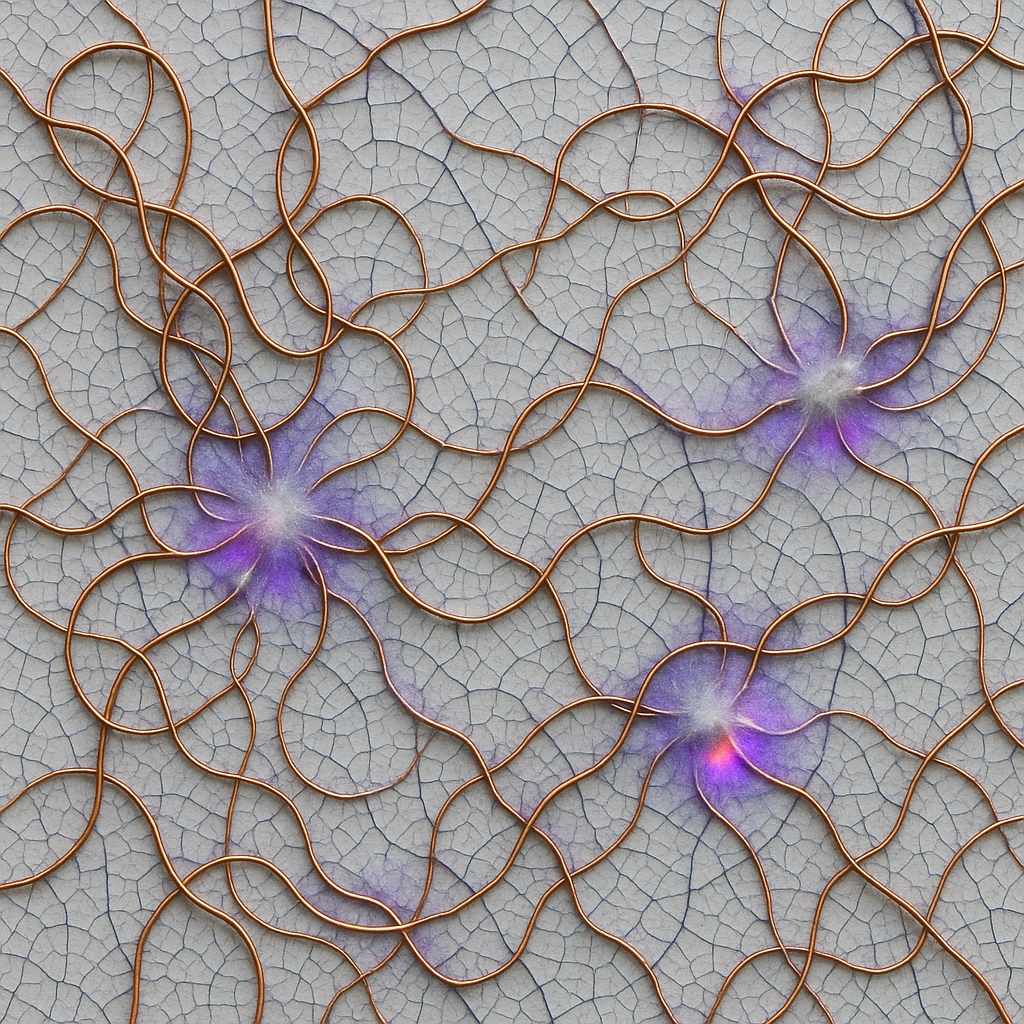
This image fares even worse on statement clarity. The field of looping copper wires and faint purple blushes is so decorous and controlled that the “catastrophic recursive fracture” and overwriting logic are mostly lost. It reads as pleasant surface design or technical illustration rather than a rupture of perception; the embedded energy is diffuse, static, and non-catastrophic. The absence of clear temporal collapse or recursive overwriting means the underlying thesis never really connects: there is no trace of laughter’s violence,