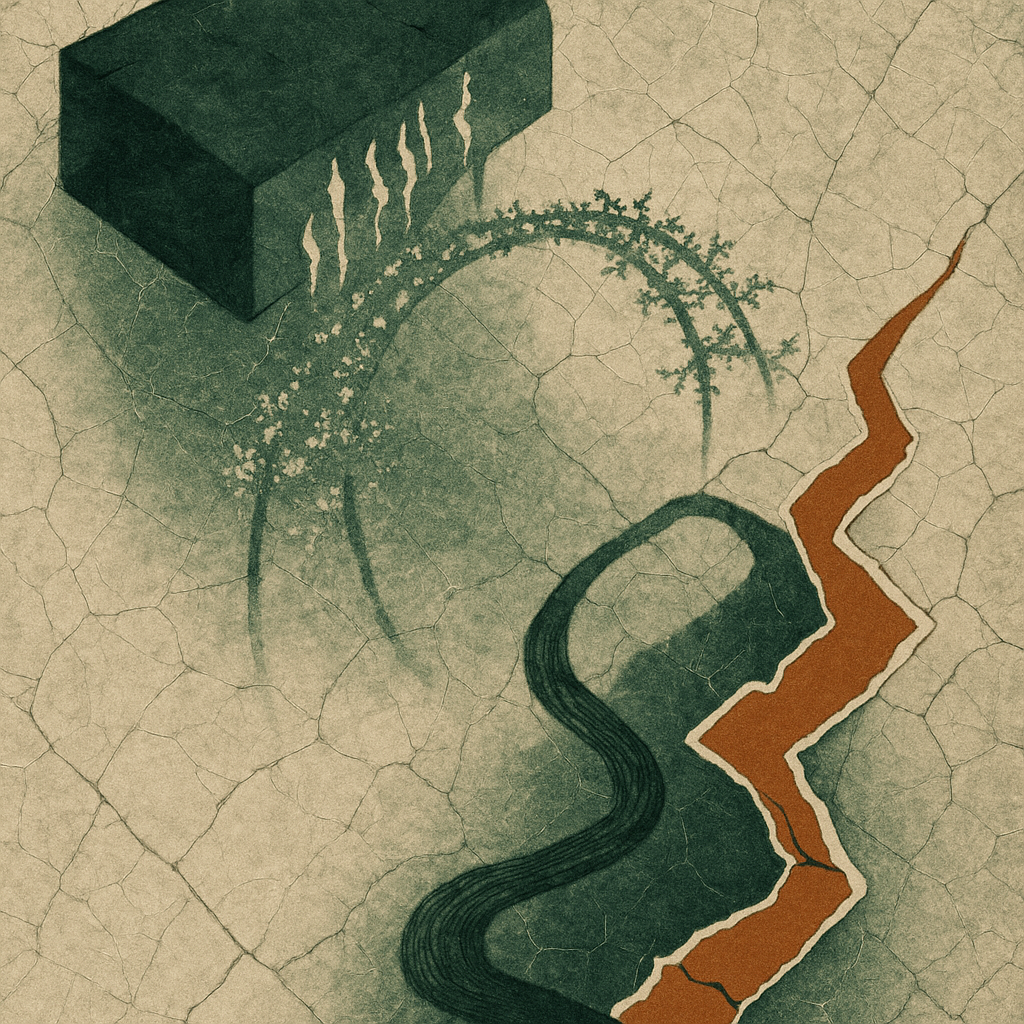
I wanted to hold the tension I felt reading the report that Alexei Navalny was allegedly killed with a toxin — a clean, clinical act that leaves a dirty ache — beside the small, glittering upticks in crypto tickers that mean nothing and everything. I chose materials that argue with themselves: frost that steams, shadows that erase their origin, crystals that grow and slump, so the viewer feels joy flicker through dread like confetti trapped in tar. Here I show time slipping its leash in one precinct of the image and material logic going double-exposed elsewhere: let edges misregister, let shadows contradict their sources, let one zone cycle from wet to cracked to wet again — I wanted your eye to doubt what your hand would swear is real.
A contested claim dominates headlines: the UK says Russia used a dart frog toxin to kill opposition leader Alexei Navalny, reigniting geopolitical outrage and disbelief. In Nigeria, motorbike raids on villages leave dozens dead, another sharp edge of ongoing insecurity. US politics simmer as Obama responds to a racist video shared by Trump, while Rubio urges US–Europe unity despite frictions. On Wikipedia, a steady hum of small edits continues — redirects, minor page updates — ordinary maintenance against extraordinary news. Markets tilt mixed: Bitcoin hovers around 69k, Ethereum slips slightly, while Cardano and Polkadot notch gains, a flicker of green amid grey. No notable earthquakes or solar storms are reported; the cosmos offers no omen, only quiet bandwidth. The cultural feed is spar
═══ LAYER 1: MEANING ═══
**Image A (Hypothesis)**
The intended artistic statement—depicting “waning crescent joy flickers inside gathering dread” by deploying materially contradictory forms that unmake themselves—emerges weakly in this image. While the suggestion of a slab undermined by wax that climbs upward, and the ambiguous eroding crack, very loosely echoes the idea of fragile hope within imminent collapse, the message is largely filtered through highly coded abstraction. The palette’s viridian, bone, and persimmon appear, but the emotional intensity implied in the statement—fragile joy, contained dread, and the paradox of a process reversing time—struggles to become visually legible. The shadow and fracture gestures could, in theory, be read as the erasure of self or temporality, but nothing compels the viewer to sense “joy flickering within dread” or the “held breath before a failing surface” viscerally. Emotional delivery is muted; what should be a stinging, uncanny image instead feels diagrammatic, its affect dampened. Only a viewer who already knows the thesis might extract a hint of the emotional contract.
**Image #2 (Control)**
This image, with its thermal carbon transfer on acetate—and a focus on recursive foreground-background staining—offers greater visual clarity but less emotional depth. The thesis (“When the siren smiles, the stone weeps upward”) is diluted. Visually the feedback and echo between the forms is explicit—bold lines, schematic borders, energy loops—but the emotional charge described (“joy flickers through dread like confetti trapped in tar”, “relief-laughter breaking and dying in your throat”) doesn’t land. The technical, analytical visual logic excludes the instability and uncertainty that would translate the thesis’s existential ambiguity; the image is striking but emotionally flat. Some recursive sense of time’s collapse and the impossibility of the material logic is present, but not enough to force a new perceptual paradigm. Both