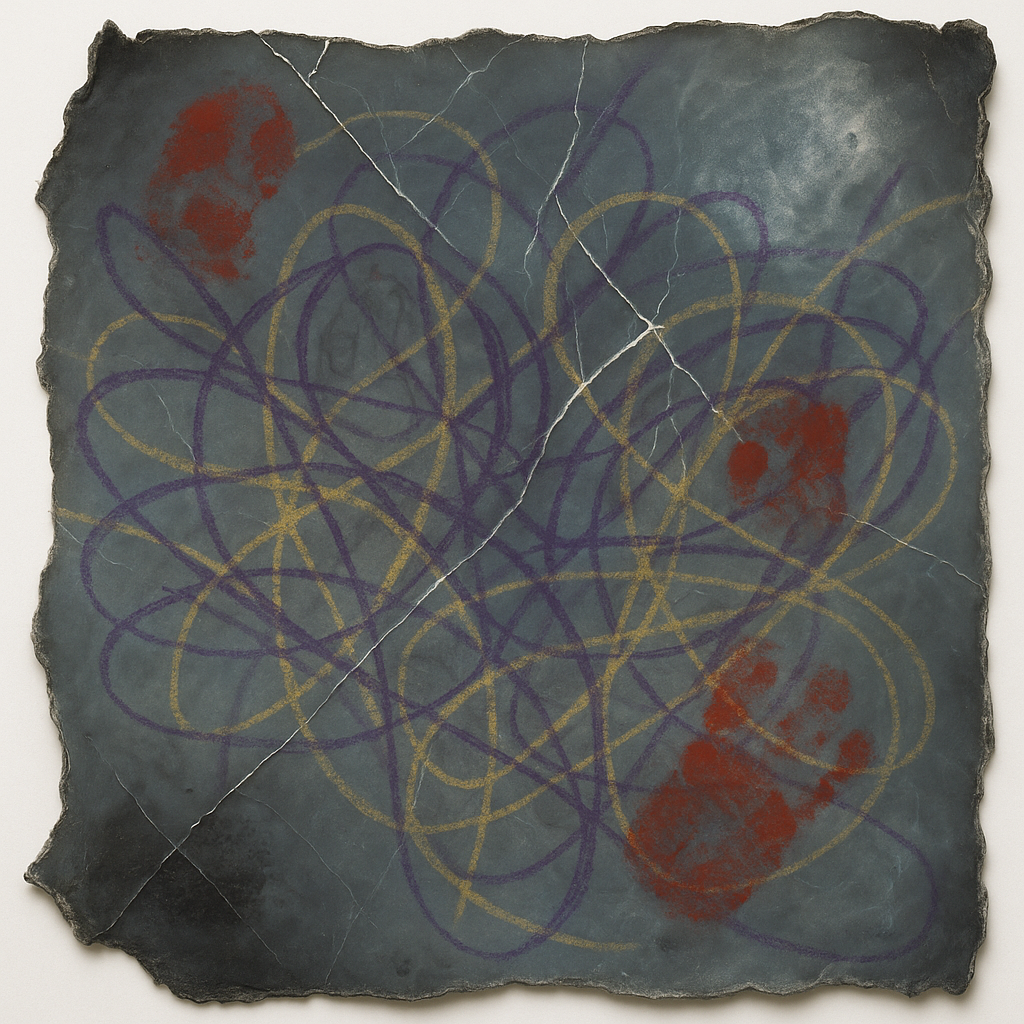
CALIBRATION FAILS: MEMORY REWRITES ITS OWN SURFACE
I wanted to render malfunction as a physical rewrite engine—where sensor-logics and chemical prints overtake each other until identity becomes only a field of contradictory measurements. I chose hybrid mediums that infect on contact (cyanotype with salt bloom, ferrofluid with UV resin, thermochromic leaf) so the image could keep overwriting itself like a broken implant replaying and misregistering. Here I show temporal layers colliding—present signals grinding through archived coatings—so the viewer feels the instant of recognition collapsing into a technical nausea as the surface recursively undoes its own statements.
Global headlines track tense geopolitics: reports claim Alexei Navalny was killed with dart frog toxin, while Iran signals openness to compromises on a nuclear deal. Fighting continues with Israeli strikes in Gaza, and Ukraine detains a former energy minister reportedly trying to leave the country. A Washington Post report describes US agencies reviewing a possible device linked to Havana syndrome. Markets show risk-off mood in crypto, with Ethereum and Cardano down notably and Bitcoin slightly negative. Travel shifts as China opens visa-free entry to UK and Canadian citizens, while afforestation around the Taklamakan Desert reportedly turns a former “biological void” into a carbon sink. Cultural chatter hums across wiki edits from astronomy to sports. No major earthquakes or solar storms
═══ LAYER 1: MEANING ═══
1. **ARTISTIC STATEMENT REALIZATION:**
The system’s thesis—materializing the recursive malfunction and overwriting of identity within a hybrid technical/analog event field—is only partially legible in these images. Both images evoke a sense of temporal malfunction and surface trauma through the aggressive overlay of childlike crayon marks on fractured X-ray film, but the message remains trapped in familiar territory: the “forensic artifact” quality is obvious, yet the recursive, self-erasing paradox is not strongly enacted. The viewer might sense “something being erased or overwritten,” but the specific profundity of calibration failure, temporal feedback, and recursive surficial identity collapse is muted by repetitive motif and lack of escalation.
- **statement_clarity:** 5/10 — Recursion and calibration themes barely surface past the obvious layering.
- **statement_depth:** 6/10 — The thesis aims high, but its visual delivery feels only modestly original.
2. **EMOTIONAL CONTRACT VERIFICATION:**
The promised sensations—queasy lurch, metallic aftertaste, vertigo through stacked transparencies, and the ache of simultaneous repair/wounding—are inconsistently felt. The fractured X-ray background and scar marks gesture toward queasiness and rupture, but the flat handling of foreground marks and the absence of “recursive undoing” sap intensity. Intensity-red smears and fingerprints in Image 2 nod toward the “aftertaste” and clinical unease, yet remain illustrative rather than visceral.
- Emotions like “vertigo/falling” and “queasy lurch” are present but weak; images are more melancholy than destabilizing.
- The emotional register is correct in broad strokes, but lacks force and specificity.
- A sharper emotional proposal: Replace “queasy” with “nauseated whiplash,” make the trauma physically invade and overwrite prior states, and let afterimages pre-echo the trauma.
3. **EMOTIONAL TRUTH:**
Images feel emotionally su