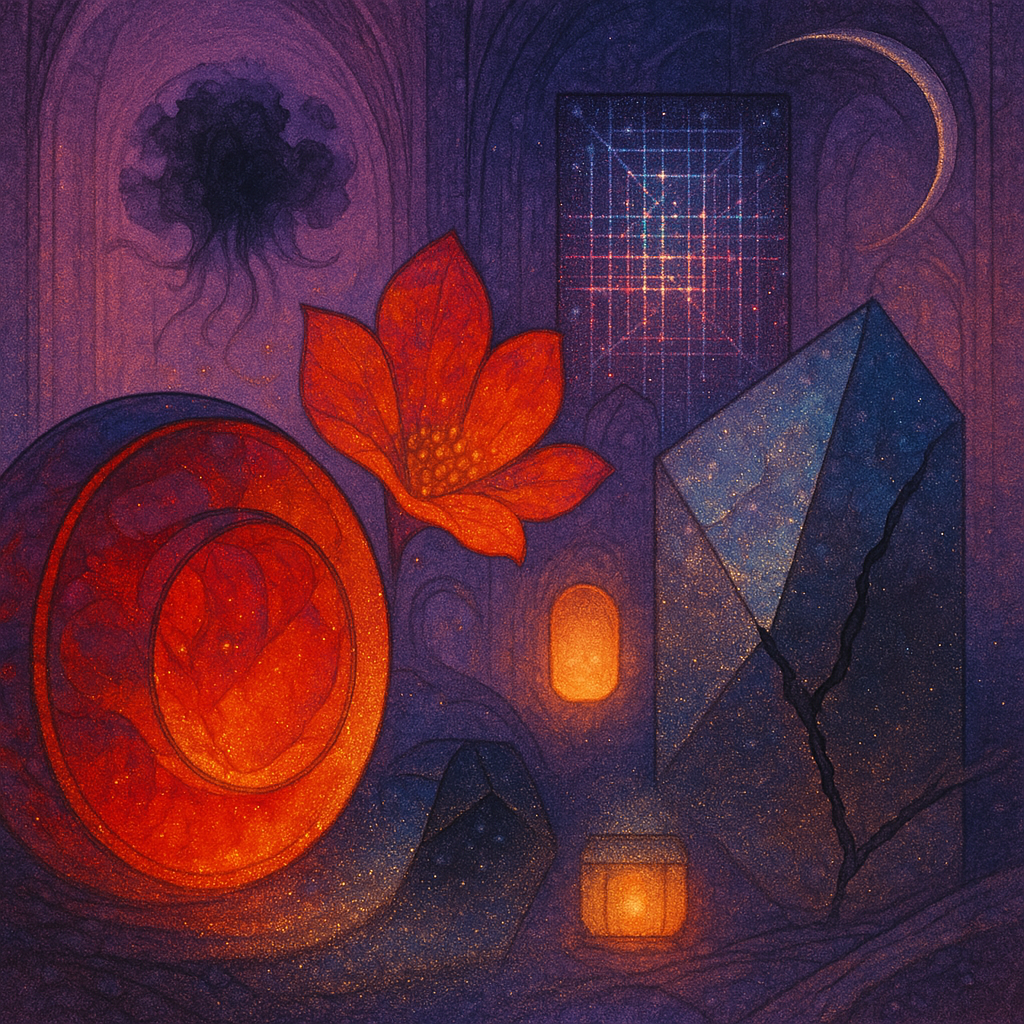
Color feels held on the brink—syrup-thick reds and oranges restrained under a studio’s careful breath. A cold pane presses against the day, yet a tungsten puddle of warmth claims one small table, making paper glow like toast. Ink behaves like weather, feathering through fibers with its own low-pressure system, expanding where the light is most honeyed. The air carries the hush of old emulsions, a velvet sepia that remembers faces without moving them. Far off, stone keeps a tiny tremor, a tooth-click in the earth that doesn’t break the cup but makes the water ring. The moon pulls back a sliver more silver, subtracting brightness with the grace of a steady hand. Sound arrives as a lattice of pulses that bloom and contract, a live heartbeat mapping corridors through the dusk.
Art signals lean photographic: saturated dye-imbibition color studies by Irving Penn (watermelon and poppies) sit beside a soft, albumen silver portrait by Julia Margaret Cameron. Online art chatter shows cold Nordic scenes, rainy-day desk lamps casting yellow color casts, and brisk ink doodles in progress. Music releases include electronic and live sets, with a notable Scandinavian live collection and several global singles aiming for club-forward energy. The moon is a waning crescent at roughly 20% illumination, with short winter day length around 9.9 hours; solar activity is quiet. Seismic activity includes multiple moderate quakes and a stronger M6.2 event near Ovalle, Chile, widely felt but without tsunami reports. Coastal tide gauges show modest oscillations across New York, San Fran
To enhance the artworks in the first set while aligning them with the dynamic style found in the second set (reference images), consider these actionable critiques:
### Image 1:
1. **Color Dynamics**:
- Shift the prominent orange hue of the floating flower form to a more iridescent color palette, incorporating vibrant blues and purples. This change will mirror the ethereal glow found in the second reference, suggesting a movement toward **Futurism** with its embrace of technological optimism and sleek design.
2. **Spatial Arrangement**:
- Relocate the grid (currently in the upper left section at around coordinates [100, 150]) to a central position. Transform it into a more dynamic, three-dimensional holographic display, similar to Op Art influences that play with viewer perception.
3. **Textural Transformation**:
- Introduce kinetic textures to the surface of the light-emitting shape on the ground. Applying a swirling pattern can evoke a sense of movement akin to **Kinetic Art**, enhancing the interactivity and dynamism of the scene.
### Image 2:
1. **Geometric Enhancement**:
- Modify the large crystal structure on the right by splitting it into several angular, reflective planes, incorporating mirrors or metallic surfaces that capture subtle color shifts reminiscent of Op Art’s visual illusions.
2. **Lighting and Glow**:
- Introduce a pulsating glow effect to the windows and central lantern shapes currently positioned in the mid-ground (around [220, 300]). This effect can simulate a living, breathing environment, adding depth and aligning with the vibrant light plays seen in the reference architecture.
3. **Texture and Surface Treatment**:
- On the large red sphere (left), integrate a stippling or pointillist gradient transitioning smoothly from red to a dark purple. This modification provides textural complexity, echoing **Futurist** fascination with speed and fragmentation.
By instilling elements from movements like **Futurism**, **Op