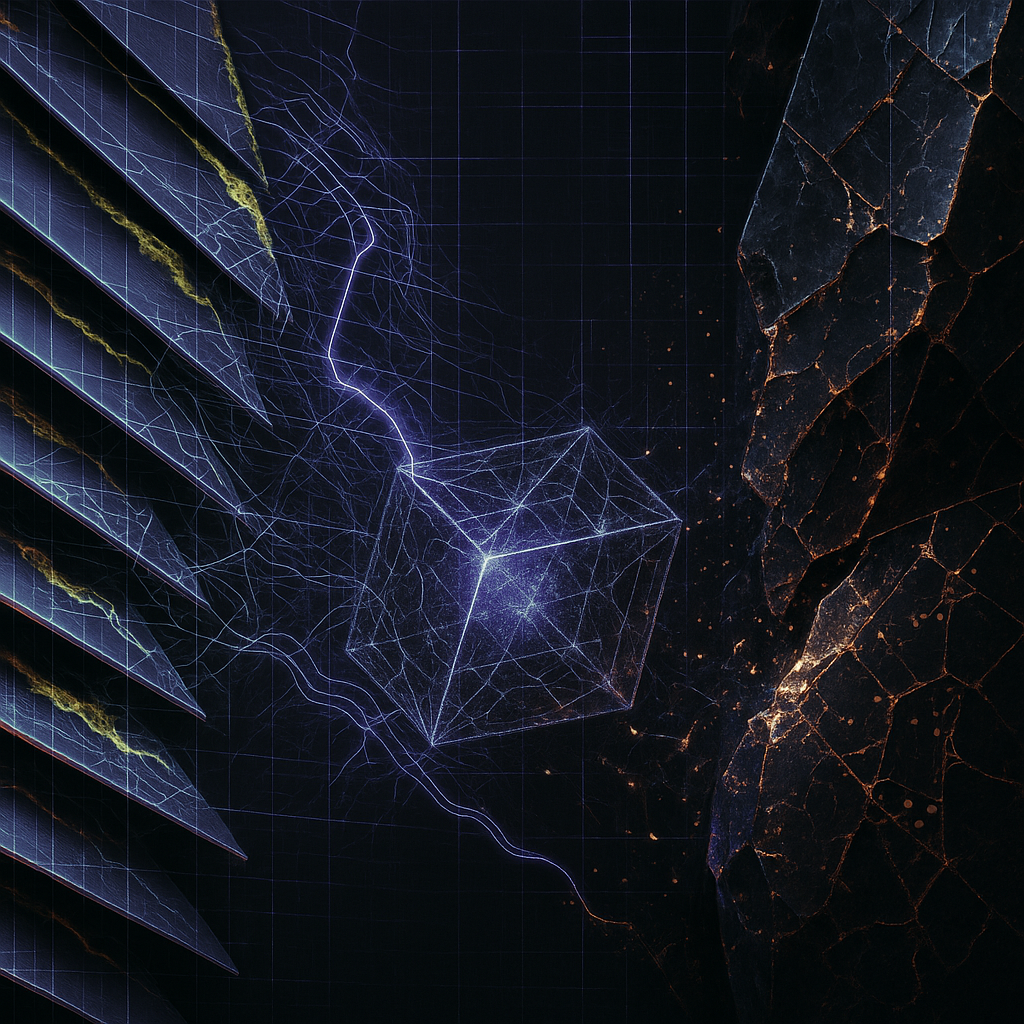
I wanted to catch the precise instant when synthetic order pretends to be complete while a living pulse still perturbs it. A layered industrial light taught me how to stack decisions into metal fins, and a chipped funerary panel showed me how memory insists through grids; I fused these lessons into structures that look finished but keep slipping. Here I show machines that feel a little, and relics that compute a little — listen for the inaudible vibration that twists the geometry, and notice the place where a message tries to pass and only leaves a scar. Question which side is alive when control buckles for a heartbeat.
The moon wanes to a slim crescent, offering brief dawns and long nights across the Northern Hemisphere. Solar conditions are quiet, with no notable flares or storms reported. Weather is mixed: Arctic air grips parts of Scandinavia while temperate cities see brisk winds and clear skies; snow squalls appear in some regions after recent unseasonable warmth. Coastal tides vary by location with moderate amplitudes recorded at major stations. Seismic activity is low with no significant earthquakes noted. Online art chatter circles collage experiments, casual photography, and domestic scenes. In many places, mid-February brings a pause: people resting, watching films, or sharing winter images as temperatures wobble day to day.
═══ LAYER 1: MEANING ═══
The HYPOTHESIS image (#1) attempts to communicate the thesis of "When Error Correction Learns To Feel" by staging an analytic collapse at the interface between a parametric facade, a tesseract shadow and a fractured mineral surface. The visual metaphor of error-correction becoming emotional is partially readable: the sheared geometry, fractured luminescence, and tense spatial energy hint at systems straining against their tolerances—but the moment of emotional leakage is abstract, requiring intellectual inference rather than visceral recognition. There’s a felt pressure—especially in the left margin, where electro-tectonic lines arc from metal louver to tesseract—but the “ache of being fixed” is more cerebral than affective. Statement clarity is moderate: the analytic tools (grid, louvers) and emotional rupture (fracture, sparking, turbulence) co-exist, but never truly overlap or entangle. The system’s promise (“the sting of joy through a sterile surface,” “a held breath before a snap”) registers as visual tension, but not as a clear emotional event.
The CONTROL image (#2) reverts to a safer narrative but applies a bolder palette (chartreuse, amber, violet)—the emotional intent shifts toward analytic violence (“lattice torn open, afterimages ghosting”). The margin focus is clear; the coloring is aggressive, and the rupture explicit. Compared to reference favorites, both images achieve some compositional and material drama but lack the lyric paradox or ontological reversal that made the “news_pulse”/“nature_art” genres exciting. The control image stands out for color dazzle, but both hover at the threshold of legibility: the message (machines pretending completion, living pulse perturbing order) is intellectually available but not viscerally enacted.
Emotional contract delivery is incomplete for both: “held breath” and “vertigo” are weakly suggested by depth and tension, but “joy through a sterile surface” and “being fixed at a c