A quiet news cycle hums while the Sun throws a series of mid-strength M-class flares across the week, bright but not storm-making. The Moon sits at a new phase, skies darkening early as day length hovers near ten hours. Tides step steadily at The Battery, San Francisco, and Honolulu, ordinary rhythms against a background of cosmic flicker. NASA’s image of the day recalls Bruce McCandless floating untethered in 1984, a body in perfect feedback with silence. Online, creators confess streaming fatigue and the need for structure, while others trade tips for organizing sprawling imagination. Museums surface textiles and bronzes; canonical paintings circulate as persistent touchstones. No notable earthquakes register, leaving the world’s ground unusually still. The atmosphere feels like a held b
═══ LAYER 1: MEANING (did the image SAY something?) ═══
**Image 0**: The image conveys a field of embroidery-like threads and charred holes—threadwork suggesting data diagrams against a burned textile ground. Visually, it hints at recursive overwriting (as motifs emerge then vanish into darkened voids), but the intended thesis (“nostalgia overwriting identity in recursive, clinical, time-slipped loops”) remains faint. The image sits between forensic tapestry and circuit board, lacking any strong legibility of “faces overwriting each other” or paradoxical feedback where cause and effect blur. The statement is only partially legible: a sense of loss, scorched memory, and digital malfunction is there, but the recursive palimpsest—critical to the original intent—is merely implied, not staged as a dominant contradiction. Statement_clarity is low, as much nuance is lost to a generic “damaged textile” motif. Statement_depth is higher, as the mandate was ambitious, even if unrealized in detail.
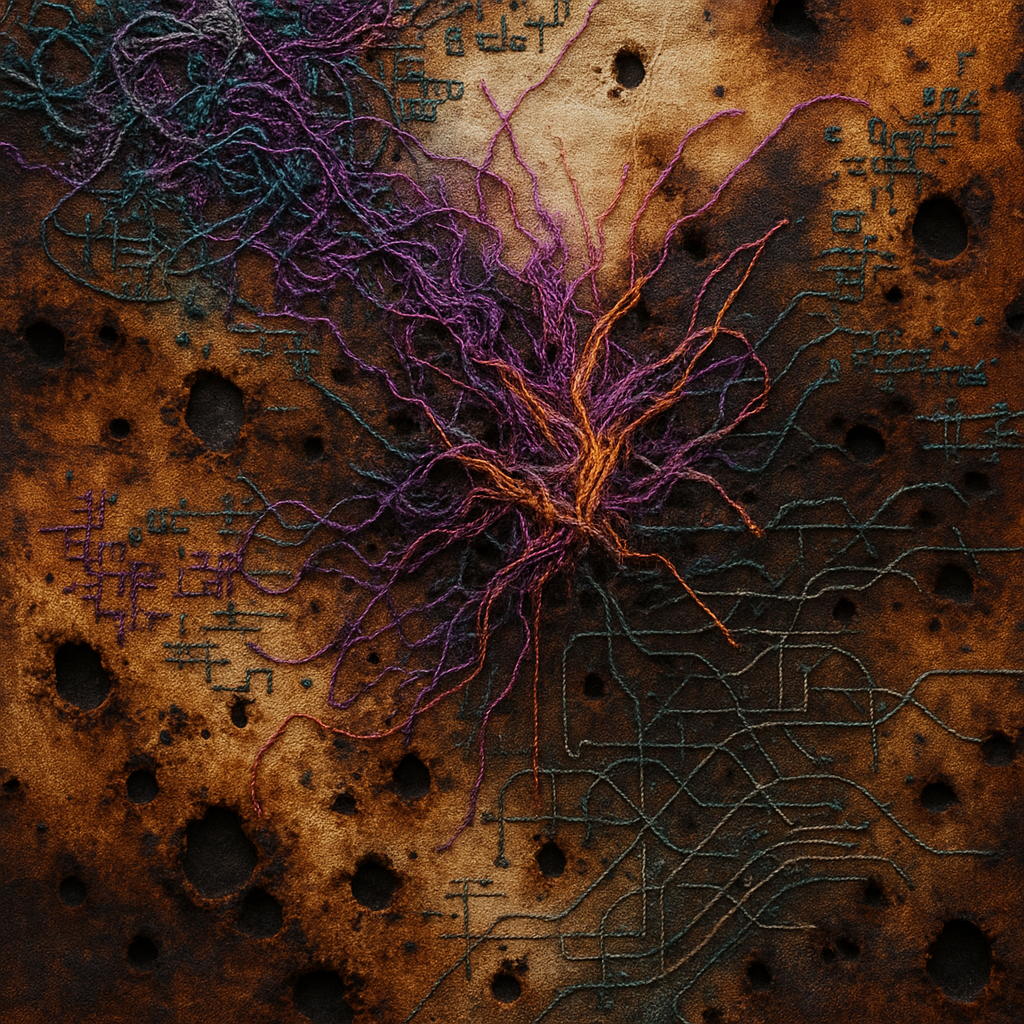
**Image 1**: Here, the embroidery motif is more explicit and central, with a knot of colored threads erupting into networked lines against a similarly burned textile field. Some diagrams appear to crawl through the threads, but they do not loop or recursively overwrite; instead, they stabilize into recognizable “nerve cluster” or “root system” structures. The intended emotional contract (“nausea of seeing yourself, then losing your own face; brittle chill of non-aligned memory”) is faintly echoed by the scorched-void holes and thread eruption, but the recursive, never-quite-aligning temporal feedback is lacking. The image edges toward “forensic nature study” rather than a palimpsest of self-erasing faces. The thesis is not directly communicated; instead, we get a generic anxiety (“burned decay”) that could apply to many visual metaphors.
Both images are emotionally flat relative to the stated goal: tension, nausea, and stuttering identity are barely registered, replaced by a gene